The Airstream Trailer That Was Supposed to Save Earth From Moon Germs
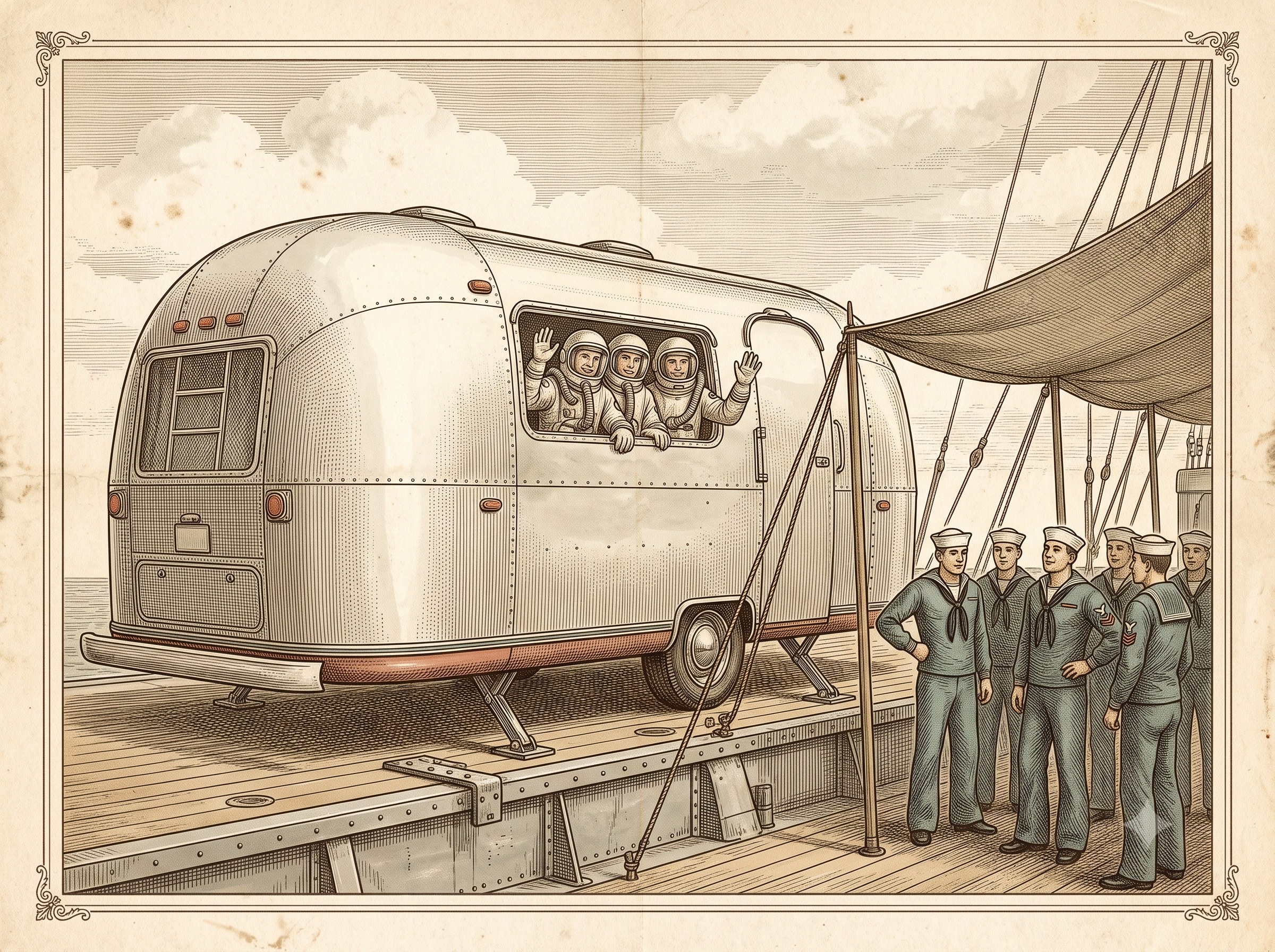
On the evening of July 24, 1969, three men who had just walked on the Moon sat in a silver camping trailer bolted to the deck of an aircraft carrier, waving at the President of the United States through a window. It was an Airstream — the kind families towed to national parks — with a kitchen, six bunks, and a bathroom. On paper, it was the last thing standing between Earth's biosphere and whatever might have hitched a ride home from the Sea of Tranquility.
By the Curiosities Desk · · 6 read · Filed under Space · Today’s round
What happened?
Nobody in 1969 could prove the Moon was sterile. As early as 1960 the National Academy of Sciences warned that organisms from other worlds could contaminate Earth, and in 1962 a young Carl Sagan argued that microbes might survive just beneath the lunar surface. A 1964 interagency conference on “back contamination” — the accidental introduction of alien organisms to Earth — concluded bluntly that no procedure could guarantee a returning spacecraft was clean. Planners had to assume that if infection of Earth were possible, it would happen.
So NASA built for it. The centerpiece was the Lunar Receiving Laboratory (LRL), an 86,000-square-foot complex in Houston built to hold astronauts, spacecraft, and Moon rocks behind a biological barrier for three weeks — long enough for a slow-moving illness to show itself. Getting the crew from a capsule bobbing in the Pacific to that building was the job of the Mobile Quarantine Facility: one of four modified Airstream trailers. Air pressure inside was kept lower than outside, so any leak would suck air in rather than blow it out.
The plan on paper was airtight: seal the command module the moment it hit the atmosphere, hoist it onto the carrier, and join it to the trailer by an impervious tunnel. Then, months before launch, engineers realized a sealed capsule risked suffocating the crew — or drowning them after splashdown. Crew safety won. The capsule would be vented, and the astronauts would climb out into the open ocean.
Which is what happened. A Navy swimmer opened the hatch of Columbia and threw in three biological isolation garments — hooded, rubber-gloved, filtered coveralls. Neil Armstrong, Buzz Aldrin, and Michael Collins put them on and were winched up to a helicopter. Collins later called that moment the weakest link in the system. It got worse: the astronauts found seawater inside their supposedly sealed suits.
Aboard the USS Hornet they sealed themselves into the Airstream with flight surgeon Dr. William Carpentier and NASA engineer John Hirasaki, who had drawn the short straw among volunteers and would be the first person on Earth to climb inside the returned capsule. The four spent more than 60 hours in the trailer as it sailed to Pearl Harbor, flew to Houston in a C-141, and was trucked to the LRL.
Then the leaks really began. Just before the crew reached Houston, NASA photo technician Terry Slezak picked up a film magazine from the Moon and found his hand coated in something black and greasy — lunar dust, from a magazine Armstrong had dropped on the surface. Slezak and five colleagues went into quarantine too. Over the next ten days, lab reports logged a leaking sample bag, an overflowing drain, glove after glove tearing open inside sealed biocabinets, bubbling drinking fountains and urinals, and an autoclave line that sprayed four people with contaminated liquid. Nineteen people ended up behind the barrier. Most were never mentioned to the press.
On the evening of August 10, 1969, Dr. Charles Berry opened the door. Nobody was sick.
Why was it strange?
The strangeness isn’t that NASA worried about moon germs. It’s that the agency built one of the most elaborate containment systems ever attempted, staffed it with technicians who had to agree in writing that they would not try to escape if exposed and that their next of kin would not claim their bodies — then watched it spring leaks from the middle of the Pacific to a Houston men’s room.
The competing pressures are almost comic in hindsight. Geologists wanted lab air pressure kept high, so air would flow away from the priceless Moon rocks and keep them pristine. Biologists wanted it low, so air would flow in and trap any lunar organisms. The biologists won. The geologists were furious.
And one loophole undid everything: quarantine could be broken for a medical emergency. If a lunar microbe had made an astronaut genuinely ill, the response would have been to take him out of containment and drive him to a hospital.
The same thread — Planetary Protection — continues in The Tin of Meat That Spoiled After a Dose of Radiation Meant to Kill Everything.
What did scientists learn?
Three things, none of them the thing they were watching for.
First, the Moon really is, as far as anyone can tell, biologically dead. Every sample, every test animal, every technician came back negative. The most newsworthy biological result of the program was that some plants grew faster in lunar soil — not alien life, but elemental nutrients in the dust that had never met water and were unusually easy for roots to absorb.
Second, and more useful: containment is hard. Not “difficult to engineer” hard — closer to impossible. The quarantine failed at the hatch, at the suits, at the film magazine, at the gloves, at the plumbing. NASA’s engineers weren’t careless; they were handed a task with no clean solution.
Third, a surprise: in 1970, a camera Surveyor 3 had left on the Moon for over two years came back carrying Streptococcus mitis, a harmless mouth bacterium apparently breathed onto it before launch. Later analysts note the lab’s sloppy conditions mean it may simply have been contaminated in Houston — a fitting coda for a facility that couldn’t keep anything separate from anything else.
Another odd chapter in medicine: The Doctor Who Drank a Beaker of Bacteria to Prove Ulcers Weren’t Caused by Stress.
How does it affect us today?
Quarantine for lunar crews was dropped after Apollo 14, once the evidence was overwhelming. But the underlying idea, now called planetary protection, never went away — it moved outward. Space agencies in the United States, Europe, and China are all working on missions to return samples from Mars, a world far likelier than the Moon to have hosted microbial life, and in 2020 NASA issued a formal directive on protecting Earth from Martian back contamination. Every current argument about how to sterilize a Mars sample container, and how many redundant seals it needs, was first had over an Airstream trailer.
Elsewhere in the space stories: The Newspaper That Took 49 Years to Admit Rockets Work in Space.
Fun fact
When the crew reached Honolulu, someone filed a customs form for them. The General Declaration, signed by all three and dated July 24, 1969, lists the flight as “Apollo 11,” the route as Cape Kennedy → Moon → Honolulu, and the cargo as “Moon rock and moon dust samples.” Beside the public-health question about “any other condition on board which may lead to the spread of disease,” someone typed: TO BE DETERMINED.
Sources
- Lunar Receiving Laboratory Project History (NASA/CR–2004–208938) — Susan Mangus and William Larsen, NASA Johnson Space Center, June 2004. The primary institutional history of the facility.
- Apollo 11 General Declaration (customs form), July 24, 1969 — U.S. Customs and Border Protection.
- Mobile Quarantine Facility, collection record A19740677000 — Smithsonian National Air and Space Museum.
- 50 Years Ago: Apollo 11 Astronauts Leave Quarantine — John Uri, NASA History, 2019.
- A lunar pandemic — Dagomar Degroot, Aeon, 2020. An archival account of the LRL’s containment breaches, drawn from contemporaneous lab reports.