Accidental Discoveries · Biology
The Tin of Meat That Spoiled After a Dose of Radiation Meant to Kill Everything
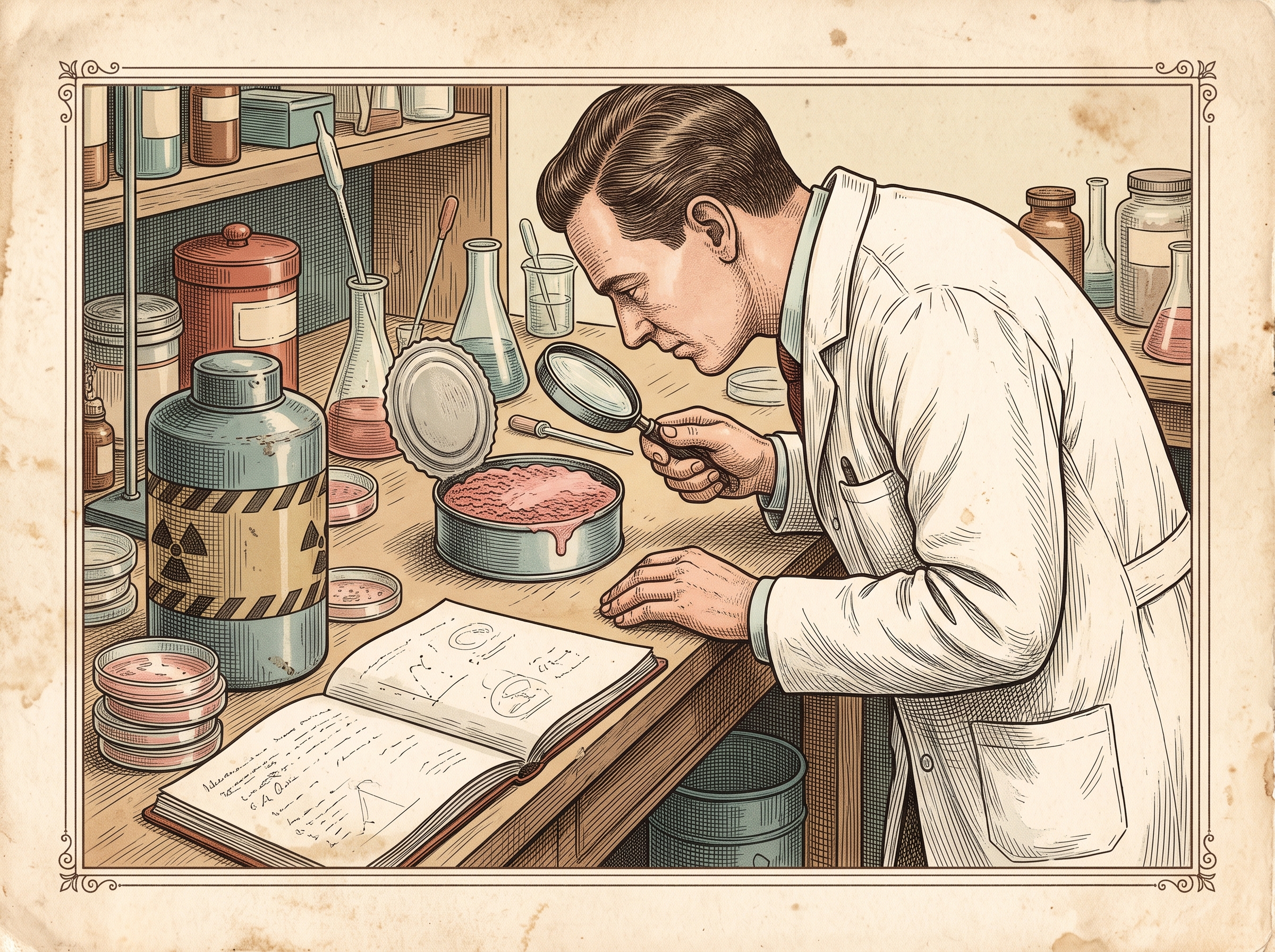
In the mid-1950s, food scientists in Corvallis, Oregon, were testing a very atomic-age idea: that gamma rays could sterilize canned meat and keep it edible forever. They dosed tins of ground meat with radiation at a level thought to kill anything alive, and set them aside. Some of the cans spoiled anyway. The spoilage was pink. Cultured on a plate, it turned out to be a bacterium that could absorb something like a thousand times the radiation dose that kills a human being and go on dividing as if nothing had happened.
By the Curiosities Desk · · 5 min read · Filed under Biology · Today’s round
What happened?
The experiment belonged to a brief, enthusiastic era. After the Second World War, preserving food with ionizing radiation — radiation energetic enough to knock electrons off atoms — looked like an answer to everything from army rations to spoiled produce, and laboratories across the United States were working out how much of it a given food needed. One of those laboratories belonged to the Oregon Agricultural Experiment Station, the research arm of what was then Oregon State College.
Arthur Wallace Anderson, a microbiologist who had taken his doctorate in bacteriology there in 1952 and joined the faculty in 1953, was the person who looked into the ruined cans. He isolated the organism responsible, and in 1956 he and five colleagues — H. C. Nordan, R. F. Cain, G. Parrish and D. Duggan — published its description in the journal Food Technology under a wonderfully flat title: “Studies on a radio-resistant micrococcus. I. Isolation, morphology, cultural characteristics, and resistance to gamma radiation.”
They called it Micrococcus radiodurans. The second half of the name simply means radiation-enduring. It was the first radiation-resistant microorganism anyone had isolated, and it made Anderson’s reputation: Oregon State gave him its Basic Research Award in 1959, and the state followed with the Governor’s Northwest Scientist Award in 1962.
The bacterium outgrew its name. In 1981, after closer study of its biochemistry and ribosomal RNA, Brooks and Murray moved it into a genus of its own: Deinococcus. As later researchers piled on dosimeters, the numbers became genuinely hard to believe. A review of its genome published in 2001 noted that D. radiodurans survives acute gamma-ray doses exceeding 1,500 kilorads — about 15,000 grays — without dying and without picking up the mutations such a dose would normally force on a cell. For scale, a whole-body dose of roughly 5 grays is usually fatal to a person, and a few hundred to a thousand grays will kill the laboratory workhorse Escherichia coli.
Why was it strange?
Not just the toughness. The puzzle was that nothing on Earth should need it.
A bacterium that shrugs off 15,000 grays is adapted to a hazard that does not exist. No pond, hot spring, uranium seam or desert on this planet delivers anything close to that dose — and this organism came out of a can of meat in Oregon. Natural selection does not build elaborate defenses against a threat no ancestor ever met, which left biologists holding a capability with no apparent cause.
The second surprise was that D. radiodurans is not armored at all. Its DNA breaks exactly as readily as yours. Work published in Nature in 2006 showed that a 7,000-gray dose leaves its 3.28-million-base-pair genome in hundreds of short fragments — shattered, by any ordinary definition. The cell then picks the pieces up and puts the genome back together, correctly, and resumes growing.
The same thread — Planetary Protection — continues in The Airstream Trailer That Was Supposed to Save Earth From Moon Germs.
What did scientists learn?
The lesson was that survival can be a matter of repair rather than resistance.
D. radiodurans carries several copies of its genome at once, so a fragment destroyed in one copy usually has an intact twin somewhere else to be matched against. Its DNA sits in a tightly packed, ring-like bundle, which appears to keep broken ends close to their neighbors instead of letting them drift. Its recombination machinery — the enzymes that splice matching DNA sequences together — then rebuilds the chromosome in stages, stitching overlapping fragments into longer and longer stretches. The cell also holds unusually high levels of manganese, which seems to shield the repair proteins themselves from the oxidative damage radiation produces. A cell whose repair crew survives can rebuild almost anything.
That still left the question of why. The best answer came in 1996, from Valerie Mattimore and John Battista at Louisiana State University, and it is beautifully mundane. They took 41 mutant strains of D. radiodurans that had lost their radiation resistance and simply dried them out for six weeks. All of them died at rates far above the normal strain. Desiccation — drying — turns out to break double-stranded DNA much as radiation does. Their conclusion was that radioresistance in this organism is “incidental”: a side effect of being extraordinarily good at surviving dehydration, which is a stress bacteria genuinely do face. The bug was never built for reactors. It was built for drought.
Another time the mistake was the invention: The Dogs That Drooled Too Soon — and the Bell Pavlov Didn’t Ring.
How does it affect us today?
The immediate lesson landed on the food industry: a “sterilizing dose” is a claim about the organisms you have already met. Food irradiation is now a mature, regulated technology, and its doses are set against the specific organisms that matter for a specific product, not against an assumption that enough radiation kills everything.
The longer reach is off-world. Because D. radiodurans is the hardiest thing in the catalogue, it has become the test case for planetary protection — the rules meant to stop Earth life hitchhiking to other planets, and alien material contaminating Earth. A 2022 study in Astrobiology, aimed at Mars Sample Return planning, found that when the bacterium is dried and frozen, as it would be in the Martian subsurface, its tolerance rises to about 140,000 grays. From that the authors calculated how long it could lie dormant under Mars: a few hours on the exposed surface, where ultraviolet light destroys it; roughly 1.5 million years at ten centimeters down; and on the order of 280 million years ten meters down. Their blunt conclusion was that Earth microbes left on Mars by a spacecraft should be considered permanent.
All of which traces back to a handful of cans in Oregon that refused to behave.
Another accident worth keeping: The Fish Extinct for 66 Million Years That Rode to the Museum in a Taxi.
Fun fact
It does not merely survive radiation; it will live in it. The 2001 genome review notes that D. radiodurans grows continuously under chronic exposure of about 6 kilorads an hour — roughly 60 grays, or twelve times a human lethal dose, every hour — and keeps right on dividing. In 1998 the magazine The Sciences ran a profile of it headlined “Conan the Bacterium,” and microbiologists have used the nickname ever since.
Sources
- Arthur W. Anderson Papers, 1949–2000 — Oregon State University Libraries, Special Collections and Archives Research Center (archival record of Anderson’s career, the isolation of Micrococcus radiodurans, and his 1959 and 1962 awards)
- Makarova, K. S., et al. (2001). Genome of the extremely radiation-resistant bacterium Deinococcus radiodurans viewed from the perspective of comparative genomics. Microbiology and Molecular Biology Reviews 65(1): 44–79
- Mattimore, V., & Battista, J. R. (1996). Radioresistance of Deinococcus radiodurans: functions necessary to survive ionizing radiation are also necessary to survive prolonged desiccation. Journal of Bacteriology 178(3): 633–637
- Zahradka, K., et al. (2006). Reassembly of shattered chromosomes in Deinococcus radiodurans. Nature 443: 569–573
- Horne, W. H., et al. (2022). Effects of desiccation and freezing on microbial ionizing radiation survivability: considerations for Mars Sample Return. Astrobiology 22(11): 1337–1350