Accidental Discoveries · Biology
The Dogs That Drooled Too Soon — and the Bell Pavlov Didn't Ring
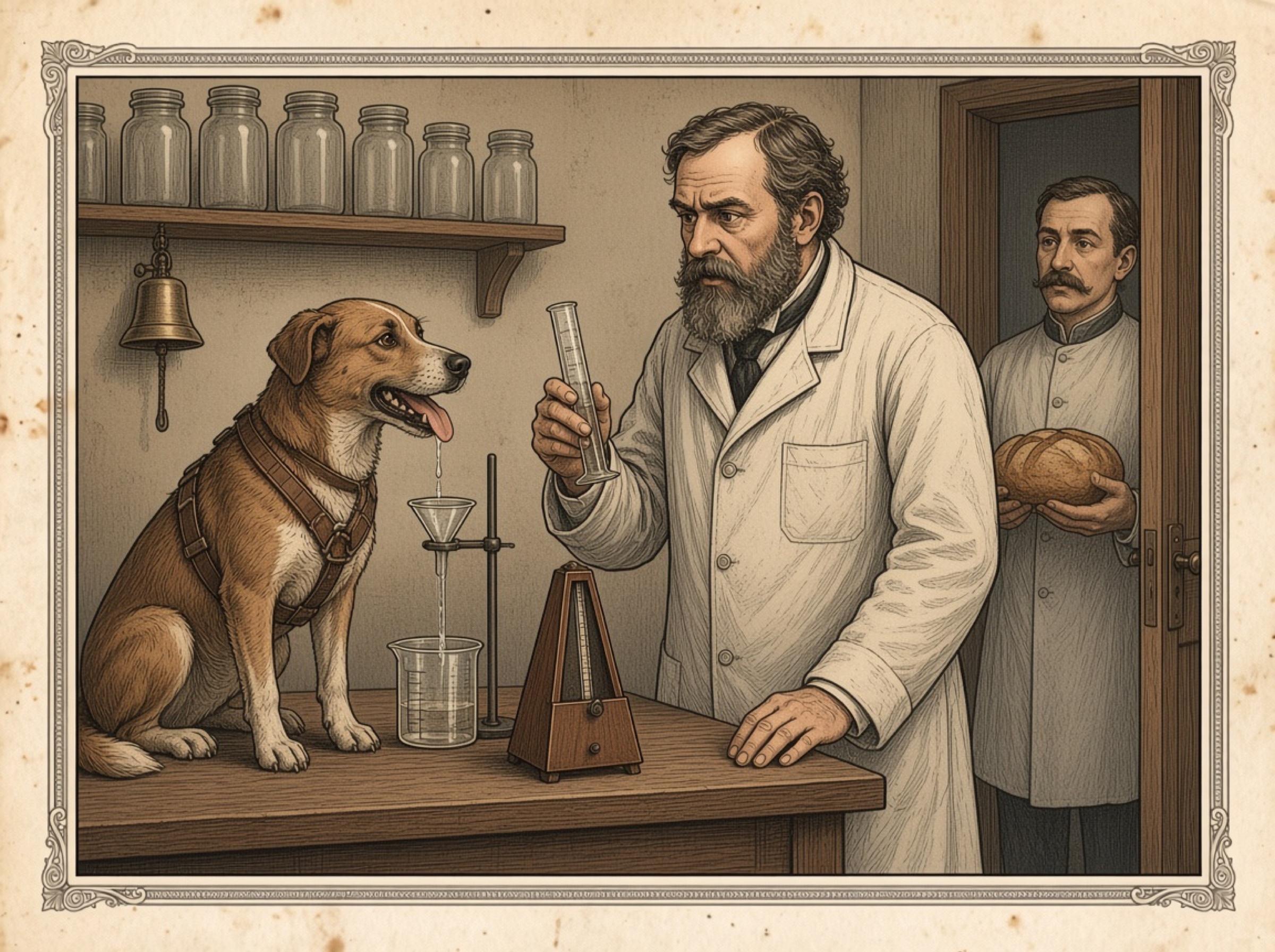
In the 1890s, Ivan Pavlov ran one of the most precise digestion labs in the world, in St. Petersburg, Russia. He measured dog saliva and stomach juice down to the drop. There was just one problem: the dogs kept starting early. Show one a piece of bread from across the room and the saliva flowed before a crumb touched its tongue. The stray drops were spoiling his numbers. Pavlov's eventual decision to study the nuisance instead of fighting it turned a digestion lab into the birthplace of one of psychology's most famous ideas.
By the Curiosities Desk · · 5 min read · Filed under Biology · Today’s round
What happened?
Pavlov was not a psychologist. He was a physiologist, a scientist who studies how the body’s organs work, and from 1891 his lab at the Institute of Experimental Medicine set out to map digestion from mouth to intestine.
His key method was surgical. Instead of studying an anesthetized animal on the table and then losing it, his team operated on dogs to create a fistula, a small opening that let a gland’s juices drain into a collecting tube, and then let the dogs heal. The same healthy animal could then be studied for months or years. In some dogs the food pipe was also rerouted to the skin of the neck, so a dog could chew and swallow while the food fell back out before reaching the stomach. Pavlov called this “sham feeding.” By today’s standards these surgeries raise serious ethical questions. Pavlov, for his part, insisted in his 1904 Nobel lecture that his dogs lived long, healthy lives and “eagerly moved from their cages to the laboratory.”
Sham feeding produced a lot of pure gastric juice. Pavlov’s lab began bottling it. From 1898, according to his biographer, the historian Daniel Todes, the lab ran a small “gastric juice factory,” selling the dogs’ stomach juice as a remedy for indigestion in Russia, France, and Germany. The sales more than doubled the lab’s budget. Pavlov mentioned it with pride in the Nobel lecture, noting that the dogs “donate a part of their vital supplies to the benefit of man.”
The trouble was those early-starting glands. Physiologists already had a name for the effect: “psychic secretion,” juice released by the sight, smell, or even expectation of food. The story usually told is that the dogs began drooling at the footsteps of the lab attendant who fed them. That detail is often repeated but hard to trace to a single record. What is well documented is that the effect was strong, varied from dog to dog, and muddied measurements meant to capture a gland’s pure response to food.
Around 1901, two of Pavlov’s young co-workers took the nuisance seriously. Anton Snarskii, in his doctoral thesis, described psychic secretion as a kind of elementary memory that linked new impressions to old ones. Ivan Tolochinov began testing how the sight and smell of food affected salivation, and in 1902 he gave the first public talk to use the term “conditional reflex.” Pavlov at first resisted the psychological language. Then he made the idea his own. In 1903 he presented it to the International Medical Congress in Madrid, and he devoted the next three decades to it.
His Nobel Prize in 1904 was not for the drooling dogs. It was for digestion. But he spent the final third of his Nobel lecture on what he called “appetite juice” and the strange new reflexes that respond to signals rather than to food itself.
Why was it strange?
The discovery came from treating contamination as data. Pavlov’s whole method was designed to remove the mind from the experiment and isolate the body’s machinery. The mind kept leaking back in through the salivary glands.
Then there is the bell. Almost everyone has heard that Pavlov rang a bell before feeding his dogs. According to Todes, that image is mostly a myth. Pavlov needed signals he could repeat exactly, and a bell’s tone was hard to control. His team used metronomes, electric buzzers, tuning forks, flashing lights, whistles, touches to the skin, and rotating objects. The psychologist Roger K. Thomas, combing Pavlov’s own writing, found a brief early mention of the “violent ringing of a bell,” but Pavlov cited it as a stimulus that worked poorly. Todes points to a likely culprit for the myth: the Russian word zvonok can mean a buzzer or a bell, and translators often picked “bell.”
Even the famous phrase is a slight mistranslation. Pavlov’s Russian term, uslovnyi refleks, means “conditional reflex,” a reflex that exists only under certain conditions. English editions, notably the 1927 translation Conditioned Reflexes, popularized “conditioned.”
The same thread — Digestion — continues in The Beef and Cabbage Lowered Into a Man’s Stomach on a Silk String.
What did scientists learn?
Pavlov separated two kinds of reflexes. An unconditional reflex is built in: food on the tongue makes saliva flow, no learning required. A conditional reflex is learned: a neutral signal, such as a metronome’s tick, that reliably comes just before food eventually triggers saliva on its own.
His lab mapped the rules with great care. Repeat the signal without food and the response fades, which he called extinction. A faded response can return after rest. Dogs trained to one tone also responded to similar ones, and with training they could learn to tell very close tones apart. In the Nobel lecture Pavlov described the learned reflex as a temporary pathway in the nervous system, opened when a signal is repeatedly paired with something that matters to the body.
It also proved that appetite is part of digestion. In his sham-fed dogs, food that the dog enjoyed set the stomach working before anything arrived. Physiologists now call this the cephalic phase of digestion (“cephalic” means “of the head”): the brain tells the gut to get ready.
Another time the mistake was the invention: The Fish Extinct for 66 Million Years That Rode to the Museum in a Taxi.
How does it affect us today?
Classical conditioning, as Pavlov’s process is now called, became a foundation of 20th-century psychology, especially for American behaviorists who studied only measurable behavior.
The principles show up in modern clinics. Exposure therapy for phobias relies partly on extinction: meeting a feared signal again and again without harm weakens the learned alarm. Doctors recognize anticipatory nausea, in which some chemotherapy patients feel sick on the way to the clinic, as a conditioned response. Animal trainers use a clicker that a pet learns to treat as a promise of a reward. And your mouth watering when you smell dinner is a cephalic-phase response Pavlov measured in milliliters.
Another accident worth keeping: The Tin of Meat That Spoiled After a Dose of Radiation Meant to Kill Everything.
Fun fact
Pavlov got money from Alfred Nobel a decade before he won a Nobel Prize. In his prize lecture he recalled that Nobel had sent him and a colleague a letter “enclosing a considerable donation” for their labs, suggesting they study aging and death.
Sources
- Ivan Pavlov, “Physiology of Digestion,” Nobel Lecture, December 12, 1904 — NobelPrize.org (primary source)
- “Ivan Pavlov – Biographical” — NobelPrize.org, from Nobel Lectures, Physiology or Medicine 1901–1921
- Daniel P. Todes, “From the Machine to the Ghost Within: Pavlov’s Transition From Digestive Physiology to Conditional Reflexes” — American Psychologist 52, no. 9 (1997)
- Daniel P. Todes, “Ivan Pavlov in 22 Surprising Facts” — OUPblog, Oxford University Press (2014)
- Roger K. Thomas, “Correcting Some Pavloviana Regarding ‘Pavlov’s Bell’ and Pavlov’s ‘Mugging’” — research paper (via ResearchGate)