The Year in Space That Turned Twin Astronauts Into a Living Experiment
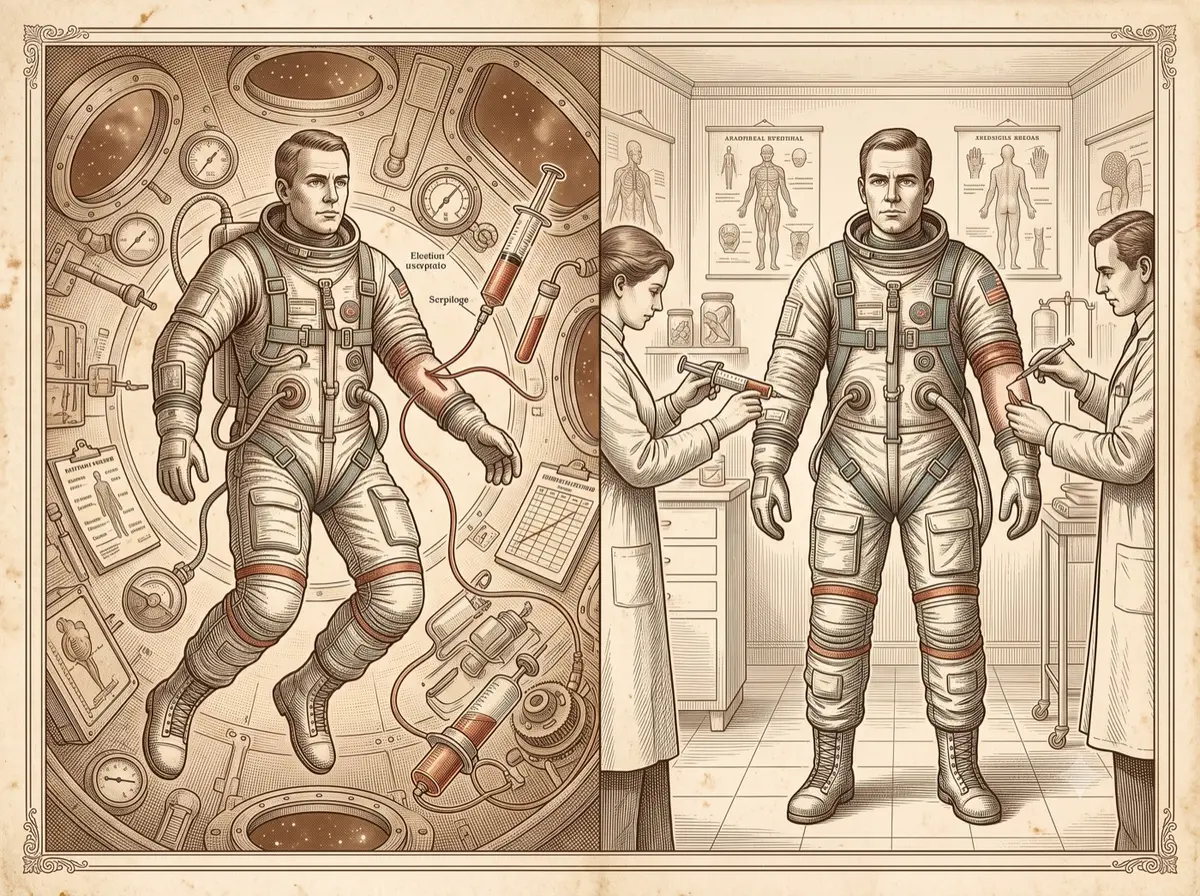
In March 2015, one identical twin strapped into a Soyuz capsule and rocketed toward the International Space Station for nearly a year. His brother stayed on the ground in Texas and Arizona, living an ordinary life. For the next 340 days, researchers drew blood, collected urine, and swabbed gut bacteria from both men on a strict shared schedule — treating two retired NASA astronauts as though they were a single human body, split into two samples: one in orbit, one on Earth.
By the Curiosities Desk · · 6 min read · Filed under Space · Today’s round
Part of Medicine, Before It Was Sure
What happened: NASA's Twins Study
The astronaut in space was Scott Kelly. The one on the ground was his identical twin, Mark Kelly, also a former NASA astronaut. Scott launched on March 27, 2015, alongside Russian cosmonaut Mikhail Kornienko, on a mission NASA called simply the “one-year mission” — at the time, the longest single spaceflight any American had undertaken. He returned to Earth on March 2, 2016, after 340 days aboard the space station.
NASA’s Human Research Program had spent years planning trips to Mars, a round trip that could take up to three years, and needed better data on what long-duration spaceflight does to a human body. Scott and Mark Kelly gave the agency an unusual opportunity: because identical twins share essentially the same genome, any biological differences that emerged between them during the mission could be attributed with unusual confidence to spaceflight itself, rather than to ordinary genetic variation between two unrelated people.
Ten research teams from universities and institutions across the country signed on, each studying a different system in the body: telomeres (the protective caps on the ends of chromosomes, the DNA-containing structures inside our cells), immune response, gene expression, cognition, bone density, gut microbiome, epigenetics, cardiovascular health, and more. Scott even received a flu vaccine while in orbit — the first time an astronaut had ever been vaccinated in space — so researchers could check whether the immune system still worked normally off-planet. It did.
The results were compiled into a single paper, “The NASA Twins Study: A multidimensional analysis of a year-long human spaceflight,” published in the journal Science in April 2019. It remains the most detailed molecular comparison of a single person’s body before, during, and after spaceflight ever conducted.
Why it was strange: NASA's Twins Study
The strangeness here cuts two ways. First, there’s the sheer oddity of the experimental design: NASA didn’t build a machine to simulate space on Earth, it used a spare human being. Mark Kelly wasn’t just a supportive brother — he was the control group, giving blood and answering cognitive tests on the same schedule as Scott, thousands of miles away and several hundred miles up.
Second, and more surprising, the findings ran headlong into a public misunderstanding about how genes work. When NASA’s early data showed that a portion of Scott’s gene expression hadn’t reverted to normal within six months of landing, some news outlets reported it as “seven percent of Scott Kelly’s DNA changed” — implying his genetic code itself had been altered by spaceflight, making him no longer identical to his brother. NASA had to issue a public clarification: Scott’s DNA sequence never changed. What shifted was gene expression — which genes were switched on or off, and how strongly — a process every human body does constantly in response to stress, altitude, diet, or exercise. It’s a distinction between the hardware and the settings, and the mix-up became its own small case study in how easily real, nuanced science can curdle into a myth once it leaves the lab.
Another treatment that history kept the receipt for: The Senator Who Went to Space and Came Back as a Unit of Nausea.
What scientists learned: NASA's Twins Study
Most of what happened to Scott’s body during the mission was temporary and reassuring. About 91.3% of the changes in his gene expression returned to baseline within six months of landing. His immune system responded appropriately to the in-flight vaccine. His gut microbiome, which shifted noticeably while he ate the space station’s shelf-stable food, returned to its preflight makeup once he was home. His DNA sequence — the actual genetic code he shares with Mark — never changed at all; the twins remained genetically identical.
A few effects were more durable. Scott’s telomeres unexpectedly lengthened during the mission, then shortened rapidly within two days of landing — the opposite of what researchers expected, since telomeres typically shorten with age and stress. About 7% of his gene expression changes, mostly involving DNA repair, immune function, and the body’s response to oxidative stress, still hadn’t reverted after six months. Researchers also measured some cognitive slowing in speed and accuracy after landing, along with thickening in his carotid artery wall — a marker relevant to cardiovascular health — that persisted at the study’s end. None of these findings suggested lasting harm, but they flagged exactly where longer missions might need closer monitoring.
Another odd chapter in medicine: The Airstream Trailer That Was Supposed to Save Earth From Moon Germs.
How it reaches us today: NASA's Twins Study
The Twins Study became a foundational reference for how NASA, and other space agencies, plan for missions beyond the space station’s low-Earth orbit — including eventual trips to Mars, where astronauts would face months of radiation exposure and isolation with no possibility of a quick return. The telomere findings in particular fed into broader research on aging and cellular stress that reaches well beyond spaceflight. And because the study measured so many systems in one person over such a long stretch, it’s still cited as a methodological model for how to study rare, extreme human experiences when you only have a sample size of one — or, in this case, two.
The public confusion over the “changed DNA” headlines also left a mark: it’s become a go-to example, in science journalism and biology classrooms alike, of the difference between a genome (fixed) and gene expression (constantly shifting) — and a reminder of how much can get lost translating a nuanced finding into a punchy headline.
A close cousin: The Frog in the Hospital Basement That Told You If You Were Pregnant.
Fun fact: NASA's Twins Study
The Earth-bound “control” twin in this experiment didn’t stay a private citizen for long. In 2020, Mark Kelly was elected to the U.S. Senate representing Arizona — becoming the fifth former astronaut in American history to serve in Congress.
Sources: NASA's Twins Study
- NASA — NASA’s Twins Study Results Published
- Garrett-Bakelman et al., “The NASA Twins Study: A multidimensional analysis of a year-long human spaceflight,” Science, 2019
- NASA — Astronaut Scott Kelly Returns Safely to Earth After One-Year Mission
- National Geographic — No, Scott Kelly’s Year in Space Didn’t Mutate His DNA
- CNN — Former astronaut Mark Kelly sworn in as a US senator
Related stories: NASA's Twins Study
- Biosphere 2: The Sealed World Where the Oxygen Mysteriously Vanished — A sealed glass world where the oxygen quietly disappeared
- Laika: The Moscow Stray Who Orbited Earth, and the Truth Hidden for 45 Years — A Moscow stray orbited Earth, and the truth took 45 years
- The Teenager Who Sent Two Spiders to Spin Webs in Space — A student’s experiment sent two spiders to spin webs in orbit