Biosphere 2: The Sealed World Where the Oxygen Mysteriously Vanished
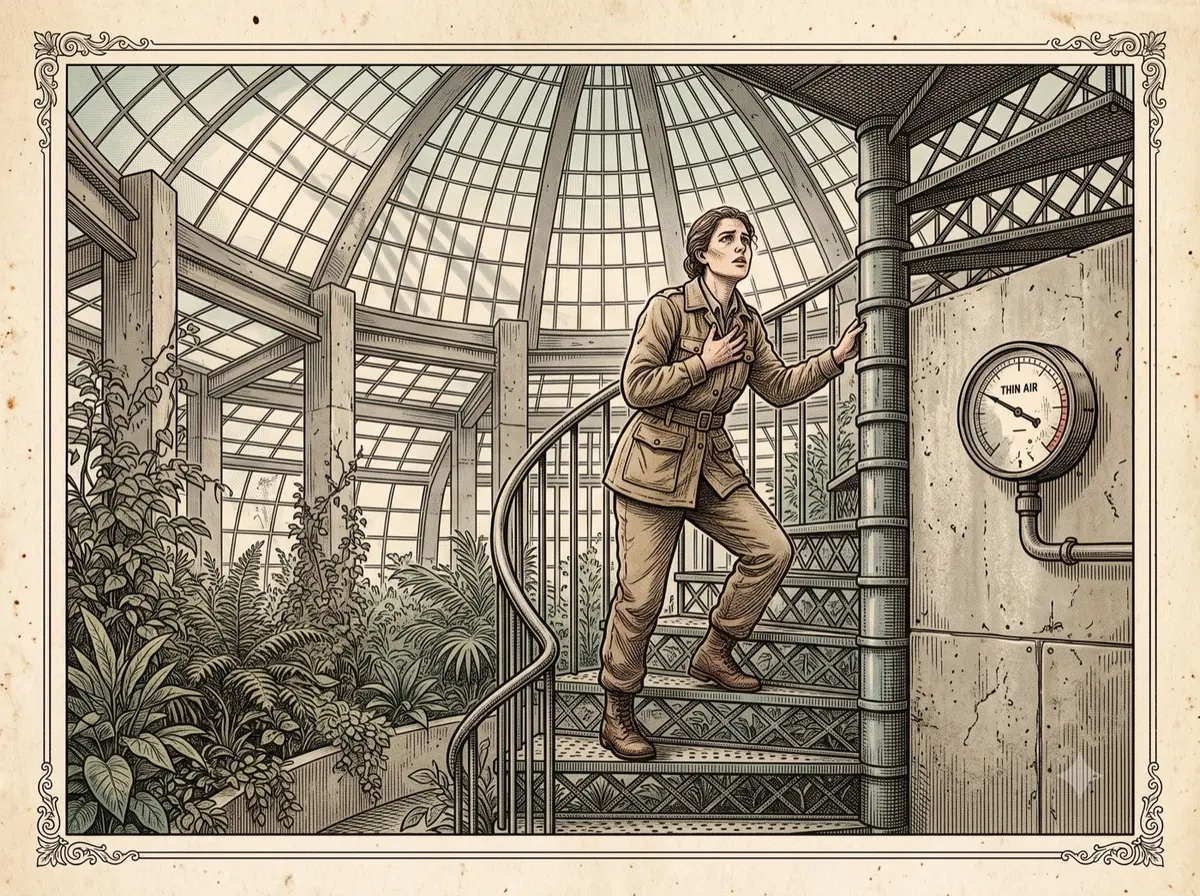
Sixteen months into a two-year experiment, eight people sealed inside a giant glass terrarium in the Arizona desert were quietly suffocating. The air that started as ordinary, breathable atmosphere had thinned until it matched the top of a 13,000-foot mountain. Crew members gasped climbing stairs and stopped mid-sentence to catch their breath. The strangest part: the oxygen was disappearing, and no one could say where it had gone.
By the Curiosities Desk · · 6 min read · Filed under Biology · Today’s round
What happened: The Biosphere 2 Experiment
In 1991, a 3.14-acre structure of steel and glass rose out of the desert near Oracle, Arizona. It was called Biosphere 2 — the idea being that Earth itself is Biosphere 1, and this was a second, miniature copy. Launched in 1984 by ecologist John P. Allen and bankrolled with roughly $150 million from billionaire Ed Bass, it was the most ambitious closed ecological system ever built, and it remains the largest.
Inside, designers packed seven distinct worlds under one roof: a 20,000-square-foot rainforest, an ocean with a living coral reef, mangrove wetlands, a savannah, a fog desert, a farm, and a human habitat with labs and living quarters. The whole thing was sealed almost perfectly airtight, leaking less than 10% of its air per year. Because sunlight heats trapped air and makes it expand, engineers built two enormous domed diaphragms called “lungs” that breathed in and out to keep the pressure from blowing the windows out.
On September 26, 1991, eight people — among them physician Roy Walford, Jane Poynter, Taber MacCallum, and Mark Nelson — stepped inside and the door was sealed behind them for two years. They called themselves “biospherians.” They grew 83% of their own food, recycled their own water and air, and were meant to live entirely off what their tiny planet could produce.
It did not go smoothly. The crew was hungry almost the entire time, losing an average of 16% of their body weight. Condensation turned the “desert” swampy. Morning glory vines, meant to be a minor ground cover, ran wild and smothered other plants in the rainforest. Most insects died — but cockroaches and ants thrived, swarming through the habitat. And, most ominously, the oxygen kept falling. It began at the normal 20.9% and slid downward at a steady quarter-percent a month until it reached 14.5%. In January and again in August of 1993, the team gave up and pumped pure oxygen in from outside to keep the crew safe.
Why it was strange: The Biosphere 2 Experiment
A drop in oxygen, on its own, isn’t a mystery. Living things breathe oxygen and exhale carbon dioxide, so if respiration outpaces photosynthesis, oxygen falls. The puzzle was that the carbon dioxide didn’t add up. When oxygen vanishes through respiration, an almost equal amount of CO2 should appear in the air to balance the books. Inside Biosphere 2, the oxygen was clearly leaving — but the expected mountain of carbon dioxide simply wasn’t there.
It was as if the air were being robbed and the stolen goods were nowhere to be found. The missing carbon dioxide concealed the real culprit and turned a straightforward measurement into a genuine scientific whodunit.
The same thread — Ecology — continues in The Time Australia Sent Machine Guns After 20,000 Emus.
What scientists learned: The Biosphere 2 Experiment
The case was cracked by two geochemists at Columbia University’s Lamont–Doherty Earth Observatory, Jeff Severinghaus and Wallace Broecker. Using isotopic analysis — reading the chemical fingerprints in the carbon — they traced where the carbon dioxide had gone. The answer was hiding in the walls.
Biosphere 2 contained an enormous amount of exposed, freshly poured concrete. Curing concrete pulls carbon dioxide out of the air and locks it into calcium carbonate, a reaction called carbonation. So the soil microbes were doing exactly what microbes do — consuming oxygen and producing carbon dioxide as they broke down the rich, organic-heavy soils the designers had used. But as fast as that CO2 appeared, the concrete drank it up. Oxygen disappeared into the biospherians’ lungs and the microbes’ metabolism; carbon disappeared into the masonry. The books only seemed unbalanced because part of the ledger was written in stone.
The deeper lesson was humbling. The team had tried to build a working planet, and discovered that even a carefully engineered one springs leaks no one anticipated — through the soil, through the insects, through the very concrete holding it together. Earth’s life-support system, it turned out, is far harder to replicate than to take for granted.
Elsewhere among living things: The 23 Cats the RAF Parachuted Into Borneo to Fight a Rat Plague.
How it reaches us today: The Biosphere 2 Experiment
Biosphere 2 failed as a self-sustaining colony but succeeded as a teacher. It became a vivid, real-world demonstration of how tightly coupled and unforgiving closed life-support systems are — exactly the knowledge needed for any serious plan to keep humans alive on the Moon or Mars, where there is no atmosphere to fall back on. Agencies and researchers studying long-duration spaceflight still cite it as a cautionary tale about complexity.
The structure itself didn’t die with the experiment. After a turbulent handoff in the mid-1990s, it eventually came under the management of the University of Arizona, which still runs it as a research facility open to the public. Today its sealed environments are used to run experiments impossible in the wild — drought-stressing an entire rainforest, or watching how rainfall sculpts a barren slope — making it one of the world’s most unusual climate-science laboratories.
Another ambitious failure: The Baby Raised With a Chimpanzee Who Learned to Bark for Oranges.
Fun fact: The Biosphere 2 Experiment
When Biosphere 2’s management collapsed into a legal fight in 1994, financier Ed Bass brought in an investment manager to take over operations: a then-little-known businessman named Steve Bannon, decades before his career in politics. Days later, two members of the original crew broke in before dawn and flung open the airlocks in protest — letting about 10% of the carefully sealed atmosphere escape into the Arizona night.
Sources: The Biosphere 2 Experiment
- University of Arizona, Biosphere 2 (official site): https://biosphere2.org
- Severinghaus, J. P., Broecker, W. S., Dempster, W. F., MacCallum, T., & Wahlen, M. (1994). “Oxygen Loss in Biosphere 2.” Eos, Transactions American Geophysical Union, 75(3), 33–37.
- Encyclopaedia Britannica, “Biosphere 2”: https://www.britannica.com/topic/Biosphere-2
- Wikipedia, “Biosphere 2”: https://en.wikipedia.org/wiki/Biosphere_2
Related stories: The Biosphere 2 Experiment
- The Mouse Utopia With Endless Food That Went Extinct Anyway — Mice given endless food built a utopia and went extinct anyway
- The Year in Space That Turned Twin Astronauts Into a Living Experiment — One twin in orbit, one on Earth, for a year
- The Toad Australia Released to Fight a Pest — and Turned Into a Bigger One — Cane toads were imported to kill beetles and conquered a continent