The Baby Raised With a Chimpanzee Who Learned to Bark for Oranges
In 1931, the psychologists Winthrop and Luella Kellogg brought a baby chimpanzee named Gua home to Florida to grow up beside their infant son, Donald, hoping she would learn to act human. They measured everything, down to the sound each baby's head made when tapped with a spoon (his gave "a dull thud"; hers sounded like a "mallet upon a wooden croquet ball"). But the result that may have ended the study ran the wrong direction. Whenever Gua spotted an orange and gave her excited chimpanzee food bark, little Donald started barking for it too.
By the Curiosities Desk · · 5 min read · Filed under Biology · Today’s round
What happened?
The idea had been building since 1927, when Winthrop Kellogg was a graduate student at Columbia University. He had been reading about so-called “wild children,” such as two girls reported to have been found living with wolves in India. Many experts assumed such children were born with an intellectual disability. Kellogg suspected they acted like animals simply because animals had raised them.
That raised a mirror-image question. What if you raised an animal exactly like a human child? A chimpanzee seemed the obvious candidate. By then Kellogg was a psychology professor at Indiana University, and with a grant from the Social Science Research Council he took most of the 1931–32 academic year off. The family moved to Orange Park, Florida, next door to Yale’s Anthropoid Experiment Station, the primate colony run by the psychologist Robert Yerkes.
Not everyone in the household was convinced. In their book, the couple admit that “the enthusiasm of one of us met with so much resistance from the other” that they nearly never agreed to try. According to NPR’s retelling, Luella was the reluctant one.
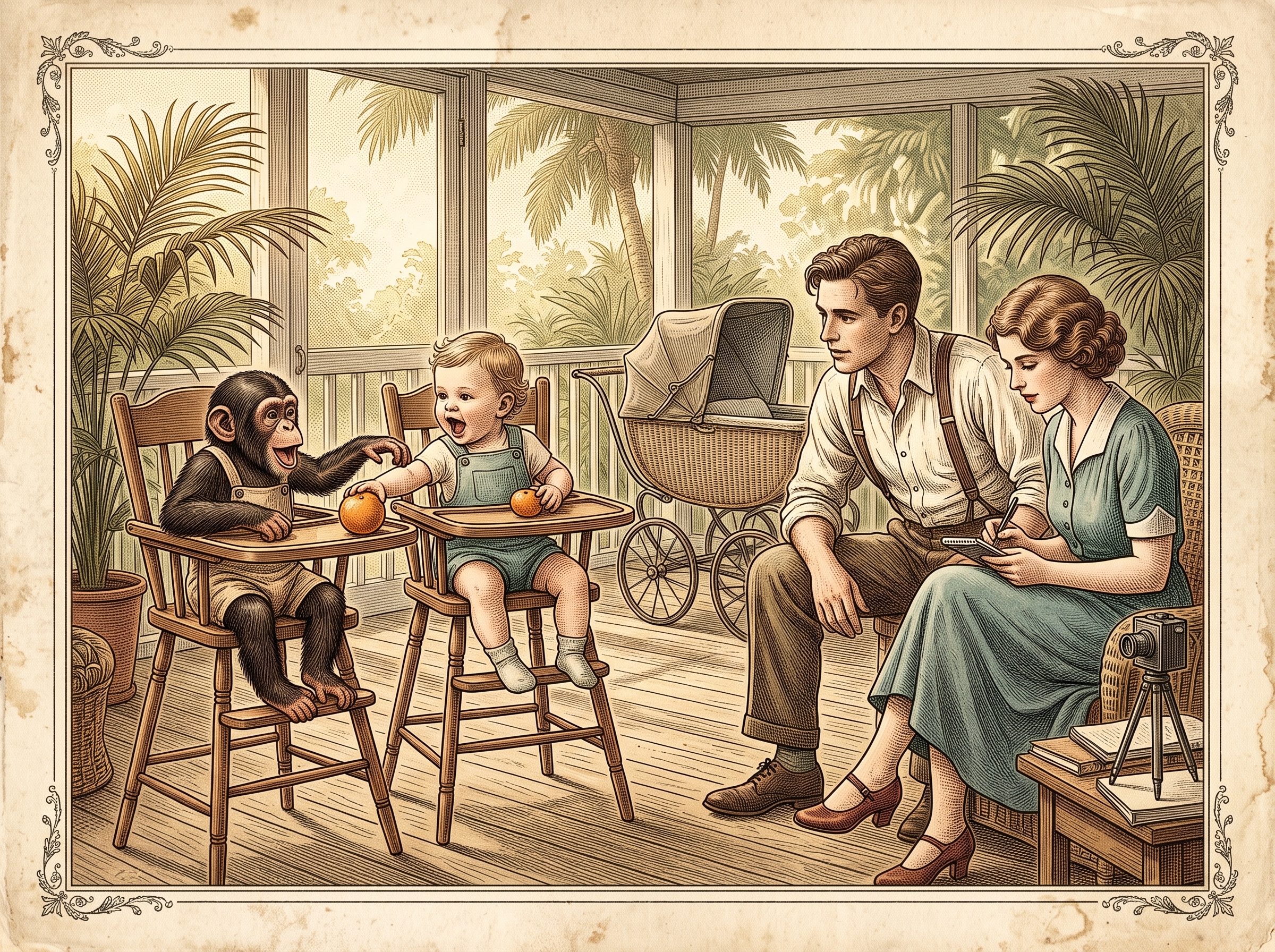
On June 26, 1931, a 7½-month-old female chimpanzee named Gua moved in. Donald was 10 months old. From then on, the rule was simple: treat the two babies identically, “as brother and sister.” Gua wore diapers and later rompers. She rode in a baby carriage, ate in a high chair, slept in a bed, and was kissed good night.
The Kelloggs ran a punishing schedule of tests, with daily records and films. They checked reflexes and problem-solving, fired a gun to compare startle responses, tracked which spoken phrases each baby understood, and, yes, tapped both skulls with a spoon.
For months, Gua was the star pupil. Chimpanzees mature faster than humans, and she often beat Donald to the milestones. She learned to eat with a spoon and drink from a glass. She opened doors before he could. She also learned to respond to English commands like “Don’t touch!” and “Get down!”
Language was another story. Despite much coaching, Gua never said a word. She had meaningful sounds of her own, but she never babbled like a human infant, and she didn’t copy Donald’s noises.
Donald, however, copied hers. When he was about 14 months old, his parents noticed him imitating Gua’s food bark, the call she made when she saw something she wanted to eat. “Whenever an orange or other desired food was observed and barked for by Gua,” they wrote, “Donald would usually take up this imitative call.” Before long he was making the sound on his own. At 19 months, his spoken vocabulary was still just three words.
On March 28, 1932, after nine months, the experiment stopped. Gua went back to the Orange Park colony, eased in gradually, and the Kelloggs returned to Indiana. Their book, The Ape and the Child, came out in 1933.
Why was it strange?
The famous version says the Kelloggs quit when their son started sounding like a chimp. That may be true, but they never actually said so. As the historians Ludy Benjamin Jr. and Darryl Bruce pointed out in 1982, the couple were remarkably specific about almost everything else but gave no reason for stopping, not in the book and not in two articles Kellogg wrote decades later.
Benjamin and Bruce list several possibilities. The Kelloggs may have been exhausted, or wanted the rest of their leave to write the book. Gua was getting stronger and, by Kellogg’s account, harder to manage, so she might have hurt Donald by accident. And then there were the food barks. Kellogg’s students later passed along that worry, but it remains a well-supported guess rather than a documented fact.
The bigger surprise is the flip itself. The study was designed to see how far a human home could pull an ape toward humanity. Nobody planned for the pull going the other way. A baby learns from whoever is around, and for nine months that included a chimpanzee.
Another ambitious failure: Biosphere 2: The Sealed World Where the Oxygen Mysteriously Vanished.
What did scientists learn?
The Kelloggs’ main conclusion was that environment matters enormously. Treated as a child, Gua behaved much like a child, up to the limits of her body and brain. She learned household routines, responded to spoken commands, and outperformed a same-age human on many practical tasks.
But speech was a hard wall. In the late 1940s, Keith and Catherine Hayes raised a chimpanzee named Viki who, after years of coaching, could produce only about four rough words. Kellogg reviewed all of these projects in a 1968 article in Science and concluded that chimpanzees could communicate richly with gestures and signals but were not built for spoken language.
Researchers long blamed the shape of the ape throat and voice box. A 2016 study in Science Advances challenged that idea. Using X-ray videos of living macaque monkeys, W. Tecumseh Fitch and colleagues found that a monkey vocal tract could physically produce enough distinct sounds for speech. The bottleneck, they argued, is the brain’s control over that anatomy, not the anatomy itself.
Another experiment that taught more by not working: The Mouse Utopia With Endless Food That Went Extinct Anyway.
How does it affect us today?
Gua’s year in the Kellogg house helped launch decades of ape language research. Scientists eventually stopped trying to make apes talk and switched to sign language and symbol keyboards, with subjects like Washoe and Koko. Whether those apes truly used language remains debated.
The study also became a classic case in research ethics. Raising an infant chimpanzee away from her mother and then returning her to a colony, and involving one’s own baby as a test subject, would face serious review today. Gua herself reportedly died of pneumonia in December 1933, a little over three years old.
Kellogg kept chasing animal minds. In the 1950s he studied bottlenose dolphins and helped show they navigate by echolocation, or natural sonar, work collected in his 1961 book Porpoises and Sonar.
A close cousin: The Time Australia Sent Machine Guns After 20,000 Emus.
Fun fact
Gua never said a single word, but Donald learned hers. At 11½ months, her name was one of only three words he could say.
Sources
- Kellogg, W. N., and Kellogg, L. A. The Ape and the Child: A Study of Environmental Influence Upon Early Behavior. New York: Whittlesey House / McGraw-Hill, 1933 (via HathiTrust).
- Benjamin, Ludy T., Jr., and Bruce, Darryl. “From Bottle-Fed Chimp to Bottlenose Dolphin: A Contemporary Appraisal of Winthrop Kellogg”. The Psychological Record 32 (1982): 461–482.
- Kellogg, W. N. “Communication and Language in the Home-Raised Chimpanzee”. Science 162, no. 3852 (October 25, 1968): 423–427.
- Fitch, W. Tecumseh, et al. “Monkey Vocal Tracts Are Speech-Ready”. Science Advances 2, no. 12 (December 9, 2016).
- Cole, Adam. “What Are the Planet’s Real ‘Talking’ Chimps and Gorillas Saying?” NPR, July 25, 2017.