The Time Australia Sent Machine Guns After 20,000 Emus
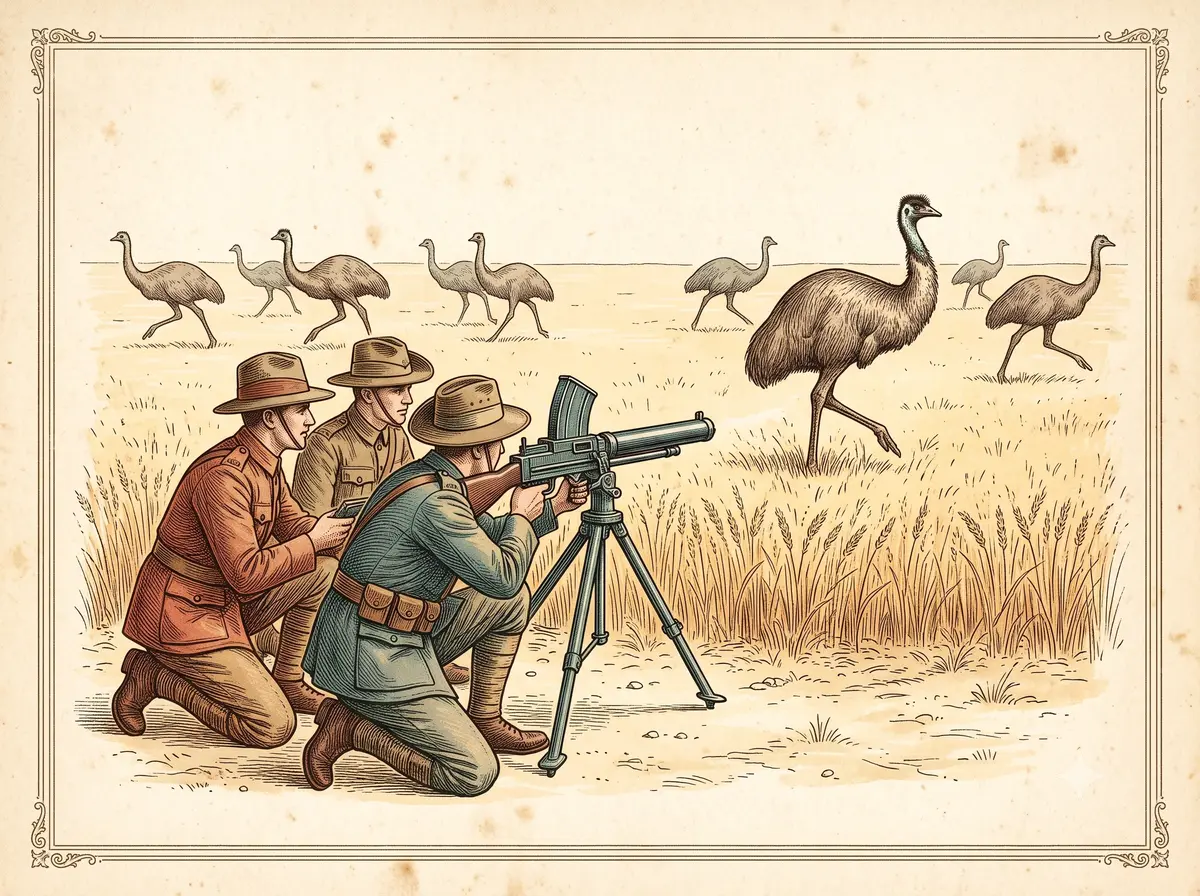
On 4 November 1932, in a wheat paddock in Western Australia, a gunner from the Royal Australian Artillery lay behind a Lewis machine gun and watched more than a thousand emus walk toward a dam. He waited until they were close. He opened fire. Twelve birds went down, the gun jammed, and the rest of the flock simply ran away — fast, in every direction at once, like water thrown at a wall.
By the Curiosities Desk · · 5 min read · Filed under Biology · Today’s round
What happened: The Great Emu War
The birds were not the original problem. The problem was wheat.
After the First World War, the Australian government settled thousands of returned soldiers on farmland in Western Australia, much of it in marginal country at the dry edge of the Wheatbelt. When the Great Depression hit in 1929, those farmers were urged to plant more wheat and promised subsidies that never arrived. By October 1932 they were preparing a harvest they were also threatening to withhold.
Then roughly 20,000 emus arrived. Emus are nomadic — they move inland-to-coast after breeding, following water and food. The cleared paddocks and stock dams the settlers had built turned out to be excellent emu habitat. The birds ate the wheat, trampled what they didn’t eat, and knocked gaps in fences that rabbits then walked through.
A delegation of the farmers went to see the federal Minister of Defence, Sir George Pearce. These were men who had spent 1916 in France. They knew exactly what a machine gun could do to a mass of advancing bodies, and that is what they asked for. Pearce agreed, with conditions: the guns would be fired by soldiers, Western Australia would pay for transport, and the farmers would cover food, lodging and ammunition. A Fox Movietone cinematographer was sent along to film it.
The force consisted of three men — Major Gwynydd Purves Wynne-Aubrey Meredith of the 7th Heavy Battery, Sergeant S. McMurray and Gunner J. O’Halloran — with two Lewis light machine guns and 10,000 rounds. Rain delayed them, scattering the birds. They reached the Campion district on 2 November 1932.
It went badly from the first hour. The settlers tried to drive about 50 emus into an ambush; the birds split into small groups and ran, and the opening burst fell short. A later burst killed “a number.” That afternoon a smaller flock yielded “perhaps a dozen.” Then came the jammed gun at the dam on 4 November. By day four, army observers were reporting — with what reads like grudging respect — that “each pack seems to have its own leader now, a big black-plumed bird which stands fully six feet high and keeps watch while his mates carry out their work of destruction.”
Meredith bolted a Lewis gun to a truck. The truck could not catch the emus, and the ground was so rough that the gunner could not fire a single shot from it.
By 8 November, 2,500 rounds had been spent. Estimates of the dead ranged from about 50 (one contemporary account) to 500 (the settlers’ own figure). Parliament had started asking questions and the newspapers had started laughing, so Pearce pulled the guns out. Meredith’s report noted that his men had suffered no casualties.
The operation resumed on 13 November after the Western Australian premier lobbied for it, and ran until Meredith was recalled on 10 December. His final report claimed 986 confirmed kills using 9,860 rounds — a suspiciously tidy ten rounds per bird — plus exactly 2,500 wounded birds he believed had since died. Historians treat both figures as almost certainly inflated.
Why it was strange: The Great Emu War
The strangeness isn’t that the army lost to birds. It’s that everyone involved was competent, and it still didn’t work.
Meredith was a professional artillery officer. The Lewis gun was a proven weapon. The emus were large, slow-breeding, and standing in open country in daylight. On paper this was the easiest culling job imaginable. What defeated it was that the birds behaved like a dispersed population rather than a target — and a machine gun is a tool for concentrating fire on a concentrated enemy. Against animals that split into dozens of small groups and outran a truck, the expensive weapon was worse than useless. It was uneconomic.
The ornithologist Dominic Serventy put it best, and only slightly tongue-in-cheek: “The Emu command had evidently ordered guerrilla tactics, and its unwieldy army soon split up into innumerable small units that made use of the military equipment uneconomic.”
The same thread — Ecology — continues in Biosphere 2: The Sealed World Where the Oxygen Mysteriously Vanished.
What scientists learned: The Great Emu War
Emus are built for exactly this. Dromaius novaehollandiae stands up to 1.9 metres tall, weighs 18–60 kg, and can sprint at close to 50 km/h — the second-fastest running bird alive. Their body plan is a distance-running machine with a very small target profile from the front. A bird moving at that speed across broken ground, changing direction, is a genuinely hard shot even for a trained gunner.
More importantly, emu numbers are driven by rainfall, not by shooting. The birds are nomadic across enormous ranges, and populations swell and crash with inland rain. Killing a few hundred animals out of a moving population of tens of thousands doesn’t dent the trend; the gap refills from somewhere else. This is a general principle in wildlife management, learned repeatedly and expensively: culling a mobile, boom-and-bust species is a treadmill. Changing what the animals can reach is not.
Which is why the thing that actually worked was fencing. Western Australia already had a barrier fence system, built from 1902 to stop rabbits and later known at various points as the Emu Fence. From the 1930s onward, exclusion fencing — not gunfire — became the main defence for the Wheatbelt.
Another ambitious failure: The Baby Raised With a Chimpanzee Who Learned to Bark for Oranges.
How it reaches us today: The Great Emu War
That fence is still there. Now called the State Barrier Fence and managed by Western Australia’s Department of Primary Industries and Regional Development, it runs well over 1,000 km from the Zuytdorp cliffs north of Kalbarri down toward the state’s southeast, keeping wild dogs, emus and other animals out of the agricultural zone. It has been upgraded and extended in the modern era, and it remains debated — barriers that stop pests also cut across the movement of native wildlife.
The broader lesson outlived the paddock. Modern pest management leans on exclusion, habitat modification and monitoring first, with lethal control as a targeted supplement rather than the headline act. Emus, meanwhile, are protected native wildlife under Australian federal law. They also appear on the Australian coat of arms — which means the birds that beat the artillery are, technically, on the letterhead of the government that sent it.
Another experiment that taught more by not working: Acoustic Kitty: The CIA Wired a Live Cat for Sound to Spy on the Soviets.
Fun fact: The Great Emu War
When Western Australian farmers asked for troops again, the government said no — but in November 1950, after a parliamentary appeal, the Army released 500,000 rounds of .303 ammunition for farmers to use themselves. And the bounty system quietly outperformed the entire military operation: 57,034 emu bounties were claimed in a single six-month stretch in 1934.
Sources: The Great Emu War
- Johnson, Murray (2006). “‘Feathered foes’: soldier settlers and Western Australia’s ‘Emu War’ of 1932.” Journal of Australian Studies 30(88): 147–157. — the peer-reviewed account this article leans on most heavily.
- “Machine Guns Sent Against Emu Pests.” The Argus, 3 November 1932, p. 2 (via Trove, National Library of Australia) — contemporary primary reporting.
- “‘Emu War’ Defended.” The Argus, 19 November 1932, p. 22 (via Trove) — Pearce defending the operation in the Senate.
- Burton, Adrian (2013). “Tell me, mate, what were emus like?” Frontiers in Ecology and the Environment 11(6): 336.
- Department of Primary Industries and Regional Development, Western Australia. “State Barrier Fence.”
A note on the famous quote: Meredith is often quoted saying the emus “can face machine guns with the invulnerability of tanks.” The line comes from a retrospective newspaper feature published in 1953, more than twenty years after the events, and has been attributed inconsistently — treat it as good legend rather than confirmed record.
Related stories: The Great Emu War
- The Toad Australia Released to Fight a Pest — and Turned Into a Bigger One — Cane toads were imported to kill beetles and conquered a continent
- The 23 Cats the RAF Parachuted Into Borneo to Fight a Rat Plague — The RAF airdropped cats into Borneo after a pesticide backfired
- The Mouse Utopia With Endless Food That Went Extinct Anyway — Mice given endless food built a utopia and went extinct anyway