The Mouse Utopia With Endless Food That Went Extinct Anyway
On June 22, 1972, researcher John B. Calhoun stood over a steel pen in a Maryland laboratory and counted the survivors: 122. Four years earlier, he had placed eight mice inside with everything they could ever want — endless food, clean water, cozy nesting boxes, and not a single predator for as far as a mouse could imagine. At its peak, that same pen had held more than 2,200 of their descendants. Now the population was in free fall, and it would keep falling until every mouse inside was dead.
By the Curiosities Desk · · 5 min read · Filed under Biology · Today’s round
What happened: The Mouse Utopia Experiment
Calhoun was a psychologist and ethologist at the National Institute of Mental Health (NIMH) who had spent decades building artificial worlds for rodents. Starting in 1947, he ran population experiments on a Maryland farm, and by the late 1950s he was packing rats into enclosures designed to remove every ordinary cause of death — starvation, disease, cold, predation — to see what happened when only crowding remained as a limiting factor. Those rat studies produced a strange finding he named the “behavioral sink” in a 1962 Scientific American article: given unlimited food, rats didn’t spread out to eat in peace. They crowded into one favored feeding pen anyway, trampling and stressing each other, until the group’s social behavior collapsed.
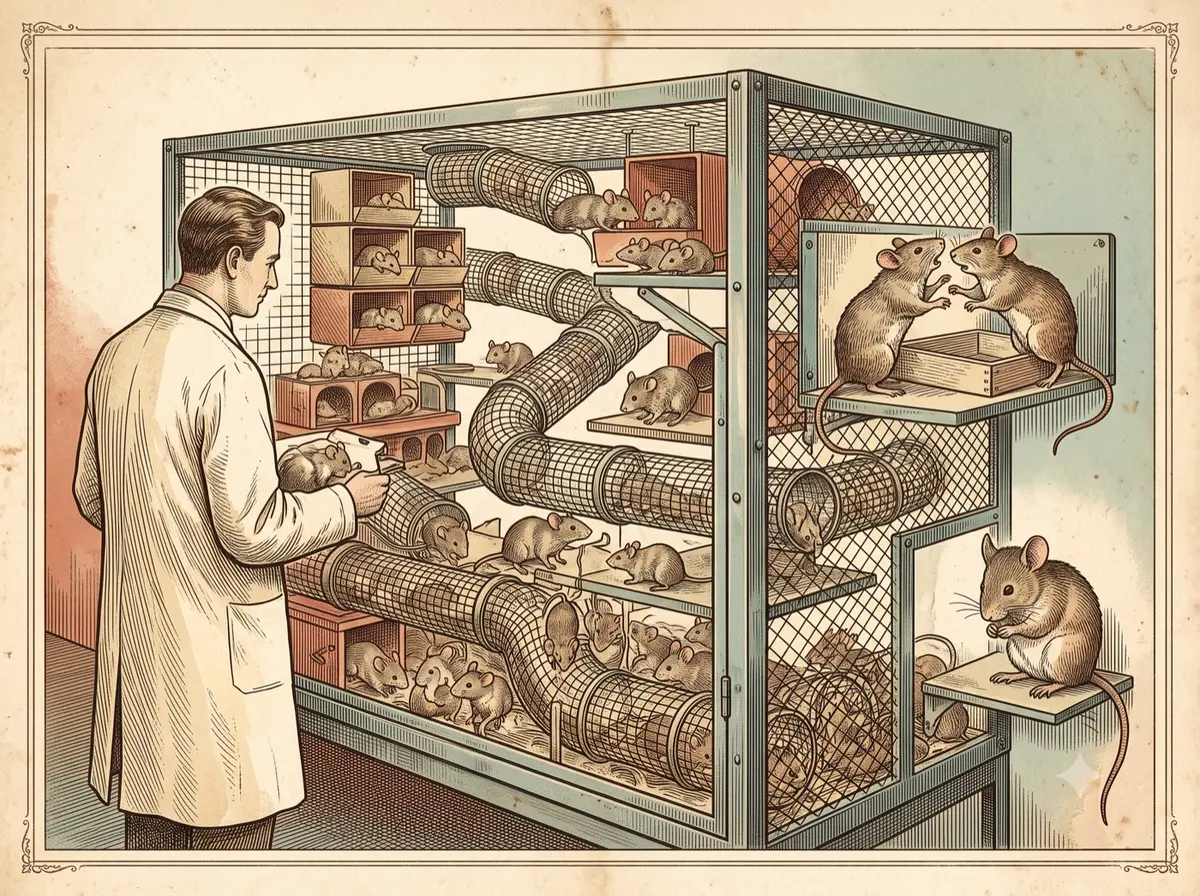
In 1968, Calhoun built his most ambitious version yet: a 101-by-101-inch galvanized steel pen he called the “Mortality-Inhibiting Environment for Mice.” It had 256 individual nesting compartments, reachable by mesh tubes and ramps, plus food hoppers and water bottles that were refilled faster than any population could empty them. By his own calculations, the space could comfortably house around 3,840 mice. He called it Universe 25 — the twenty-fifth in a series of similar setups, the previous 24 having been cut short by lab space constraints before they could run their course.
Calhoun released four male and four female mice into Universe 25 and let them breed. The population exploded at first, doubling roughly every two months. But growth slowed well before the mice ran out of food, space, or water. By around day 560, the population peaked at roughly 2,200 — barely more than half of what the pen could theoretically support. Then it turned.
Dominant males fought increasingly violent battles over nesting territory, even though open compartments sat empty elsewhere. Males pushed out of the competition withdrew entirely: Calhoun called them “the beautiful ones,” mice that never courted, never fought, and did nothing but eat, sleep, and groom themselves in isolation. Females grew erratic too, abandoning litters mid-move, neglecting nests, and attacking their own young. Infant mortality climbed until, by around day 600, no pup born into the colony was surviving. The population entered an irreversible decline. By that June morning in 1972, only 122 mice remained, mostly past breeding age. The last mouse in Universe 25 died the following year.
Why it was strange: The Mouse Utopia Experiment
Universe 25 didn’t collapse from any of the causes Calhoun had deliberately engineered out. There was no famine, no plague, no cold snap, no predator. The colony died with the food hoppers full and the water bottles running, purely from a breakdown in social behavior.
Stranger still, the collapse never reversed itself, even after the population dropped far below the pen’s capacity and space opened back up. Mice that had been born into the overcrowded chaos, when later moved into roomy enclosures with healthy, willing mates, still failed to court or breed normally. They had missed some developmental window for learning how to be an adult mouse, and once it closed, it stayed closed. This looked less like a population running out of resources and more like a population that had quietly lost the instructions for reproducing itself.
Another ambitious failure: The Baby Raised With a Chimpanzee Who Learned to Bark for Oranges.
What scientists learned: The Mouse Utopia Experiment
Calhoun’s central claim was that crowding alone wasn’t the villain — what he called “social density” was. Mice, like many complex social animals, need to acquire courtship, mating, and parenting behavior through normal development, which requires access to meaningful social roles: territory to defend, a mate to court, pups to raise. When too many mice compete for too few of those roles, young animals can grow up without ever learning the behaviors a functioning colony depends on, no matter how much food sits in the hopper.
That’s a real finding about one set of caged mice. It’s also, historians of science now caution, a much shakier basis for grand claims than it was treated as at the time. Universe 25 was never replicated by an independent lab, it was observational rather than a controlled experiment with a comparison group, and Calhoun’s contemporaries raised concerns about inconsistent husbandry and missing physiological data — confounds that make it hard to isolate “crowding” from everything else happening inside that pen. And when psychologist Jonathan Freedman later tested crowding’s effects directly on human subjects in the 1970s, he found no consistent link between density and stress or aggression. The leap from “a box of mice” to “the fate of cities” was Calhoun’s own interpretation, not something the data alone proved.
Another experiment that taught more by not working: Acoustic Kitty: The CIA Wired a Live Cat for Sound to Spy on the Soviets.
How it reaches us today: The Mouse Utopia Experiment
Calhoun’s later experiments, which redesigned pens with more tunnels and escape routes, showed that giving crowded animals more complex space to disperse into softened the negative effects considerably. That idea — that density matters less than whether individuals retain some control and retreat within it — went on to influence environmental psychology and architecture, shaping how designers think about prisons, public housing, and dense urban space.
Universe 25’s cultural footprint outran its scientific one. It landed in 1968, the same year Paul Ehrlich published The Population Bomb, and its imagery of a doomed, overcrowded society fed directly into the era’s anxieties, echoing through films like Soylent Green. Today, historians of science invoke it for a different reason: as a case study in how a vivid, well-photographed animal experiment can travel far further through public imagination than its evidence supports — a reminder to ask whether a striking metaphor is being mistaken for a proven mechanism.
A close cousin: The Navy Tried Everything to Give 100 Sailors the Flu — and Not One Got Sick.
Fun fact: The Mouse Utopia Experiment
Calhoun leaned into the metaphor harder than most scientists dare. Describing the mice’s final, irreversible social collapse, he called it a “spiritual death,” borrowing the phrase “second death” directly from the Book of Revelation — a NIMH researcher reaching for scripture to describe what he’d watched happen in a steel box of mice.
Sources: The Mouse Utopia Experiment
- Calhoun, J. B. (1973). “Death Squared: The Explosive Growth and Demise of a Mouse Population.” Proceedings of the Royal Society of Medicine, 66(1 Pt 2), 80–88. (Primary source) https://www.ncbi.nlm.nih.gov/pmc/articles/PMC1644264/
- Calhoun, J. B. (1962). “Population Density and Social Pathology.” Scientific American, 206(3), 139–148.
- Melchor, A. “Universe 25 Experiment.” The Scientist: https://www.the-scientist.com/universe-25-experiment-69941
- Fessenden, M. & Molinek, R. “This Old Experiment With Mice Led to Bleak Predictions for Humanity’s Future.” Smithsonian Magazine: https://www.smithsonianmag.com/smart-news/this-old-experiment-with-mice-led-to-bleak-predictions-for-humanitys-future-180954423/
- “Behavioral sink.” Wikipedia: https://en.wikipedia.org/wiki/Behavioral_sink
Related stories: The Mouse Utopia Experiment
- Biosphere 2: The Sealed World Where the Oxygen Mysteriously Vanished — A sealed glass world where the oxygen quietly disappeared
- The Time Australia Sent Machine Guns After 20,000 Emus — Australia deployed machine guns against emus, and lost
- The Toad Australia Released to Fight a Pest — and Turned Into a Bigger One — Cane toads were imported to kill beetles and conquered a continent