The Navy Tried Everything to Give 100 Sailors the Flu — and Not One Got Sick
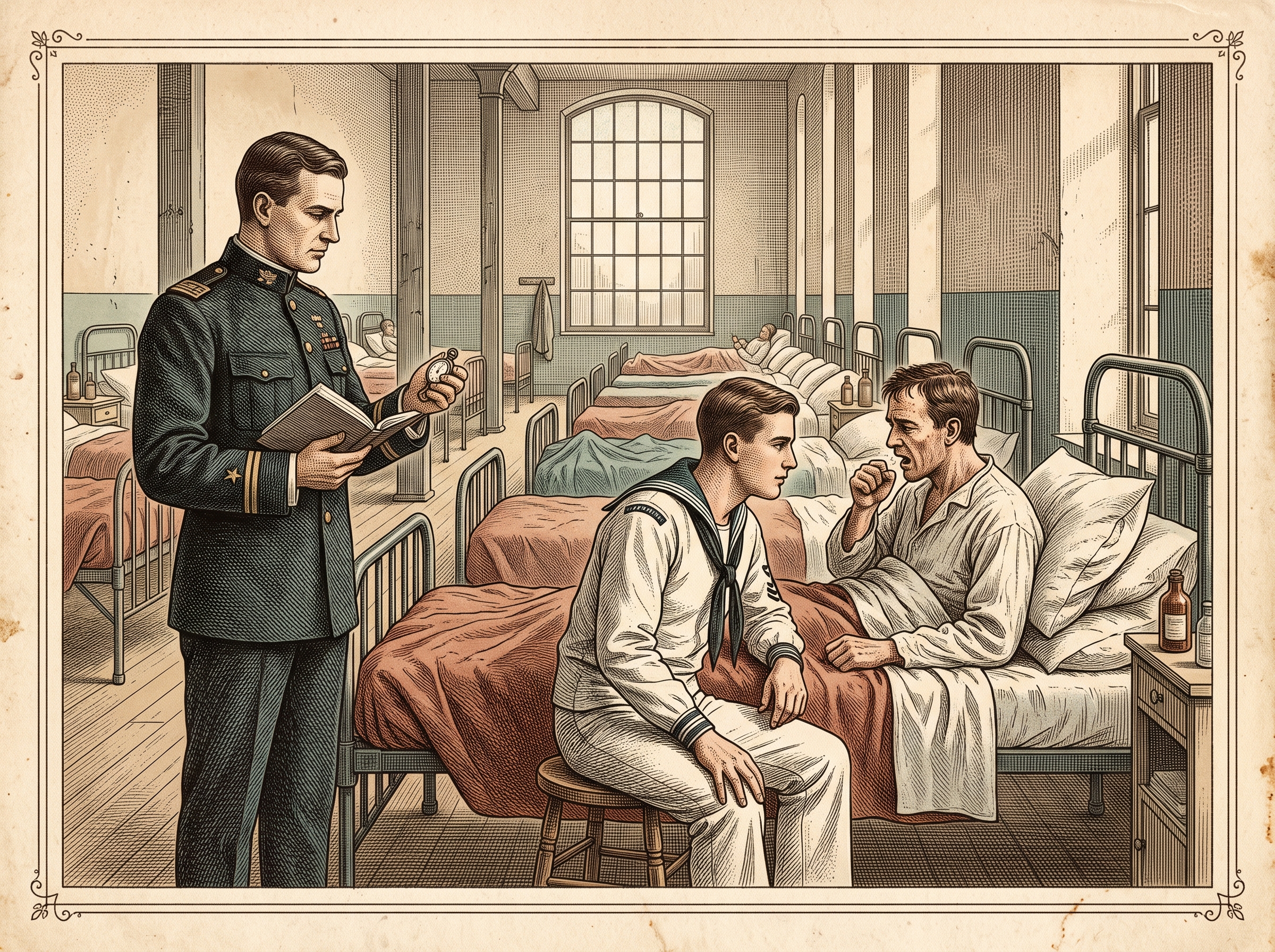
A healthy young sailor sits down beside a hospital bed, his face about two inches from a man burning with the 1918 flu. On a signal, the patient breathes out as hard as he can, and the sailor breathes in. They do it five times. Then the patient coughs straight into the sailor's face, five more times. Then the sailor stands up, moves to the next bed, and does it all again, ten patients in a row. It was one of the most determined attempts in history to make someone sick. It didn't work.
By the Curiosities Desk · · 5 read · Filed under Medicine · Today’s round
What happened?
In the autumn of 1918, the influenza pandemic was tearing through the United States, and Boston had been one of the first American cities hit. Doctors could see the disease moving from person to person, but they could not say exactly what caused it or exactly how it traveled. Viruses had never been seen, and many experts believed the culprit was a bacterium called Pfeiffer’s bacillus.
So the U.S. Navy and the U.S. Public Health Service set up an experiment on Gallops Island in Boston Harbor in November 1918. It was led by Milton J. Rosenau, a Navy reserve officer and Harvard professor of preventive medicine, working with Navy Lieutenant J. J. Keegan and Public Health Service doctors Joseph Goldberger and G. C. Lake. Rosenau later wrote that the volunteers numbered about 100 men from the Navy, “mostly between 18 and 25” — the age group the pandemic was hitting hardest. The official report lists the first group as coming from the U.S. Naval Detention Training Camp on nearby Deer Island. Popular retellings often say the men were Navy prisoners promised pardons; the 1919 reports themselves don’t mention that, so treat it as an unconfirmed part of the story.
The team tried almost every route they could think of. They dripped pure cultures of Pfeiffer’s bacillus into volunteers’ noses. They collected mucus from the noses and throats of sick sailors, many from the USS Yacona, where 80 of 95 crew members fell ill, and sprayed or swabbed it into the volunteers’ noses and throats. In one series, they cut the time between taking the mucus and applying it to 30 seconds or less, so nothing could go stale. They filtered the mucus to remove bacteria and injected it under the skin. They drew blood from patients and injected that, too.
Then came the bedside test at the Chelsea Naval Hospital. Ten volunteers each visited ten flu patients, most of them in the first three days of illness. Each volunteer chatted with a patient for five minutes, traded five deep breaths at a distance of about two inches, and took five coughs to the face.
Nobody got the flu. Not from the sprays, not from the injections, not from the coughs. Across the country, a parallel team on Angel Island in San Francisco Bay ran similar tests on sailors from the Yerba Buena Naval Training Station. Their volunteers didn’t get the flu either, though three developed sore throats from ordinary bacteria in the unfiltered samples.
According to later accounts, including a 2018 Boston Globe report, a doctor connected to the work caught influenza and died. The official papers don’t record it.
Why was it strange?
Everyone knew influenza spread. In 1918 it was infecting huge numbers of people around the world. Yet when scientists tried to pass it on deliberately, as directly as they could, with sick donors and willing recipients, it refused to cooperate.
The researchers did not pretend otherwise. The Public Health Service published its findings under the title “Some Interesting Though Unsuccessful Attempts to Transmit Influenza Experimentally.” Rosenau opened his 1919 paper by admitting his team had “entered the outbreak with a notion that we knew the cause of the disease.” He ended with one of the most honest lines in medical literature: “Perhaps, if we have learned anything, it is that we are not quite sure what we know about the disease.”
Another ambitious failure: The Olympic Marathon That Rationed Water — and Fed the Winner Rat Poison.
What did scientists learn?
The failure was a clue, not proof that flu isn’t contagious. Rosenau said so himself: his volunteers “may not have been susceptible. They may have been immune.” Boston had already gone through a fierce wave of flu that fall. Many of the young sailors had probably been exposed already, and some may have had mild infections that left them protected without ever feeling ill.
There were other problems too. The researchers didn’t know what they were looking for. The real cause, a virus far too small to see under their microscopes, wasn’t isolated from humans until 1933, when British scientists Wilson Smith, Christopher Andrewes and Patrick Laidlaw passed it into ferrets. Without knowing the culprit, the 1918 team couldn’t check how much of it was in their samples, or whether it was still alive by the time it reached a volunteer. And pinning down exactly when and how flu spreads turns out to be hard even today.
Another experiment that taught more by not working: The Rescue Kits That Tried to Revive the Drowning by Blowing Smoke Up Their Backsides.
How does it affect us today?
Deliberately infecting volunteers, now called a human challenge study, is still used to test flu vaccines and treatments. Modern versions use carefully measured doses of a known virus strain, informed consent, and medical monitoring.
Even with all of that, flu can still be stubborn. In a challenge study published in 2020, researchers in the UK infected 42 donors and housed them with 75 healthy volunteers for four days, about 15 hours a day. Only one recipient caught the flu. The authors said the study fell short of the transmission rate it was designed to produce. More than a century after Gallops Island, getting the flu to jump on command is still not as simple as it sounds.
A close cousin: The Student Who Drank Vomit to Prove Yellow Fever Wasn’t Contagious.
Fun fact
The first proof that the newly discovered flu virus could infect a human came by accident. In 1936, a ferret infected with human flu at London’s National Institute for Medical Research sneezed in the face of researcher Charles Stuart-Harris. Time magazine reported that about 45 hours later, he was in bed with influenza.
A note: The 1918 pandemic was one of the deadliest events in modern history, and influenza is still dangerous for many people. If flu or any illness is weighing on you or someone close to you, a doctor, pharmacist, or local health service can help.
Sources
- Rosenau, M. J. “Experiments to Determine Mode of Spread of Influenza.” JAMA 73, no. 5 (1919): 311–313. doi:10.1001/jama.1919.02610310005002
- “Some Interesting Though Unsuccessful Attempts to Transmit Influenza Experimentally.” Public Health Reports 34, no. 2 (January 10, 1919): 33–36. CDC Stacks
- Nguyen-Van-Tam, J. S., Killingley, B., et al. “Minimal transmission in an influenza A (H3N2) human challenge-transmission model within a controlled exposure environment.” PLOS Pathogens (2020). PMC7390452
- “Medicine: Sneeze.” Time, August 17, 1936. Time archive
- “Flu tests are carried out on Gallops Island.” When and Where in Boston (citing the Boston Globe). whenandwhereinboston.org