The Olympic Marathon That Rationed Water — and Fed the Winner Rat Poison
Deep into the 1904 Olympic marathon, the race leader had been begging for a drink of water for miles. His handlers kept saying no. They sponged out his mouth with warm water instead, and about seven miles from the finish they handed him a raw egg white mixed with a dose of strychnine — a stimulant better known as rat poison. He went on to win the gold medal. He did not cross the finish line entirely under his own power.
By the Curiosities Desk · · 5 min read · Filed under Medicine · Today’s round
What happened?
On August 30, 1904, at 3:03 p.m., 32 runners lined up in St. Louis for the marathon of the third modern Olympic Games, which were being held alongside that year’s World’s Fair. The thermometer sat around 90°F. The course — 24.85 miles, a bit shorter than today’s standard 26.2 — ran over seven hills on unpaved country roads that were inches deep in dust. Cars carrying officials, coaches, and doctors rolled alongside the runners, kicking that dust straight into their lungs.
The race also had almost nothing to drink. There was a single official water stop, at a well roughly 12 miles out. According to widely repeated accounts, including Smithsonian’s, the games’ chief organizer, James E. Sullivan, kept water scarce on purpose to test the effects of “purposeful dehydration.” That motive comes to us through later retellings rather than a written plan from Sullivan, so treat it as the reported explanation, not a proven one.
William Garcia of California collapsed with internal bleeding, reportedly from swallowed dust, and was close to death when found. Others dropped out vomiting or cramping. Len Tau, one of two Tswana runners from South Africa — the first Black Africans to compete in the modern Olympics — was chased about a mile off course by a dog.
Then there was Félix Carvajal, a former mailman from Cuba who had reportedly lost his travel money gambling in New Orleans and hitchhiked the rest of the way to St. Louis. He ran in street shoes and long trousers (legend says a fellow athlete cut them off at the knee). He chatted with spectators, playfully snatched two peaches from strangers in a car, detoured into an orchard for apples that turned out to be rotten, got stomach cramps, and lay down for a nap. He still finished fourth.
The first man to reach the stadium was Fred Lorz, a bricklayer from New York. The crowd cheered, and he was photographed with Alice Roosevelt, the President’s daughter. Then word spread that Lorz had dropped out with cramps around the nine-mile mark, ridden about 11 miles in a car, and hopped out to jog the rest. He said he’d finished only as a joke. Officials disqualified him on the spot.
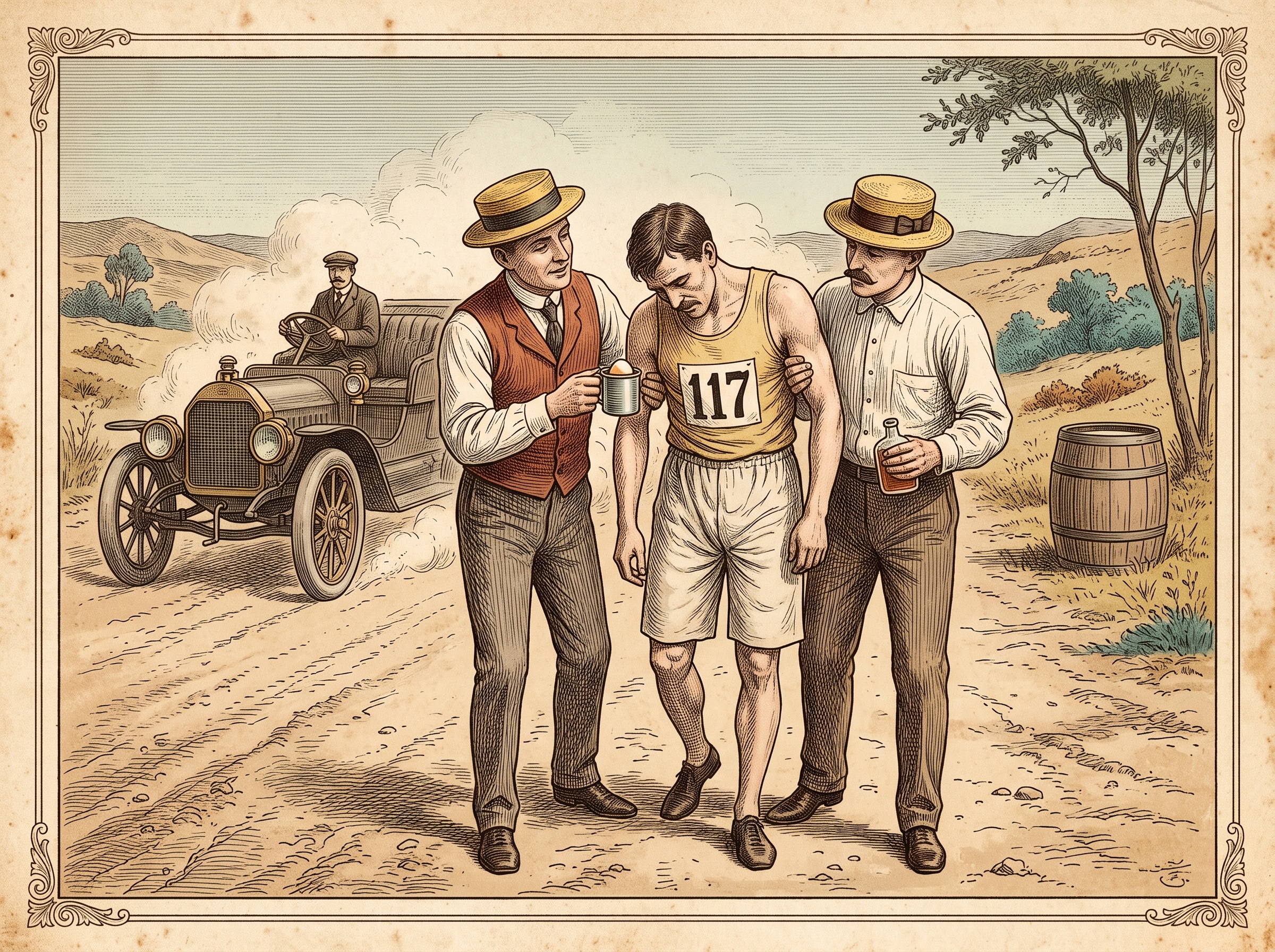
That left the real leader, Thomas Hicks, an English-born runner from Cambridge, Massachusetts. His trainers, including Charles Lucas, who later wrote an official report on the games, had refused him water since about the 10-mile mark. About seven miles from the finish they gave him “one-sixtieth grain of sulphate of strychnine” (roughly one milligram) in the white of an egg. At the 20-mile mark came a second dose, two more eggs, and a mouthful of brandy. Lucas described Hicks in the final stretch as running “mechanically,” his face ashen and his knees almost stiff. Hicks reportedly hallucinated, begged to lie down, and had to be held up by his handlers as he shuffled across the line, his feet still moving. His winning time, 3 hours, 28 minutes, 53 seconds, remains the slowest in Olympic marathon history. Only 14 of the 32 starters finished.
Why was it strange?
Because the “experiment” and the “treatment” were running in opposite directions at the same time. The organizers were reportedly studying how the body copes without fluids, while the winner’s team dosed him with a poison and alcohol to keep him moving. Nobody was measuring anything. There were no controls, no records of how much anyone drank, and no way to separate the effects of heat, dust, strychnine, brandy, and exhaustion. As an experiment, it couldn’t answer its own question.
And the official conclusion drawn from it was exactly backward. In his 1905 report, Lucas wrote that the race showed, “from a medical standpoint,” that drugs “are of much benefit to athletes along the road.”
Another ambitious failure: The Navy Tried Everything to Give 100 Sailors the Flu — and Not One Got Sick.
What did scientists learn?
Dehydration, meaning the body losing more water than it takes in, reduces the volume of blood the heart has to pump. In heat, the body also sends blood to the skin to shed warmth, so the muscles and the skin end up competing for a shrinking supply. The result is a rising core temperature, a racing heart, and falling performance — and, in serious cases, heat stroke.
Strychnine, meanwhile, works by blocking glycine, one of the nervous system’s “brake” signals. In tiny doses it produces twitchy, overexcited muscles, which is why it was once sold as a tonic. In larger doses it causes violent convulsions and can stop breathing. The line between the two is thin, and Hicks, by most accounts, was close to it.
Sports medicine later learned to guard against the opposite mistake, too. The 2015 international consensus statement on exercise-associated hyponatremia — a dangerous drop in blood sodium, often caused by drinking far more than you sweat out — advises endurance athletes to drink according to thirst rather than forcing fluids or refusing them.
Another experiment that taught more by not working: The Rescue Kits That Tried to Revive the Drowning by Blowing Smoke Up Their Backsides.
How does it affect us today?
The 1904 marathon is often cited as the first recorded case of performance-enhancing drug use in the modern Olympics, and at the time it broke no rules because there weren’t any. The International Olympic Committee didn’t create its Medical Commission or publish its first list of banned substances until 1967, and the first compulsory drug tests came at the 1968 Winter Games in Grenoble and the Summer Games in Mexico City. Stimulants were on that very first list. Today, strychnine sits on the World Anti-Doping Agency’s prohibited list.
The race also helped make the case for what’s now standard at every marathon: regular water stations, medical tents, and course officials whose job is to pull struggling runners off the road, not to hand them brandy.
A close cousin: The Six Macaques Given a Keyboard to Write Shakespeare — Who Typed Five Pages of the Letter ‘S’.
Fun fact
Fred Lorz was banned for his car-assisted “finish,” but the ban was lifted — and the following spring he won the 1905 Boston Marathon, this time on his own two feet the whole way.
A note: this story involves a dangerous poison and a near-fatal medical emergency. If you’re training for an endurance event, talk to a doctor or qualified coach about hydration, and never take stimulants or supplements you’re unsure about. If you or someone you know is struggling with substance use, the SAMHSA National Helpline (1-800-662-4357) is free and confidential.
Sources
- Lucas, Charles J. P. The Olympic Games, 1904 (1905), Library of Congress digitized copy — primary source, written by Hicks’s trainer.
- Smithsonian Magazine — How the 1904 Marathon Became One of the Weirdest Olympic Events of All Time
- Olympics.com — St. Louis marathon: The strangest race in Olympic history
- International Olympic Committee — 1967: Creation of the IOC Medical Commission
- Hew-Butler, T. et al. (2015). Statement of the Third International Exercise-Associated Hyponatremia Consensus Development Conference, Clinical Journal of Sport Medicine.