The Six Macaques Given a Keyboard to Write Shakespeare — Who Typed Five Pages of the Letter 'S'
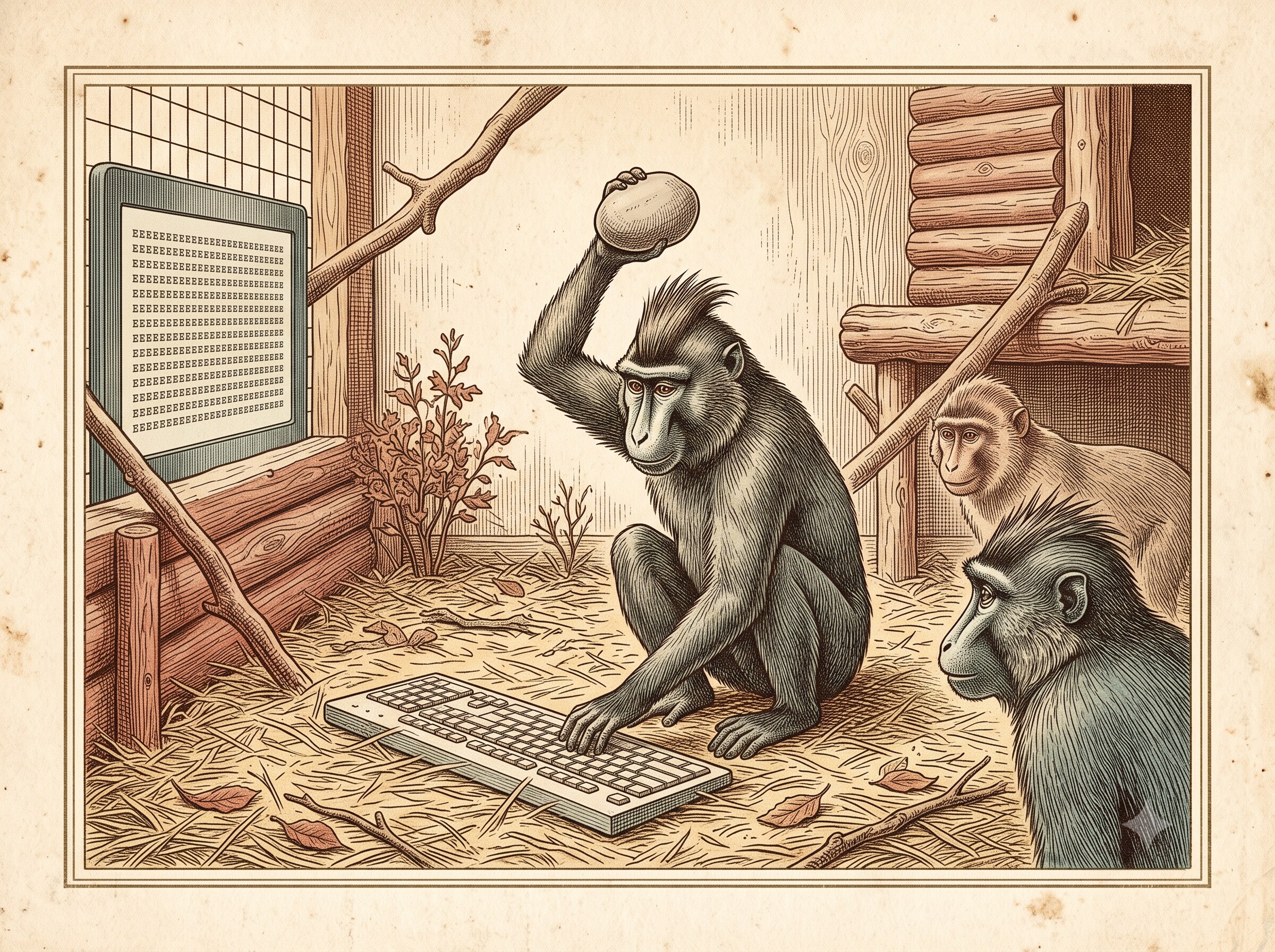
A computer keyboard sat on the floor of a monkey enclosure at a zoo in Devon, wired to a radio link so that the internet could watch literature happen in real time. According to accounts published at the time, the dominant male picked up a stone and began hammering the keys with it. The rest of the troop expressed their editorial opinion by urinating and defecating on the machine. Over the following weeks, six macaques produced five pages of text. Almost every character was the letter "s."
By the Curiosities Desk · · 5 min read · Filed under Physics · Today’s round
What happened?
The setup was an art project with a mathematical joke at its heart. In the spring of 2002, staff and students connected to the University of Plymouth’s Institute of Digital Art and Technology (i-DAT) put a keyboard and screen into the enclosure of six Sulawesi crested macaques (Macaca nigra) at Paignton Zoo Environmental Park. Their names were Elmo, Gum, Heather, Holly, Mistletoe, and Rowan.
The keyboard fed a live web page, with a webcam alongside it so viewers could see the writers at work. It ran as part of GENERATOR, an exhibition of self-generating artworks at Spacex Gallery that opened on 1 May 2002 and closed on 22 June, curated by Spacex and STAR with support from the Arts Council of England’s National Touring Programme. Press reports at the time put the Arts Council’s contribution at £2,000.
The premise was the infinite monkey theorem: give enough monkeys enough typewriters and enough time, and one of them will eventually bang out the complete works of Shakespeare.
The macaques did not produce Shakespeare. They did not produce a word. What they produced was published, in full, as a book — Notes Towards the Complete Works of Shakespeare, credited on the title page to Elmo, Gum, Heather, Holly, Mistletoe and Rowan, “Sulawesi crested macaques from Paignton Zoo Environmental Park (UK),” issued in a limited edition of 100 copies with a DVD, and given a real ISBN.
Read it and the shape of the thing is oddly beautiful. It opens with a stray “ff,” then a short burst of v’s and p’s, and then the s’s arrive and refuse to leave — page after page, broken by a long run of g’s, a long run of q’s, a long run of a’s, and near the end a scatter of j’s, l’s and m’s that looks almost like handwriting.
Mike Phillips, the i-DAT director, was clear that this had always been more performance than experiment, and said the team learned “an awful lot” from it. His most interesting conclusion had nothing to do with Shakespeare. Monkeys, he said, “are not random generators. They’re more complex than that… They were quite interested in the screen, and they saw that when they typed a letter, something happened. There was a level of intention there.”
Why was it strange?
The strange part is that the theorem is true. This isn’t a case of a silly idea being disproved by a stone-wielding macaque. If you generate letters at random, forever, any finite string you can name — Hamlet, this article, your bank details — will almost surely turn up eventually. “Almost surely” is a technical term in probability, meaning the event has probability 1.
So the experiment failed in a way that reveals more than success would have, and it failed twice over.
First: real monkeys are not random. A random typist is an idealization. Elmo and company had preferences, favorite keys, and — as Phillips noticed — an evident interest in the fact that pressing a thing made a thing happen. That is the opposite of randomness.
Second: even if they had been perfectly random, a month was never going to be enough. Neither would a billion years.
Another experiment that taught more by not working: The Champagne Party Stephen Hawking Threw for Time Travelers — and Sent the Invitations Out Afterward.
What did scientists learn?
The monkeys were never meant to be real monkeys. The image comes from the French mathematician Émile Borel, who introduced singes dactylographes — typewriting monkeys — in a 1913 paper on statistical mechanics, and again in his 1914 book Le Hasard. Borel’s point was about physics, not primates. Imagine a million monkeys typing ten hours a day, he argued: it is vanishingly unlikely their output would reproduce the books of the world’s greatest libraries. And yet it is more likely than the laws of statistical mechanics being violated, even for an instant. The monkeys were a yardstick for absurdity. The physicist Arthur Eddington borrowed the image in 1928, imagining “an army of monkeys” typing out all the books in the British Museum.
In 2024, two mathematicians at the University of Technology Sydney, Stephen Woodcock and Jay Falletta, decided to check the yardstick. Their paper, “A numerical evaluation of the Finite Monkeys Theorem,” published in the peer-reviewed journal Franklin Open, swapped infinity for our actual universe. They assumed a 30-key keyboard, one keystroke per second, the current global chimpanzee population of roughly 200,000, and a universe lasting about 10^100 years.
Their results: a single chimp has roughly a 5% chance of typing the word “bananas” within its own lifetime. But Shakespeare’s complete works — about 884,647 words — will almost certainly never appear, even with every chimp alive typing until the heat death of the universe. The gap between “possible in principle” and “possible in this universe” turns out to be enormous.
Another ambitious failure: The Ether-Hunting Machine That Found Nothing — and Broke Physics.
How does it affect us today?
That gap is not a curiosity; it’s load-bearing. Modern cryptography rests on the same asymmetry — your password is guessable in principle and unguessable in practice, and the security of the internet lives in the space between those two statements. Woodcock and Falletta put the monkey theorem alongside the St. Petersburg paradox and Zeno’s dichotomy: problems where reasoning from infinite resources gives an answer that finite reality flatly contradicts.
The Paignton result has aged well too. In an era of text-generating AI, the typing-monkey metaphor gets reached for constantly — and it’s usually backwards. Language models are not random generators either. Like the macaques, they are shaped by what they’ve been given and by what the feedback rewards. The five pages of “s” are a decent reminder that “random” is a much stronger claim than it sounds.
A close cousin: The Loose Cable That Made Neutrinos Outrun Light for Five Months.
Fun fact
Notes Towards the Complete Works of Shakespeare is a genuine, catalogued publication. It has an ISBN (0-9541181-2-X), it carries the standard British Library cataloguing notice on its imprint page, and it lists six macaques as its authors. It also carries a copyright line reserving all rights — which raises the quietly delightful question of who, exactly, would be suing.
Sources
- Notes Towards the Complete Works of Shakespeare — the complete work, published for VIVARIA.NET in 2002 (primary source: the actual output, plus the project’s own credits and notes).
- i-DAT project page: “Notes Towards…” — Institute of Digital Art and Technology, University of Plymouth, giving the exhibition dates, funders, and the macaques’ names.
- Woodcock, S. & Falletta, J., “A numerical evaluation of the Finite Monkeys Theorem,” Franklin Open, vol. 9 (December 2024), 100171.
- University of Technology Sydney, “It’s not to be. Universe too short for Shakespeare typing monkeys” (30 October 2024) — the researchers’ own summary of their assumptions and figures.
- BBC News, “No words to describe monkeys’ play” (9 May 2003) — contemporary reporting containing the Mike Phillips quotes and the details of the keyboard’s treatment.