The Government Expedition That Tried to Bomb Rain Out of the Texas Sky
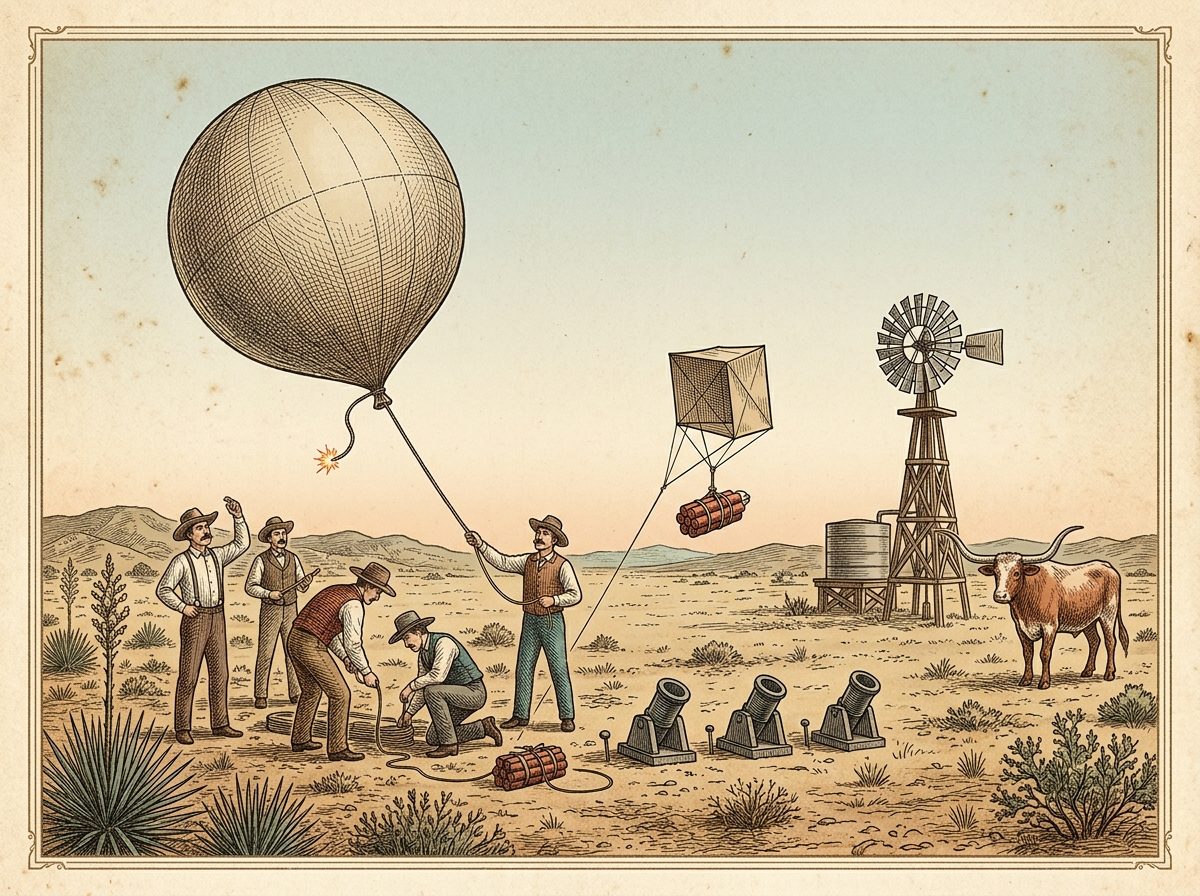
In August 1891, on a cattle ranch near Midland, Texas, a team paid by the United States Congress flew kites with dynamite tied to them, stuffed explosives into prairie dog holes, and sent up balloons full of explosive gas to blow them apart in the night sky. Nobody was at war. They were trying to make it rain.
By the Curiosities Desk · · 5 min read · Filed under Physics · Today’s round
What happened?
The idea had been around for decades. In 1871 a Civil War veteran named Edward Powers published a book called War and the Weather, which gathered accounts of heavy rain falling soon after big battles. Powers suggested that the noise of cannon fire might shake the clouds into letting go of their water, and he urged the government to test it. The notion became known as concussion theory.
Its champion in Washington was Senator Charles B. Farwell of Illinois. After a small sum for a feasibility study in 1890, Congress set aside $7,000 in 1891 for field trials under the Department of Agriculture. The man put in charge was Robert G. Dyrenforth, a Washington patent lawyer and Union Army veteran with no training in meteorology. His team included George E. Curtis, a meteorologist connected with the Smithsonian Institution, and Claude O. Rosell, a chemist from the Patent Office.
In early August 1891 they set up on the C Ranch, a vast spread near Midland owned by the Chicago meatpacker Nelson Morris. West Texas was in drought, and ranchers were watching. The arsenal was impressive: dozens of small mortar-like guns, charges of dynamite and rackarock (an industrial blasting explosive), kites meant to carry explosives aloft, and balloons filled with oxyhydrogen, a mix of hydrogen and oxygen that bursts violently when lit. A fuse was supposed to set the balloons off once they rose.
Much of it did not go to plan. According to accounts of the expedition, balloons caught fire or drifted away, guns burst, the gas-making equipment went up in flames, and the kites often refused to fly. The bombardments went ahead anyway, sometimes for hours at a stretch.
Some rain did fall during the weeks the team was on the ranch. After the final barrage, on the night of August 25 and 26, Dyrenforth wrote that he “was awakened by violent thunder.” He reported the experiments as a success. Curtis, the expedition’s own meteorologist, saw it differently. By the Texas Monthly’s reckoning of his records, he measured as little as two hundredths of an inch on one occasion, and the late-August rain had been forecast by the Weather Bureau before the explosions began. Curtis had also left the ranch before that final test.
The team kept going. On September 18, 1891, at the invitation of local leaders, they fired about 370 charges from the heights of Mount Franklin above El Paso. A Texas Historical Commission marker on the spot sums up the result: only a heavy dew. In October they blasted for more than two days near San Diego, Texas, partly paid for by the owners of the King Ranch, and about half an inch of rain fell. In 1892 a final round near San Antonio reportedly broke the windows of a nearby hotel, while the rain fell far away. Newspapers had already begun calling the leader “Dryhenceforth.”
Why was it strange?
The expedition looked like an experiment, with equipment, a budget, and a scientist on staff. But it was missing the parts that make an experiment work. There were few rain gauges at first, no control area left un-bombed for comparison, and the tests ran during the region’s rainy season, when storms were already likely. Under those conditions, almost any shower could be counted as a win.
The original idea had the same weakness. Battles were fought in the seasons when armies could move, and people remembered the rainy aftermaths more than the dry ones. A pattern built from memorable coincidences can feel convincing until someone counts the misses. Writing in Nature that October, Curtis concluded that the experiments had given concussion theory no scientific standing at all. The rainmakers who came next, including the subject of The Sewing Machine Salesman San Diego Hired to Make Rain, moved on to other methods.
What did scientists learn?
Rain depends on what is already in the air. Water vapor has to cool enough to condense, and it needs tiny particles, called condensation nuclei, to condense onto. The resulting cloud droplets are far too small to fall. They have to grow, by bumping together and merging or by freezing into ice crystals that gather water, until they are heavy enough to drop. A shock wave from an explosion passes through a cloud in a fraction of a second and does almost nothing to those slow processes. If the air is dry, there is no water to shake loose.
The lesson was less about weather than about method. When an outcome happens often by chance, a test has to show that it happens more often with the treatment than without. Later investigators, including French researchers studying the heavy shelling of World War I, found no sign that bombardment brought rain. Big blasts can surprise their planners in other ways, as an Oregon highway crew discovered in The Time Oregon Blew Up a Whale With Half a Ton of Dynamite.
How does it affect us today?
The dream of making rain did not end in Texas. It changed approach. In 1946 Vincent Schaefer, a researcher at General Electric’s laboratory in Schenectady, New York, found that a bit of dry ice turned a cloud of supercooled water (droplets still liquid below freezing) inside a cold chamber into a swirl of ice crystals. That November he dropped dry ice from a plane into a cloud over western Massachusetts and watched it turn to snow. His colleague Bernard Vonnegut soon showed that silver iodide could do something similar.
That work became cloud seeding, which is still used in several western U.S. states and in other countries. Unlike Dyrenforth’s guns, seeding tries to help clouds that already exist turn more of their water into precipitation. Even so, measuring how much extra it produces is hard, and scientists still argue over the size of the effect. The question Curtis raised in 1891, how to tell a real effect from a lucky coincidence, is still the central one.
Fun fact
Before the team ever reached Texas, it reportedly ran test explosions in the Washington, D.C., area, and a Smithsonian official complained that the blasts had frightened his cows.
Sources
- George E. Curtis, “Rain-Making in Texas”, Nature 44 (22 October 1891): 594 — the expedition meteorologist’s own summary of the experiments and their results.
- Texas Historical Commission, “The Rainmakers of 1891”, Marker No. 5407 — the September 18, 1891, bombardment from Mount Franklin above El Paso.
- Smithsonian Magazine, “When the U.S. Government Tried to Make It Rain by Exploding Dynamite in the Sky” — funding, team members, the C Ranch, and Curtis’s conclusion.
- S. C. Gwynne, “Rain of Error”, Texas Monthly, August 2003 — equipment failures, Curtis’s rainfall readings, and the “Dryhenceforth” nickname.
- True West Magazine, “Bombs Over Texas” — the King Ranch and San Antonio trials and the Washington test blasts.