The Loose Cable That Made Neutrinos Outrun Light for Five Months
For five months across the winter of 2011, the fastest thing in the universe appeared to be a ghost particle from Switzerland. Physicists at a lab buried under an Italian mountain had clocked neutrinos arriving 60 billionths of a second earlier than light itself could have made the trip. Newspapers ran Einstein's photograph next to question marks. Then somebody crawled under the detector, found a fiber-optic cable that had not been screwed all the way in, and tightened it.
By the Curiosities Desk · · 5 min read · Filed under Physics · Today’s round
What happened: The Loose Cable That Made Neutrinos Outrun Light for Five Months
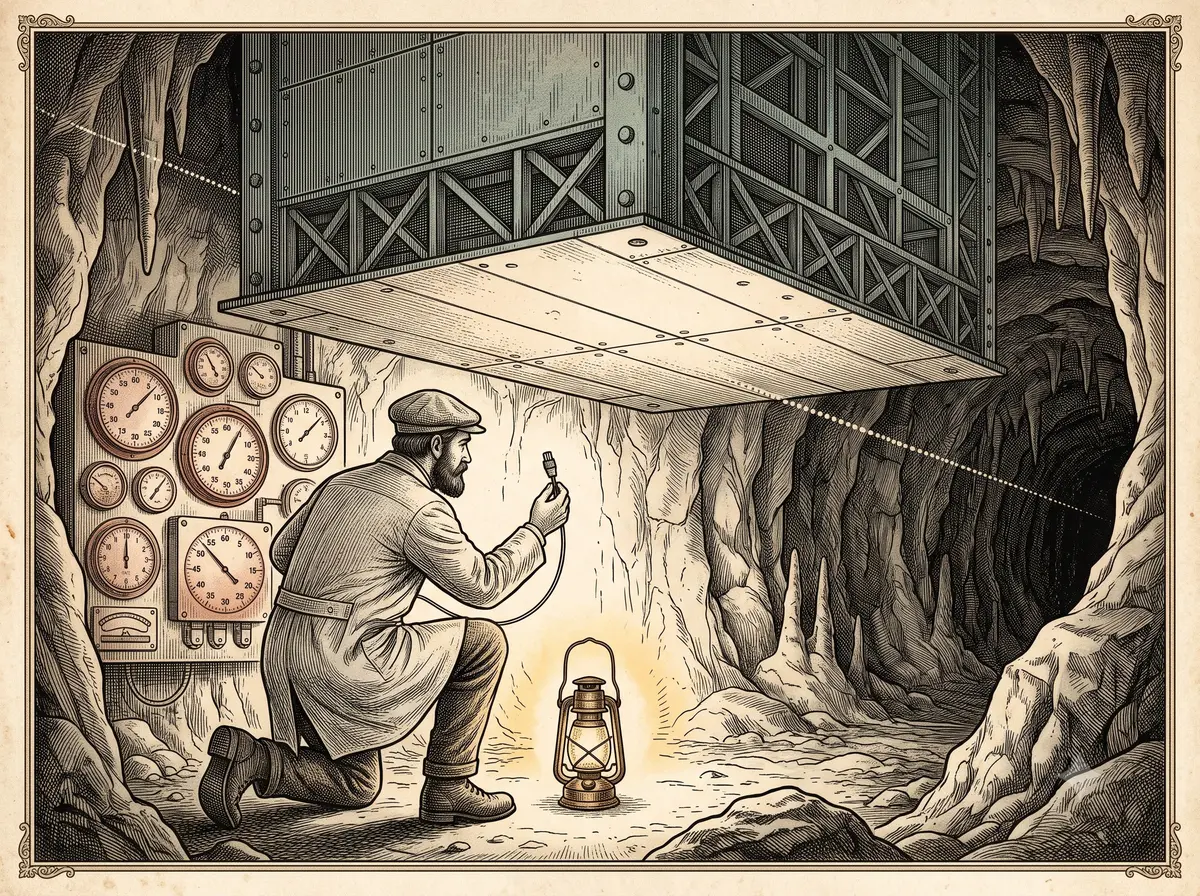
The experiment was called OPERA — Oscillation Project with Emulsion-tRacking Apparatus — a 1,250-tonne detector sitting in a cavern beneath Italy’s Gran Sasso massif. Its actual job had nothing to do with the speed of light. CERN, on the Swiss–French border, fires a beam of muon neutrinos through 730 kilometres (about 454 miles) of solid rock toward Gran Sasso, and OPERA was built to catch the rare moments when one of those neutrinos changes identity mid-flight. Neutrinos are almost absurdly antisocial particles: they carry no electric charge, barely interact with matter, and pass through the Alps as though the Alps weren’t there.
Dario Autiero, the collaboration’s physics coordinator, realised the same apparatus could do something else. If you know when a neutrino leaves CERN, when it hits Gran Sasso, and the distance to within a hair, you can measure how fast it travelled. So the team did the unglamorous work: a geodesy campaign that pinned the 730-kilometre baseline to within 20 centimetres, GPS receivers backed by caesium atomic clocks at both ends, and a delay budget for every cable and circuit board in the chain — including the eight kilometres of optical fibre carrying the surface clock signal down to the underground hall.
The neutrinos should have taken about 2.4 milliseconds. They appeared to take about 60 nanoseconds less. The team spent six months hunting for their own mistake, found nothing, and on 23 September 2011 posted the result publicly and asked the world to check it. Spokesperson Antonio Ereditato said plainly that they had “not found any instrumental effect that could explain the result of the measurement.” CERN spokesman James Gillies described the point of the announcement: they were inviting everyone else to scrutinise it, and ideally to repeat it.
The world obliged, loudly. Around 16,000 detected neutrino events and a six-sigma statistical significance made the number hard to wave away, and a blizzard of theory papers arrived proposing extra dimensions and revisions to special relativity. Most physicists quietly bet on an error, partly because neutrinos from supernova 1987A had arrived from 168,000 light-years away right on schedule.
The error turned up in February 2012, and there were two of them, pulling in opposite directions. A clock on one electronic board was ticking slightly fast, which made the flight time look longer. And the connector where the external GPS signal entered OPERA’s master clock was not fully seated. That loose fiber added a delay of roughly 73 nanoseconds to the arrival timestamp — which subtracted the same amount from the apparent flight time, and made the neutrinos look early. A later review found photographs showing the connector already loose in October 2011.
On 30 March 2012, after months of internal strain, Ereditato and Autiero resigned their leadership roles. A no-confidence vote among the team’s group leaders had already failed; they stepped down anyway. In his resignation statement Ereditato wrote that the results had been “excessively sensationalized,” and defended his colleagues: “The OPERA Collaboration has always acted in full compliance with scientific rigor: both when it announced the results and when it provided an explanation for them.”
By June 2012, four separate detectors at Gran Sasso — OPERA, ICARUS, LVD and Borexino — had all clocked neutrinos travelling at the speed of light. OPERA’s own corrected paper, published that July, put the discrepancy at 6.5 ± 15 nanoseconds: zero, within the error bars.
Why it was strange: The Loose Cable That Made Neutrinos Outrun Light for Five Months
The strange part isn’t that a cable came loose. It’s the scale mismatch. Here was a measurement so delicate it could resolve 730 kilometres to the width of your hand and time a 2.4-millisecond journey to a few billionths of a second — and it was defeated by a plug that wasn’t pushed in.
There’s a second oddity. OPERA never claimed to have broken relativity. The paper’s own words called the early arrival an “anomaly” and stated that the team would “deliberately not attempt any theoretical or phenomenological interpretation of the results.” What went around the world was not the claim they made but the claim they carefully declined to make.
The same thread — CERN — continues in The Baguette Blamed for Overheating the Large Hadron Collider.
What scientists learned: The Loose Cable That Made Neutrinos Outrun Light for Five Months
Physicists distinguish between precision and accuracy. Precision is how tightly your repeated measurements cluster; accuracy is whether they cluster around the truth. OPERA’s six-sigma result was a statement about precision only — it said the scatter in the data was small. It could say nothing about a fixed 73-nanosecond offset baked into every single reading, because a systematic error like that doesn’t jitter. It just quietly shifts everything.
That’s why replication by independent equipment matters more than another decimal place. ICARUS sat in the same rock, watched the same beam, and had its own timing chain — which is exactly why its disagreement was decisive. And the community’s instinct to weigh the result against SN 1987A was good practice too: a genuinely new physical effect should show up everywhere it ought to, not only in one apparatus.
Another ambitious failure: The Champagne Party Stephen Hawking Threw for Time Travelers — and Sent the Invitations Out Afterward.
How it reaches us today: The Loose Cable That Made Neutrinos Outrun Light for Five Months
The episode is now a standard teaching case in metrology and in how science communicates uncertainty. Timing chains in long-baseline neutrino experiments get audited far more aggressively than they did in 2010.
It also left a human mark. OPERA published a result it could not explain rather than sitting on it, and the system did what it is supposed to do: strangers found the flaw within five months. That is not a failure of science. It is close to a demonstration of it — though it came at real professional cost to the people at the centre, worth remembering before anyone tells the story as a punchline.
And OPERA’s actual mission succeeded. It found the tau neutrinos it was built to find, confirming that neutrinos change flavour mid-flight — the discovery it will be cited for long after the cable is forgotten.
Another experiment that taught more by not working: The Ether-Hunting Machine That Found Nothing — and Broke Physics.
Fun fact: The Loose Cable That Made Neutrinos Outrun Light for Five Months
The day after the announcement, Italy’s education minister issued a press release congratulating the researchers and praising her government for funding the “tunnel” between CERN and Gran Sasso. There is no tunnel. There has never been a tunnel. The whole point of neutrinos is that you can fire them straight through 730 kilometres of Alps and Apennines and they simply don’t notice.
Sources: The Loose Cable That Made Neutrinos Outrun Light for Five Months
- OPERA Collaboration, “Measurement of the neutrino velocity with the OPERA detector in the CNGS beam,” arXiv:1109.4897 (final version published in JHEP 10 (2012) 093) — https://arxiv.org/abs/1109.4897
- CERN press release, “OPERA experiment reports anomaly in flight time of neutrinos from CERN to Gran Sasso,” 23 September 2011 — https://home.cern/news/press-release/cern/opera-experiment-reports-anomaly-flight-time-neutrinos-cern-gran-sasso
- CERN press release, “Neutrinos sent from CERN to Gran Sasso respect the cosmic speed limit,” 8 June 2012 (via ScienceDaily) — https://www.sciencedaily.com/releases/2012/06/120608152339.htm
- Eugenie Samuel Reich, “Flaws found in faster-than-light neutrino measurement,” Nature News, 22 February 2012, doi:10.1038/nature.2012.10099 — https://www.nature.com/articles/nature.2012.10099
- ICARUS Collaboration, “Measurement of the neutrino velocity with the ICARUS detector at the CNGS beam,” arXiv:1203.3433 — https://arxiv.org/abs/1203.3433
Related stories: The Loose Cable That Made Neutrinos Outrun Light for Five Months
- The Ether-Hunting Machine That Found Nothing — and Broke Physics — The experiment that found nothing and rewrote physics
- Cold Fusion: The Breakthrough That Wasn’t — Two chemists announced fusion in a jar; nobody could repeat it
- The Unit Mix-Up That Doomed a Mars Probe — Pounds and newtons, and a $150 million probe lost at Mars