Cold Fusion: The Breakthrough That Wasn't
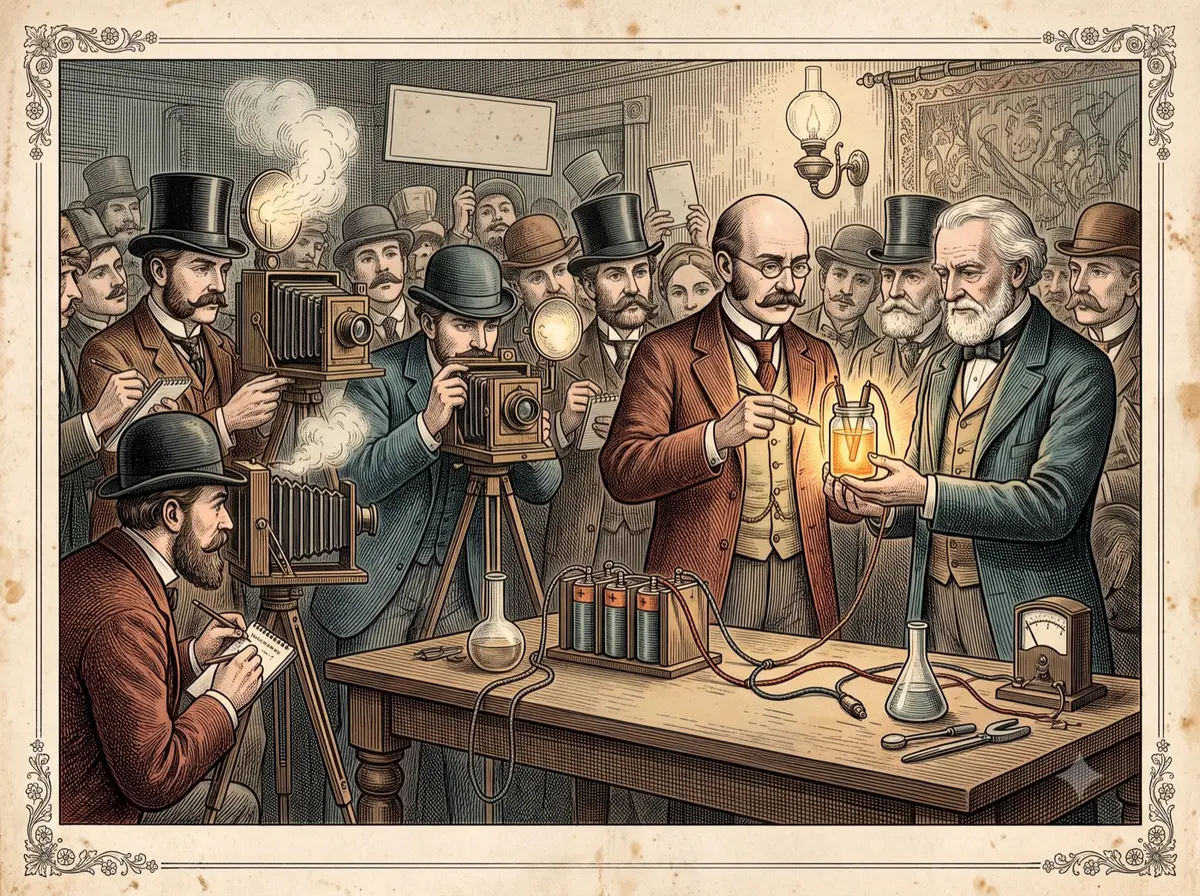
On March 23, 1989, two respected chemists stood in front of cameras at the University of Utah and announced that they had achieved nuclear fusion — the power source of the sun — in a tabletop jar of water, at room temperature. For a few electric weeks, it looked like the world's energy problems had just been solved by a beaker and a battery. They hadn't.
By the Curiosities Desk · · 5 min read · Filed under Physics · Today’s round
What happened: Cold Fusion: The Breakthrough That Wasn't
Martin Fleischmann, one of the world’s most respected electrochemists, and his colleague Stanley Pons claimed that by running an electric current through heavy water (water made with deuterium, a heavier form of hydrogen) using a palladium electrode, they had forced deuterium atoms to fuse. Their evidence was heat — more heat coming out of the cell, they said, than the electricity going in could account for. If true, it implied a nuclear reaction was happening without the enormous temperatures and pressures that fusion normally requires.
Rather than publishing through the usual slow channel of peer review first, they announced the result at a press conference. The news was a sensation. Here was clean, limitless energy from cheap materials. The University of Utah asked Congress for $25 million to pursue it, and labs around the world dropped what they were doing to replicate the experiment.
Then the replication failed. Physicists in multiple countries tried to reproduce the excess heat and the telltale signs of fusion — and overwhelmingly could not. The claims were picked apart, especially by nuclear physicists who noted that real fusion at that rate should have produced a flood of neutrons and radiation that would have sickened or killed the experimenters. Within months, the consensus had turned: whatever Pons and Fleischmann had measured, it almost certainly wasn’t fusion.
Why it was strange: Cold Fusion: The Breakthrough That Wasn't
The strangeness wasn’t a couple of cranks — it was two serious, credentialed scientists making an extraordinary claim through a press release instead of a peer-reviewed paper, and a global scientific community whipping itself into a frenzy before the work could be checked. It became the defining example of “science by press conference.” Pons and Fleischmann never retracted, and eventually moved their research program from the U.S. to France as the controversy curdled around them.
It shares a shelf with The Rays 300 Scientists Saw That Were Never There, in Science’s Most Embarrassing Mistakes.
What scientists learned: Cold Fusion: The Breakthrough That Wasn't
The deepest lesson was methodological, not chemical. Extraordinary claims demand extraordinary, reproducible evidence — and the proper order of operations is to let independent labs verify a result before announcing it to the world. Cold fusion became a textbook case study in why peer review and replication exist, and in how easily excitement, money, and media pressure can outrun the slow work of confirmation. The episode also gave the field of “pathological science” one of its most-cited examples.
Also in Science’s Most Embarrassing Mistakes: Polywater: The New Form of Water That Almost Ate the World.
How it reaches us today: Cold Fusion: The Breakthrough That Wasn't
“Cold fusion” is now shorthand for a too-good-to-be-true claim that collapses under scrutiny. The story is taught in physics, chemistry, and research-ethics courses worldwide. A small community has continued low-key research under the rebranded name “low-energy nuclear reactions,” and even Google funded a careful replication effort — published in 2019 — which again found no evidence for the original claims. Meanwhile, the real pursuit of fusion energy continues in giant, expensive machines that confirm just how hard fusion actually is.
Another from Science’s Most Embarrassing Mistakes: Clever Hans: The Horse That Could ‘Do Math’.
Fun fact: Cold Fusion: The Breakthrough That Wasn't
The rush was partly a race. A separate physicist, Steven Jones, was working on related ideas at nearby Brigham Young University, and the two camps had reportedly agreed to submit their papers to the journal Nature simultaneously. The pressure to claim priority is widely seen as part of why the Utah announcement came out the way it did.
Sources: Cold Fusion: The Breakthrough That Wasn't
- “Cold fusion,” Wikipedia — https://en.wikipedia.org/wiki/Cold_fusion
- John R. Huizenga, Cold Fusion: The Scientific Fiasco of the Century (1992)
- Berlinguette et al. (Google-funded team), “Revisiting the cold case of cold fusion,” Nature, vol. 570, 2019
Related stories: Cold Fusion: The Breakthrough That Wasn't
- Part of Science’s Most Embarrassing Mistakes
- Polywater: The New Form of Water That Almost Ate the World — A ‘new form of water’ that turned out to be sweat
- Blondlot’s N-rays — Three hundred scientists saw a radiation that did not exist
- The Superheavy Element That Only Existed in One Scientist’s Data — An element that existed only in one researcher’s fabricated data