The Baguette Blamed for Overheating the Large Hadron Collider
November 2009. Beneath the French–Swiss border lies the largest machine humans have ever built: a 27-kilometer ring of magnets chilled colder than outer space, weeks away from smashing protons together for the first time in over a year. Then, up on the surface, something lands on an outdoor electrical substation. When engineers go to look, they find feathers and a piece of bread. Within days, the whole world has a headline: a bird with a baguette has knocked out the Large Hadron Collider.
By the Curiosities Desk · · 5 min read · Filed under Physics · Today’s round
What happened?
The Large Hadron Collider (LHC) at CERN, the European particle-physics laboratory near Geneva, had a rough start. It first circulated beams in September 2008, and just nine days later a faulty electrical connection between two magnets failed, rupturing the helium enclosure and damaging a long stretch of the machine. Repairs took more than a year. By late 2009, the LHC was being cooled back down and readied for a restart. Everyone was watching — including readers who could check the collider’s temperature data, which CERN published on the web.
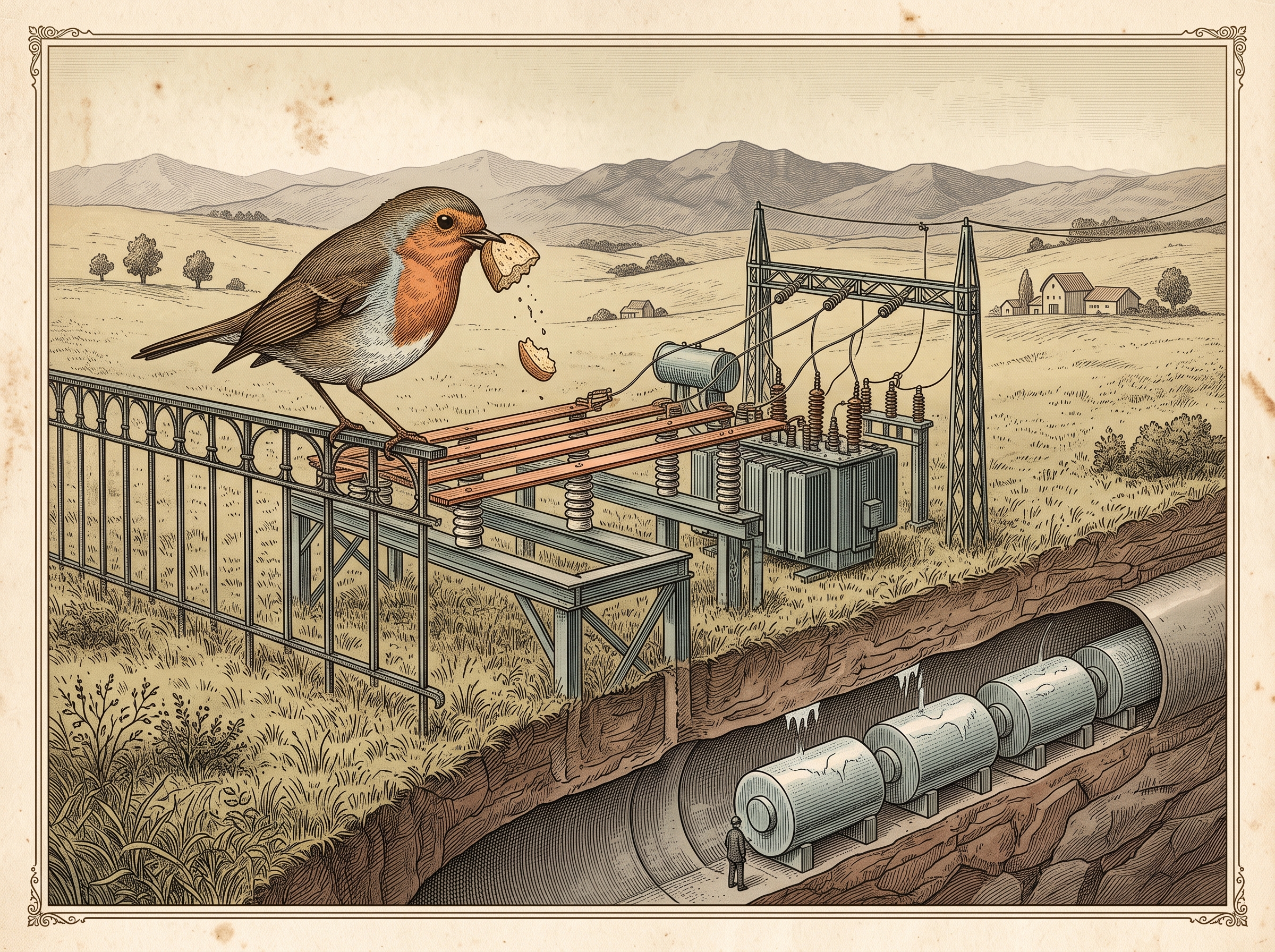
On Tuesday, November 3, 2009, some of those watchers noticed temperatures climbing in Sector 81, one of the eight arcs of the ring. Initial calls to CERN’s press office got the answer that it was routine testing. Then Mike Lamont, a CERN control-room physicist who called himself “LHC Machine Coordinator and General Dogsbody,” told reporters from The Register what engineers had found up at the surface: “a bit of baguette on the busbars.” A busbar is a thick strip of copper that carries heavy electrical current. The bread, he said, might have been dropped by a bird.
A power cut at that substation had interrupted part of the cryogenic system — the refrigeration plant that keeps the magnets cold. With it offline, stretches of the machine began to warm. The LHC’s magnets normally sit at 1.9 kelvin, less than two degrees above absolute zero. According to The Register’s reporting, parts of the circuit climbed to almost 8 kelvin. A CERN spokeswoman told The Times that the best guess was a bird — “either that or it was thrown out of a passing aeroplane.”
CERN then put out a short note on its users’ pages. The culprit, it said, was a “bird carrying a baguette bread.” It added one line that guaranteed the story would travel: the “bird escaped unharmed but lost its bread.” Newspapers ran with it. So did everyone else.
Here’s the twist. A week later, CERN’s own Bulletin ran an editorial by James Gillies, the lab’s head of communications, called “The truth about Birds and Baguettes.” In it, CERN admitted that the bird-and-bread version had gotten ahead of the evidence. The statement, he wrote, had been “rapidly concocted” to meet a flood of press calls. “To this day, we do not know what caused the power cut,” he wrote, “but it is true that feathers and bread were found at the site.”
So the honest version is this: something shorted an outdoor substation, two sectors warmed by a few degrees, the substation was repaired, and the magnets were cooled back to 1.9 kelvin. There was no damage and no delay. Whether a bird actually dropped its dinner on the busbars remains unproven. The LHC circulated beams again later that month, on schedule.
Why was it strange?
The obvious reason is scale. A machine that cost billions, built to recreate conditions a fraction of a second after the Big Bang, was brought up short (or seemed to be) by a crust of bread.
But the timing made it stranger. Just weeks earlier, the physicists Holger Bech Nielsen and Masao Ninomiya had drawn headlines for papers speculating — seriously, and with math — that if the Higgs boson were somehow “abhorrent” to nature, the future might reach back in time to stop the LHC from ever finding it. They even proposed drawing cards to decide whether to limit the collider’s runs, to test whether the odds were being nudged. Most physicists treated the idea as a long-shot thought experiment. But when a bird appeared to sabotage the machine, TIME magazine couldn’t resist asking whether it had been sent from the future.
The last layer of strangeness is the story about the story. The bird became the fact, and the fact — “we don’t know” — became the footnote.
The same thread — CERN — continues in The Loose Cable That Made Neutrinos Outrun Light for Five Months.
What did scientists learn?
The episode is a quick lesson in why the LHC is so sensitive to heat. Its roughly 1,200 main bending magnets use coils of niobium-titanium, a superconductor — a material that carries electricity with zero resistance, but only when it’s extremely cold. Superconductivity lets the coils carry huge currents and produce the powerful fields needed to steer protons around the ring at nearly the speed of light.
Warm a superconductor past its limit and it suddenly starts resisting current again. Engineers call this a quench. In a magnet storing enormous energy, an uncontrolled quench turns that energy into heat very fast — which is roughly what went wrong in 2008. A CERN engineer told The Register that quenches can happen unpredictably above about 9.6 kelvin. That’s why an 8-kelvin reading drew attention, even with no beam in the machine.
The deeper lesson was that the safety systems worked. The LHC is built to survive power cuts: protection systems detect trouble and, when beams are running, steer them into shielded “beam dump” blocks before anything is harmed. In Gillies’s words, had the machine been running, CERN would have lost “a day or two’s worth of beam time.”
Another story that outran the evidence: The Army Captain Who Asked Congress to Fund a Trip Inside the Earth.
How does it affect us today?
The LHC went on to find the Higgs boson in 2012, apparently unbothered by time-traveling birds. But the baguette became a permanent piece of physics folklore — and a case study in science communication. Gillies’s editorial is a rare example of a major lab publicly correcting its own too-good-to-check story, and saying plainly what it didn’t know.
It’s also a reminder that giant research machines live in the real world. Much of CERN sits in open countryside, with power equipment exposed to weather and wildlife. Big science has to plan not just for exotic physics, but for crumbs.
Another claim that stuck harder than the correction: The Duck Borrowed From a Farm to Prove That Quacks Do Echo.
Fun fact
The bird may be unconfirmed, but a later culprit is not. At about 5:30 a.m. on April 29, 2016, a beech marten — a small, weasel-like animal — climbed onto an open-air transformer at CERN and caused a short circuit that cut power to part of the LHC. The marten did not survive.
Sources
- James Gillies, “The truth about Birds and Baguettes”, CERN Bulletin, issue 47–48/2009.
- Lewis Page, “Large Hadron Collider scuttled by birdy baguette-bomber”, The Register, November 5, 2009.
- Michael Banks, “Throwing a baguette in the works”, Physics World, November 6, 2009.
- H. B. Nielsen and M. Ninomiya, “Card game restriction in LHC can only be successful!”, arXiv:0910.0359, 2009.
- CERN, “Repairs ongoing on electrical installations at CERN”, April 2016.