The Duck Borrowed From a Farm to Prove That Quacks Do Echo
In the summer of 2003, a farm duck named Daisy was driven from a working farm in Cheshire to a university laboratory in Greater Manchester, carried into a room lined with fibreglass wedges where sound goes to die, and asked — politely, by professional acousticians — to quack. She obliged. The recording was three kilobytes long. It settled an argument that had been circulating in pub quizzes and forwarded emails for years.
· 5 read · Filed under Physics
What happened?
The claim went like this: a duck’s quack doesn’t echo, and no one knows why. It lived on chain-mail trivia lists, the kind that pair a startling assertion with a shrug. Snopes had been fielding questions about it since at least 1999, and filed it under the pattern that gives such lists away — invent something far-fetched, append “and no one knows why,” and let it travel.
By spring 2003 it had graduated to broadcast. The line turned up on BBC Radio 4’s Home Truths and on BBC Two’s comedy panel show Shooting Stars. And according to Trevor Cox — then and now a professor of acoustic engineering at the University of Salford — the tipping point came when BBC Radio 2 rang up Danny McCaul, the manager of Salford’s acoustics laboratory, and asked whether the saying was true. McCaul explained, carefully, why a quack must echo like any other sound. The programme broadcast the myth anyway.
That, Cox writes in his book The Sound Book, was what did it. “Annoyed that his acoustic prowess had been overlooked,” McCaul and several colleagues, Cox included, decided they needed evidence rather than explanation.
The hardest part was logistics. Convincing a farm to lend out a duck and getting her to the lab, Cox recalled, took longer than the experiment. Stockley Farm in Cheshire, a working farm open to the public, supplied Daisy.
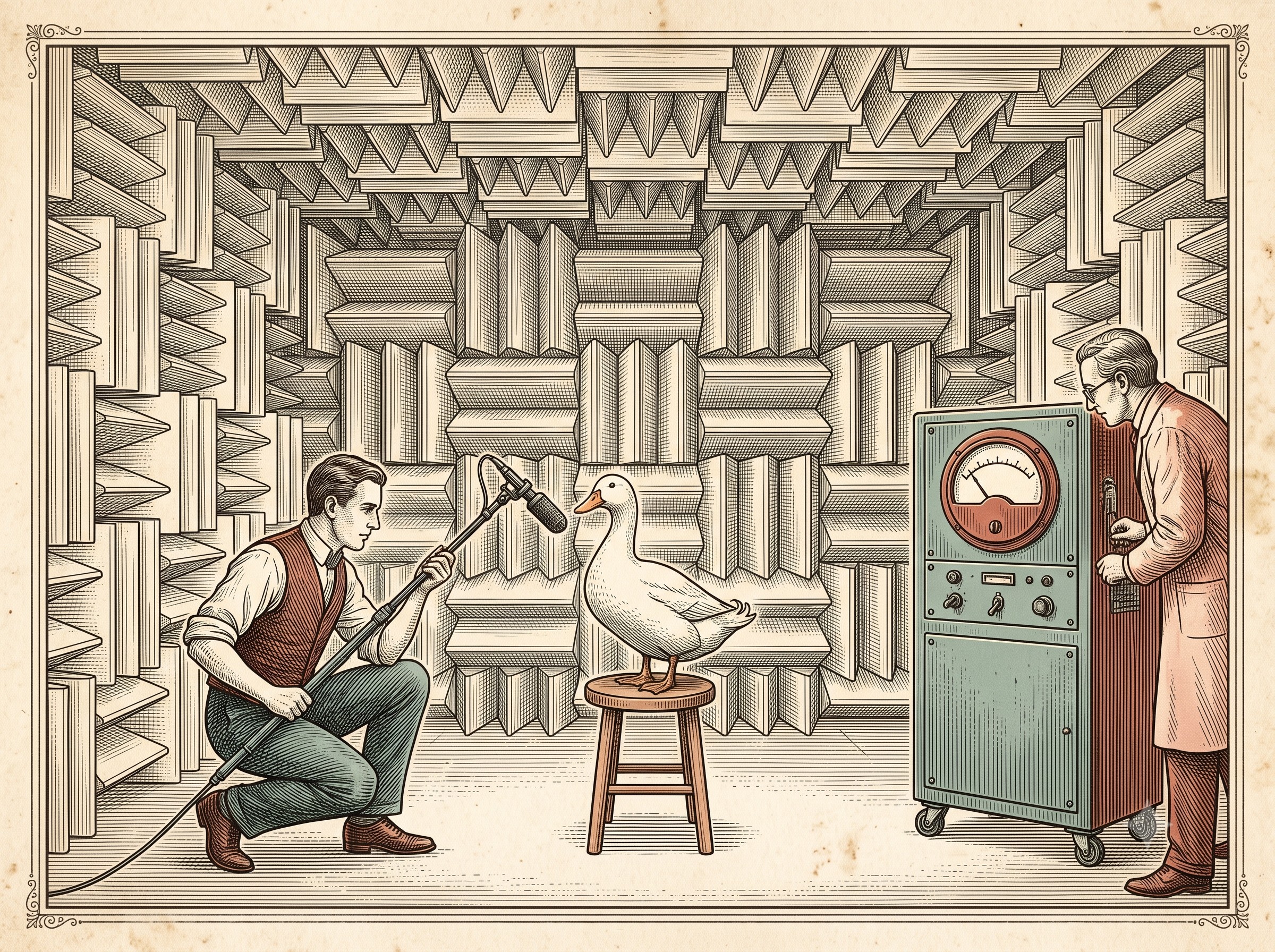
Daisy went first into Salford’s anechoic chamber — a room whose walls, floor and ceiling are covered in sound-absorbing fibreglass wedges, so that essentially no sound reflects back. (“Anechoic” means, literally, without echo.) This gave the team a clean reference: what a quack sounds like with every reflection stripped out. Then, after what the Salford write-up describes as a brief comfort break, Daisy was carried next door into the reverberation chamber — a hard-walled room roughly the size of a tall classroom that is normally used to measure how much sound building materials absorb, and that sounds, Cox says, like a cathedral.
Daisy quacked. The room threw it back at her, over and over. She quacked again. In Cox’s telling, the result “sounded evil and ghostly” — the ultimate sound effect, he wrote, for a horror film about a vampire duck.
The team then used the anechoic recording to simulate what Daisy would sound like flying past a cliff face about 50 metres away, and performing at the Royal Albert Hall. They released the audio files publicly and presented the finding at the British Association Festival of Science, held that September at the University of Salford. The wire services picked it up on 8 September 2003. The verdict was unambiguous: a duck’s quack echoes.
Why was it strange?
The strange part isn’t the answer. It’s that anyone believed the question.
For the myth to be true, a duck’s quack would have to be exempt from reflection — one specific animal noise, among all the sounds in the world, that hard surfaces simply decline to bounce back. There is no physics that permits this. Sound is a pressure wave; walls reflect pressure waves. If quacks were exempt, so much of acoustics would have to be wrong that concert halls would stop working.
And yet the claim survived for years, on television, on national radio, and in the inbox of a man whose actual job was measuring echoes. What kept it alive was the second half of the sentence — and no one knows why. A bare false fact invites checking. A false fact wrapped in an admission of mystery invites wonder instead, which is a much stickier thing.
What did scientists learn?
The interesting result was never whether, but why the myth felt plausible.
Salford’s team landed on three reasons, and they hold up. First, volume: a duck quacks quietly, so the reflected sound comes back quieter still. When you deliberately try to raise an echo, you shout — you don’t murmur. Second, habitat: to hear a distinct echo you need a big hard reflecting surface, a cliff or a building, and ducks mostly hang around open water where there isn’t one. Third, and most elegantly, shape: a quack fades in and fades out, with a long trailing “aaaacckkk.” An echo of a quack is a slightly delayed, slightly quieter copy of that same slur — and it arrives while the original is still trailing off, so the two blend. The echo is real. It just hides inside the tail of the sound that made it.
The MythBusters team reached the same conclusion independently that year, and described it the same way: the echo gets “swallowed” by the original quack.
Cox’s own field-testing was, by his admission, crude. He wandered ponds, canals and rivers listening to wildfowl and never once heard a clean, separate echo. His revised version of the saying: a duck’s quack might echo, but it’s nearly impossible to hear unless the bird quacks while flying under a bridge.
How does it affect us today?
The specifics of Daisy’s afternoon matter less than the technique, which is ordinary working acoustics. The anechoic-versus-reverberant pairing — measure the sound with no reflections, then measure it with maximum reflections, then subtract — is how laboratories characterise loudspeakers, hearing aids, aircraft cabins, and the absorption of carpets and theatre seating. Cox’s day job is the flip side of the same problem: designing diffusers and absorbers so that concert halls, cinemas and railway stations don’t fling announcements back at you as mush.
The episode is also a small, cheerful case study in how myths spread. The claim reached radio and television without anyone stopping to ask a specialist — and when someone finally did, the correct answer was less broadcastable than the wrong one. It took a duck, two laboratory chambers, and a national science festival to make the truth as shareable as the fiction.
Fun fact
Salford didn’t stop at the science. Alongside the raw recordings, the Acoustics Research Centre posted an audio file of Daisy “getting into the Christmas spirit” — her quacks arranged into a carol — with the honest warning that listening required “a suspension of musical taste.” Then the team declared that Daisy had earned her retirement and asked the public to send in other acoustic myths worth testing.
Sources
- University of Salford, Acoustics Research Centre — “A Duck’s Quack Doesn’t Echo, and no-one knows the reason why?” (primary source: the researchers’ own write-up, with the original anechoic, reverberant and simulated-cliff recordings)
- Trevor Cox, The Sound Book: The Science of the Sonic Wonders of the World — excerpted in Snopes, “Duck’s Quacks Don’t Echo?”
- UPI, 8 September 2003 — “Scientist proves a duck quack has echo”
- British Science Association — Salford 2003, Festival of Science
- MythBusters Results — Episode 8: “Duck Quack” (first aired 12 December 2003; verdict: busted)
Related stories
- The Bathtub That Took 24 Hours to Drain to Test a Myth — A physicist drained a bathtub for a day to test the Coriolis myth
- The Blind Bats That Flew Perfectly in the Dark — Blindfolded bats flew fine; deafened ones crashed
- The Schoolboy Whose Hot Ice Cream Froze Faster — and Baffled Physicists for 60 Years — A schoolboy insisted hot ice cream froze faster and stumped physicists