The Army Captain Who Asked Congress to Fund a Trip Inside the Earth
On April 10, 1818, a retired army captain in St. Louis mailed five hundred copies of a one-page announcement to every prince, parliament, college, and learned society whose address he could find. It declared that the Earth was hollow, that it was open at both poles, and that he personally volunteered to sail inside. Attached to each copy, in case anyone wondered, was a certificate attesting to his sanity.
By the Curiosities Desk · · 5 min read · Filed under Physics · Today’s round
Part of The Version Everyone Remembers
What happened: The Hollow Earth Theory
The captain was John Cleves Symmes Jr. (1780–1829), a veteran of the War of 1812 who had fought at Lundy’s Lane and the Siege of Fort Erie, mustered out in 1815, and then failed as a frontier trader. What he did not fail at was persistence.
His “Circular No. 1” is short enough to quote almost in full: “I declare the earth is hollow, and habitable within; containing a number of solid concentrick spheres, one within the other, and that it is open at the poles 12 or 16 degrees; I pledge my life in support of this truth, and am ready to explore the hollow, if the world will support and aid me in the undertaking.” He asked for a hundred companions, reindeer, and sleighs, and promised to be back by spring.
The response was not encouraging. His son Americus, publishing his father’s papers sixty years later, admitted the circular was “overwhelmed with ridicule as the production of a distempered imagination” and became “a fruitful source of jest with the newspapers.”
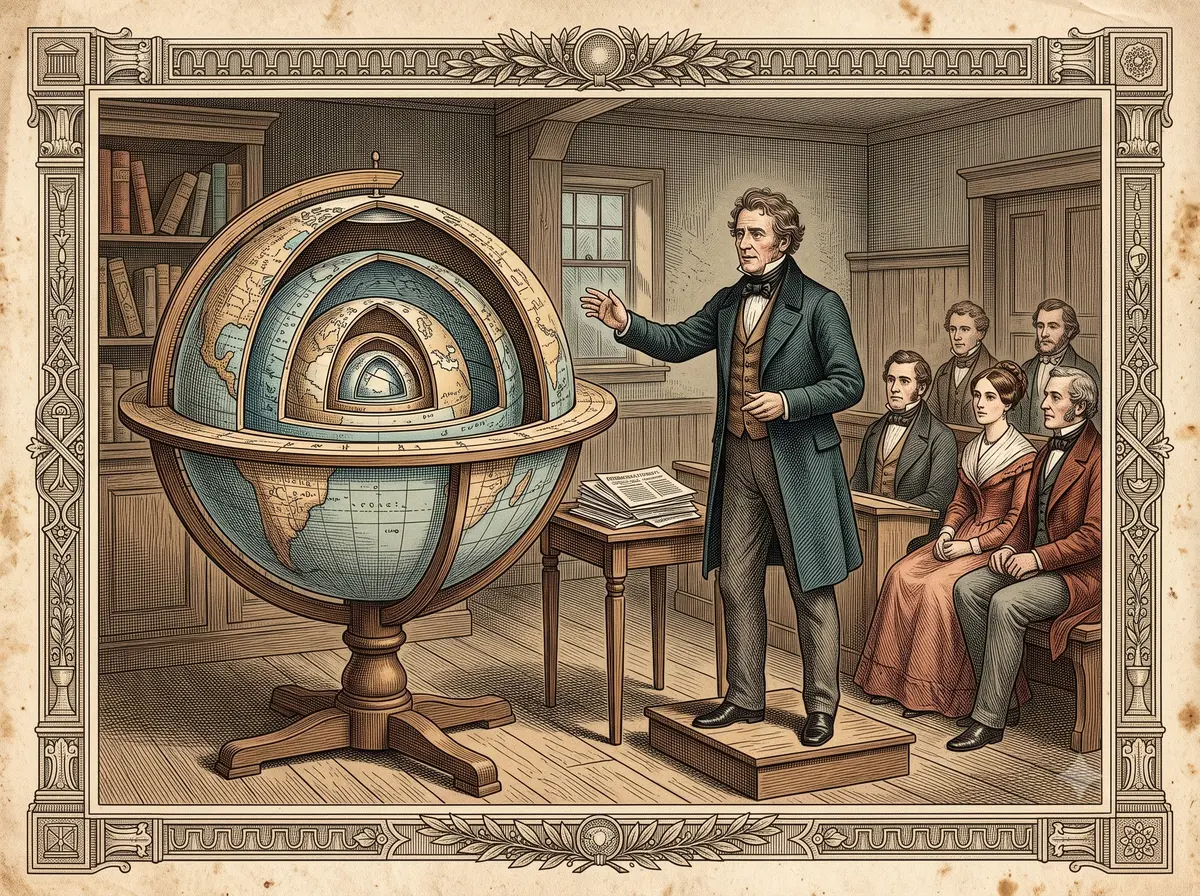
Symmes kept going anyway. Over 1818 and 1819 he issued seven more circulars. He moved his family to Newport, Kentucky, and in 1820 began lecturing across Ohio and the surrounding states, carrying a wooden globe with the polar caps sawn out so audiences could look inside. (That globe survives, in the collection of the Academy of Natural Sciences of Drexel University.) He was, by all accounts, a poor speaker — hesitant, nasal, visibly uncomfortable — and he converted people anyway. John James Audubon sketched him in 1820 and wrote on the back: “The man with the hole at the Pole.”
Then the campaign reached Washington. Symmes petitioned Congress to outfit a polar expedition; his petition was tabled in 1822 and forwarded again in December 1823. Congress voted on the question twice, and the second time the proposal drew roughly twenty-five votes in favor — not enough, but not nothing either. A national legislature had seriously discussed funding a voyage to the inside of the planet.
Symmes died in 1829 without ever seeing a pole. But his most devoted convert, an Ohio newspaper editor named Jeremiah N. Reynolds, quietly dropped the inner suns and subterranean civilizations and kept the ship. Reynolds spent a decade lobbying instead for an ordinary, respectable scientific voyage to the far south — one that would beat Britain and France to Antarctic waters. In 1836 Congress funded it. John Quincy Adams, by then a congressman, cast one of the deciding votes and told Reynolds he could now die content. The six-ship United States Exploring Expedition sailed in 1838 and returned in 1842 having charted enough Antarctic coastline to establish that it was a continent — solid land, sitting more or less exactly where Symmes had drawn his hole.
Reynolds was not invited aboard. He still carried the smell of the hollow Earth about him.
Why it was strange: The Hollow Earth Theory
Here is the part that stings: the answer already existed, and had for twenty years.
In 1798 Henry Cavendish had measured the gravitational attraction between lead spheres in a sealed shed and worked out the mean density of the Earth — about 5.48 times the density of water. Surface rock runs closer to 2.7. Whatever the planet is made of, the inside is heavier than the outside, not lighter, and certainly not empty. Symmes was arguing for a hollow Earth in a century that had already weighed it.
Symmes wasn’t a lone crank inventing nonsense from scratch, either. Edmond Halley — of the comet — had proposed a set of concentric shells inside the Earth in the 1690s to explain why compass needles drift over time, and thought the gaps between them might be inhabited. Halley liked the idea enough to be painted holding a diagram of it. The hollow Earth had a pedigree. What Symmes added was the doorway.
Another story that outran the evidence: The Baguette Blamed for Overheating the Large Hadron Collider.
What scientists learned: The Hollow Earth Theory
Nobody could see inside the Earth in 1818, and nobody can now. What changed is that we found something that could go there for us: earthquakes.
Seismic waves bend, speed up, slow down, and reflect as they pass through materials of different density and stiffness. Record the same quake at stations around the world and the arrival times form a map of what the waves passed through. In 1906 Richard Dixon Oldham noticed that waves crossing the deep Earth abruptly slowed in a way that only made sense if there was a distinct core down there. Emil Wiechert had already argued, from Cavendish’s density number alone, that the core had to be something like meteoric iron. In 1936 the Danish seismologist Inge Lehmann found waves reflecting from a boundary that shouldn’t have existed — and deduced a solid inner core inside the liquid outer one.
The planet under our feet turned out to be stranger than Symmes guessed, just in the opposite direction: not a nested set of habitable shells, but a ball of iron and nickel roughly the size of the Moon, hot as the surface of the Sun, whose churning generates the magnetic field that Halley had been trying to explain in the first place.
Another claim that stuck harder than the correction: The Bathtub That Took 24 Hours to Drain to Test a Myth.
How it reaches us today: The Hollow Earth Theory
Every compass bearing, every magnetometer reading, every model of how solar storms will hit the power grid rests on the geodynamo — the convecting liquid iron in the outer core. Halley’s and Symmes’s shared question, why is the magnetic field like this, was a good question. It just had a solid answer.
The Wilkes Expedition’s charts and specimen collections seeded what became the Smithsonian’s natural history holdings, and the precedent it set — that a government should pay for exploration with no guaranteed return — runs fairly directly to modern deep-sea and planetary science budgets. Antarctica got its first real survey because a man in Ohio believed you could sail into the planet, and because his student was pragmatic enough to stop saying so out loud.
A close cousin: The Bumblebee That Science Supposedly Proved Couldn’t Fly.
Fun fact: The Hollow Earth Theory
Symmes is buried in Hamilton, Ohio, beneath a monument raised by his son Americus: a stone pylon topped with a globe carved hollow and open at the poles. It is, as far as anyone can tell, the only grave marker in the world that is also a scientific diagram of a theory that was wrong.
Sources: The Hollow Earth Theory
- Symmes, John Cleves. Circular No. 1, St. Louis, April 10, 1818 — the primary document, reproduced in facsimile.
- Griffin, Duane A. “Hollow and Habitable Within: Symmes’s Theory of Earth’s Internal Structure and Polar Geography.” Physical Geography 25:5 (2004), 382–397 — peer-reviewed reconstruction of Symmes’s theory and campaign.
- Sinnema, Peter W. “10 April 1818: John Cleves Symmes’s ‘No. 1 Circular’.” BRANCH, June 2012 — scholarly account of the circular’s reception, including the certificate of sanity.
- Halley, Edmond. “An Account of the Cause of the Change of the Variation of the Magnetic Needle.” Philosophical Transactions of the Royal Society 16 (1692), 563–578 — the concentric-spheres hypothesis, from the source.
- Roos, Dave. “The Bizarre 19th-Century Push for a ‘Hollow Earth’ Expedition.” HISTORY, January 2026 — on the congressional votes, Reynolds, and the road to the U.S. Exploring Expedition.

Related stories: The Hollow Earth Theory
- The Motor That Ran for Twenty-Six Years on a Secret Room Full of Compressed Air — A perpetual motion motor secretly fed by a hidden room of compressed air
- The Newspaper Hoax That Put Bat-People on the Moon — A newspaper reported bat-winged people living on the Moon
- The Astronomer Who Saw Canals on Mars That Weren’t Real — An astronomer mapped canals on Mars that were never there