The Newspaper Hoax That Put Bat-People on the Moon
In the last week of August 1835, a professor of mathematics at a Virginia college pulled Edgar Allan Poe aside and assured him, quite seriously, that there was no doubt at all about the creatures living on the moon. Bat-winged people. Blue, single-horned goats. Beavers that walked upright and built fires. He had read all about it in that week's newspaper, and so, it seemed, had half of New York.
By the Curiosities Desk · · 5 min read · Filed under Space · Today’s round
Part of The Version Everyone Remembers
What happened: The Great Moon Hoax of 1835
The newspaper was The Sun, a scrappy one-cent daily competing against older papers that cost six times as much. In August 1835 it was selling roughly 8,000 copies a day, and one of its reporters, an English-born, Cambridge-educated writer named Richard Adams Locke, was about to change that.
On August 21, The Sun teased an extraordinary story, supposedly reprinted from a Scottish paper. Four days later, the first of six installments ran under the headline “GREAT ASTRONOMICAL DISCOVERIES, LATELY MADE BY SIR JOHN HERSCHEL… At the Cape of Good Hope,” credited to a “Supplement to the Edinburgh Journal of Science.” It claimed that the astronomer John Herschel — real, famous, and, crucially, actually working at the Cape of Good Hope in South Africa at that very moment — had built “a telescope of vast dimensions and an entirely new principle” and used it to settle “whether this satellite be inhabited, and by what order of beings.” The lens, readers were told, was 24 feet across and weighed seven tons. The narrative was credited to Herschel’s supposed traveling companion and amanuensis (a person employed to write from dictation), a “Dr. Andrew Grant,” who never existed.
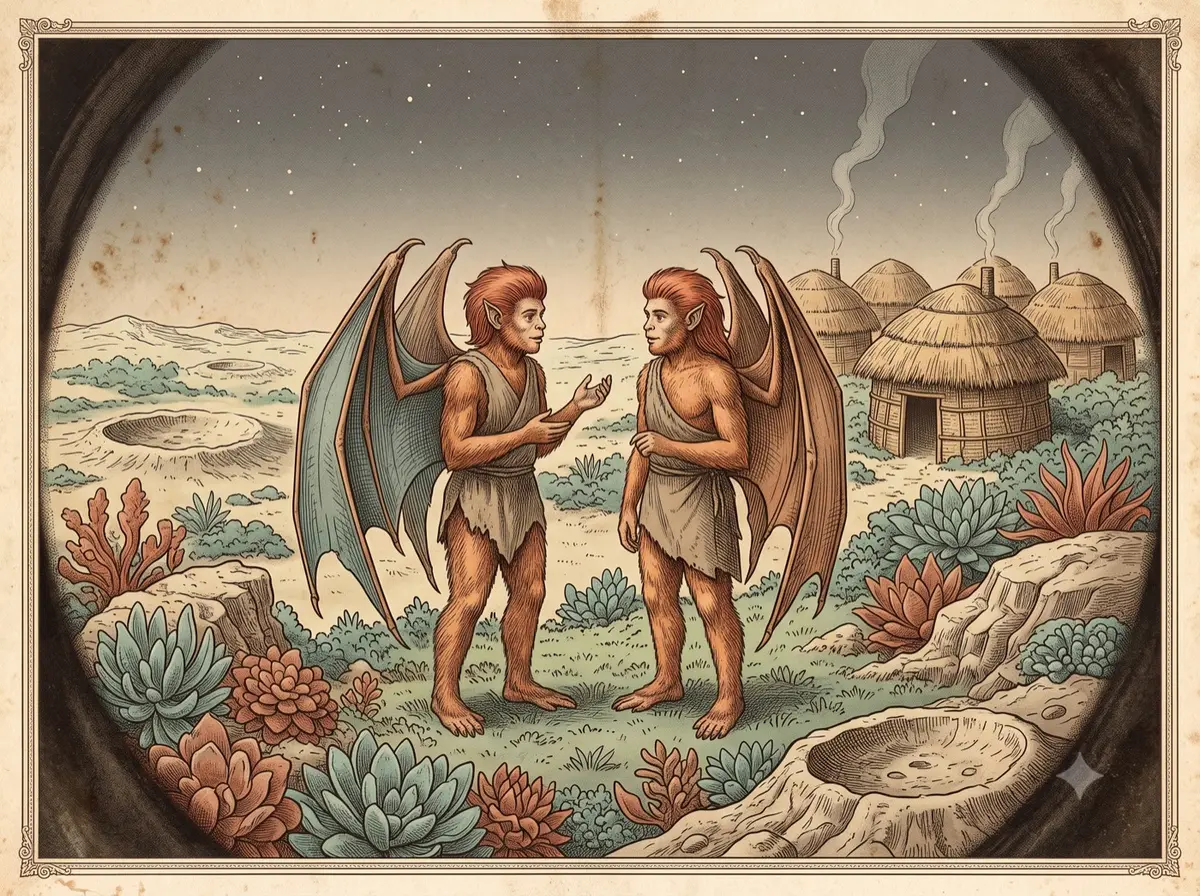
Over the following days the articles escalated: forests, an inland sea, herds of small bison, blue goats, and bipedal beavers that carried their young “like a human being” and built huts with smoke rising from them. By the fourth installment, on August 28, Locke unveiled the discovery that made the series famous — four-foot-tall, copper-haired, winged humanoids that Herschel had supposedly named Vespertilio-homo, or man-bats, observed conversing with one another and building temples. The series wrapped when the observations conveniently ended: the sun’s rays, magnified through the giant lens, had supposedly set the observatory ablaze.
Readers, for a while, believed it. One contemporary account put The Sun’s circulation at over 19,000 during the hoax’s run, though historians caution that popular retellings have exaggerated how much it moved the needle long-term. At Yale, faculty and students reportedly awaited each new installment. Poe later wrote that “not one person in ten discredited it,” and clergy in several cities discussed bringing Christian teaching to the moon’s inhabitants.
The unraveling came from a rival, not a scientist. On August 31, James Gordon Bennett, editor of the competing New York Herald, pointed out that the Edinburgh Journal of Science — the supposed source — had stopped publishing back in 1833. Locke denied writing the series that same week, in a letter to the New York Evening Post, but admitted authorship five years later, in an 1840 letter to the magazine New World. The Sun never printed a formal retraction; by mid-September, its staff had simply stopped defending the story.
Why it was strange: The Great Moon Hoax of 1835
The strangeness wasn’t that a newspaper made something up — it’s that the hoax borrowed a real astronomer’s name and real astronomical location to sell an invented discovery, at a moment when serious thinkers actually were arguing about life on the moon. The Scottish minister Thomas Dick had published widely read calculations putting the moon’s population in the billions. A Munich astronomy professor, Franz von Paula Gruithuisen, had claimed in 1824 to have spotted a walled lunar city. Locke, by his own later account, meant to satirize that kind of speculation — not confirm it. The joke, as one historian has put it, failed “not because it was bad, but because it was too good”: readers took obvious fiction for news because it fit what some real scientists were already suggesting might be true.
The same thread — Moon — continues in The Plan to Set Off a Nuclear Bomb on the Moon So Everyone Could Watch.
What scientists learned: The Great Moon Hoax of 1835
Nothing here was a controlled experiment, but the episode is a case study in how extraordinary claims get checked — or don’t. The hoax wasn’t exposed by astronomers reviewing the “discovery”; it was exposed by a rival editor doing a basic fact-check on where the story supposedly came from. Meanwhile, the real John Herschel was doing the far less thrilling work the hoax borrowed its credibility from: a four-year survey of the southern sky from his home at Feldhausen, near Cape Town, sweeping the heavens for nebulae, star clusters, and double stars, and publishing his actual results in 1847 as Results of Astronomical Observations Made at the Cape of Good Hope — thousands of catalogued objects, verified through years of repeated observation, nothing like a single unverifiable “reprint” from a defunct journal. Herschel was reportedly amused by the hoax at first, and only later annoyed at having to keep explaining, to earnest strangers, that he had not in fact found bat-men.
Another claim that stuck harder than the correction: The Great Wall ‘Visible From the Moon’ — Promised 215 Years Before Anyone Could Check.
How it reaches us today: The Great Moon Hoax of 1835
The Great Moon Hoax is now a staple case study in journalism history and media literacy classes, cited as one of the earliest documented examples of what we’d now call “fake news” — a story built to look verifiable (a named scientist, a specific location, a cited journal) without actually being checkable by an ordinary reader. The mechanism it relied on, borrowing real credentials to make an invented claim credible, is the same one behind plenty of modern misinformation that misattributes false claims to real scientists, journals, or institutions. It’s also a reminder that the reflex to check a citation — does this journal even exist? — remains one of the simplest and most effective tools for telling real science from a very good story.
Another story that outran the evidence: The Million-Dollar Space Pen Myth — and the $128.89 Pencils NASA Actually Bought.
Fun fact: The Great Moon Hoax of 1835
Poe had his own reasons to be annoyed. A few months earlier, in June 1835, he had published “The Unparalleled Adventure of One Hans Pfaall,” a story about a man who flies a hot-air balloon to the moon, and he was reportedly partway into a planned sequel when Locke’s hoax appeared and made his story feel beside the point. Poe accused Locke of stealing his thunder — while also admitting, grudgingly, that he admired the “exquisite vraisemblance” (a French term for the appearance of being real) of Locke’s writing.
Sources: The Great Moon Hoax of 1835
- Great Moon Hoax — Wikipedia (cross-checked against its cited sources)
- The Great Moon Hoax of 1835 — Museum of Hoaxes (with transcripts of the original six Sun articles)
- The Great Moon Hoax of 1835 Was Sci-Fi Passed Off as News — Encyclopaedia Britannica
- How the Sun Conned the World With “The Great Moon Hoax” — JSTOR Daily
- John Herschel in South Africa — MacTutor History of Mathematics, University of St Andrews
Related stories: The Great Moon Hoax of 1835
- The Astronomer Who Saw Canals on Mars That Weren’t Real — An astronomer mapped canals on Mars that were never there
- The Petrified Giant That Was a Fake of a Fake — A fake stone giant, and then a fake of the fake
- The Blind Bats That Flew Perfectly in the Dark — Blindfolded bats flew fine; deafened ones crashed