The Moon Golf Shot That Went 'Miles and Miles and Miles' — and Actually Went 40 Yards
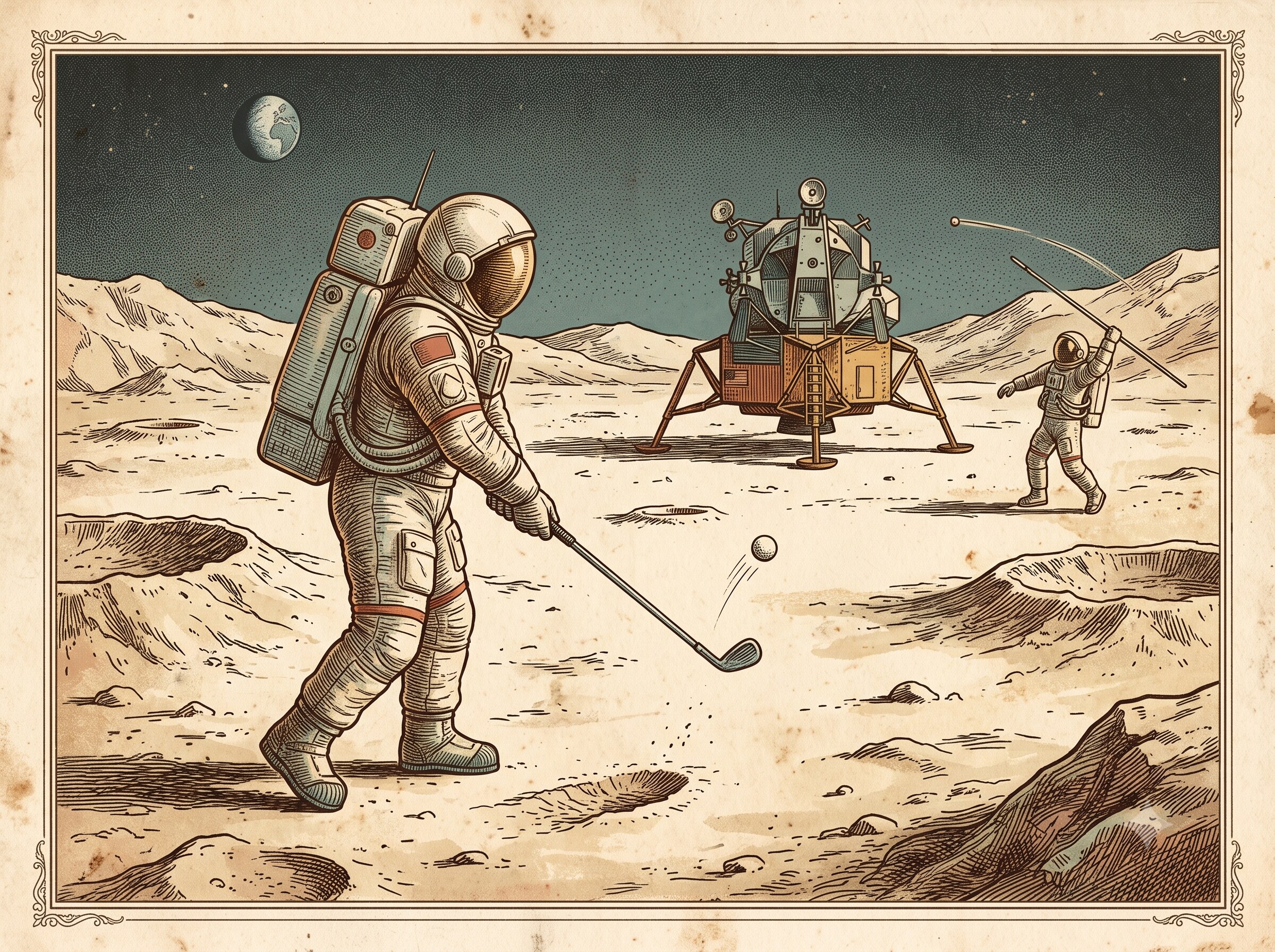
A quarter of a million miles from the nearest fairway, a 47-year-old admiral in a pressurized suit stood in the gray dust of Fra Mauro, dropped a golf ball at his feet, and swung a six-iron one-handed because the suit wouldn't let him use two. He missed. He missed again. On the third try he connected, and as the ball vanished off the edge of the television picture he announced to the entire planet: "Miles and miles and miles." Fifty years later, someone measured it.
By the Curiosities Desk · · 5 min read · Filed under Space · Today’s round
What happened?
The date was February 6, 1971, near the end of the second and final moonwalk of Apollo 14. Alan B. Shepard Jr. — the first American in space, and at 47 the oldest person ever to walk on the Moon — had spent nine hours over two excursions hauling instruments and collecting rocks with lunar module pilot Edgar Mitchell. The scientific work was done. Cabin repressurization was about eighteen minutes away.
Shepard turned to face the TV camera and said, in the flattest possible test-pilot deadpan: “Houston, while you’re looking that up, you might recognize what I have in my hand as the handle for the contingency sample return; it just so happens to have a genuine six iron on the bottom of it. In my left hand, I have a little white pellet that’s familiar to millions of Americans.”
The idea had come to him about a year earlier. Bob Hope, who took a golf club nearly everywhere, was touring NASA’s Houston center and used his driver as a walking stick while trying out a lunar-gravity simulator. Watching him teeter, Shepard thought: what a place to hit a ball. Contrary to the story that has hardened into legend, he didn’t smuggle the club aboard. He asked. Bob Gilruth, who ran the Manned Spacecraft Center, initially said no — NASA was under heavy criticism over Apollo’s cost, and had nearly lost the Apollo 13 crew the year before. Shepard eventually got a conditional yes: no cost to the taxpayer, no publicity beforehand, and only at the very end, if nothing had gone wrong.
So a Houston club professional named Jack Harden helped him fit a Wilson Staff Dyna-Power six-iron head onto the collapsible handle of the contingency sample collector — a tool for scooping lunar soil that happened to be about the length of an iron shaft. The head and two balls flew to the Moon in one of Shepard’s tube socks.
The swing did not go well. The suit was inflated stiff enough that he could grip with one hand only, and the helmet made it hard to see his own feet. His first attempt topped the ball and buried it. “You got more dirt than ball that time,” Mitchell offered. The second swing nudged it two or three feet sideways. From Mission Control, capsule communicator Fred Haise delivered the line of the mission: “That looked like a slice to me, Al.”
Swing three connected. Shepard dropped his second ball, connected again, and made his “miles and miles and miles” claim to a live color broadcast. A few minutes later, as they packed up, Mitchell picked up the staff from the solar wind experiment and threw it javelin-style, and both men watched it land in the same crater as Shepard’s first ball. Reviewing the photographs decades later, Mitchell noted with evident satisfaction: “The javelin went just a hair further than the golf ball.”
Why was it strange?
The claim stuck. For half a century, “miles and miles and miles” was the number people repeated, and Shepard himself later settled on a still-generous 200 yards. Nobody could check. The only recording of the shot was fuzzy television video — the astronauts had already packed their Hasselblad cameras away, and the famous photograph of Shepard mid-swing that appears in his own book is a composite assembled from pieces of other images.
Then, for the shot’s 50th anniversary in 2021, imaging specialist Andy Saunders went back to the source: high-resolution scans of the original Apollo flight film, which normally lives in a frozen vault in Houston. Enhanced and stitched into panoramas, the frames showed Shepard’s boot prints, his divots, and both balls sitting on the surface. Cross-referencing those landmarks with orbital photographs from NASA’s Lunar Reconnaissance Orbiter gave him a scale.
Ball one: about 24 yards. Ball two: about 40 yards.
The same thread — Alan Shepard — continues in From a Wet Spacesuit to a $23 Million Toilet: A Short History of the Space Toilet.
What did scientists learn?
Shepard’s stated reason for bringing the club — the one he used on Gilruth — was that a golf ball is a beautifully familiar way to show people what a world without air and with one-sixth of Earth’s gravity does to a moving object. That part held up.
On Earth, a golf ball is shaped by its atmosphere. The dimples generate lift; backspin produces the Magnus effect, the sideways force that makes a ball hook or slice; drag bleeds off speed the whole way. On the Moon there is none of that. Shepard’s ball followed a clean parabola — no curve, no lift, no drag — and stayed up far longer under gravity roughly one-sixth as strong, so a ball launched at the same speed and angle travels about six times as far. Which makes the flip side of the 40-yard measurement unflattering but honest: the same feeble one-handed swing would have gone only a few yards at home.
The real achievement wasn’t distance. It was making contact at all, in a suit that fought every joint, on a surface Shepard later described as “one big sand trap.”
Another story that outran the evidence: The Great Wall ‘Visible From the Moon’ — Promised 215 Years Before Anyone Could Check.
How does it affect us today?
The club is still around. Shepard donated the original to the USGA Golf Museum in New Jersey in 1974, after a personal request from board member Bing Crosby — Bob Hope’s longtime co-star, which closes the loop rather neatly. The Smithsonian’s National Air and Space Museum has a replica. The balls are still on the Moon, and Shepard never told anyone what brand they were.
More than that, the shot did what NASA feared it would undermine: it made people pay attention. Public interest in Apollo had sagged badly after Apollo 11, and a golf joke told badly on live television is, half a century later, the single thing most people can tell you about Apollo 14. Saunders’ reanalysis is its own small lesson in what modern image processing can pull out of old archives.
Another claim that stuck harder than the correction: The Million-Dollar Space Pen Myth — and the $128.89 Pencils NASA Actually Bought.
Fun fact
If a professional golfer could reproduce a tour-level swing on the Moon — Saunders ran the numbers using 2016 PGA champion Jimmy Walker’s ball speed of 185 mph at an ideal 45-degree launch angle — the ball would carry about 2.62 miles and hang in the airless sky for over a minute. So “miles and miles and miles” is achievable. Just not in a spacesuit, and not one-handed.
Sources
- Apollo Lunar Surface Journal — “A Nice Day for a Game of Golf: EVA-2 Closeout and the Golf Shots” (annotated NASA air-to-ground transcript, with commentary from Edgar Mitchell)
- Andy Saunders, “The Mystery Behind Alan Shepard’s ‘Moon Shot’ Revealed,” USGA Golf Museum, February 5, 2021
- Roger Catlin, “When Astronaut Alan Shepard Hit the Golf Shot Heard 'Round the World,” Smithsonian Magazine, February 3, 2021
- National Air and Space Museum — Head, Golf Club, Apollo 14, Replica
- NASA, “50 Years Ago: Apollo 14 Lands at Fra Mauro”