The Warship That Never Actually Teleported to Norfolk
On Easter weekend in 1955, a package arrived at the U.S. Navy's Office of Naval Research containing a dog-eared paperback about flying saucers, its margins crammed with handwritten notes in three different colors of ink. Over the next few years, that package and a string of increasingly bizarre letters convinced a growing audience that in October 1943, the Navy had made a destroyer escort called USS Eldridge turn invisible, teleport it more than 200 miles to Norfolk, Virginia, and back again in a matter of minutes, and left several sailors fused into the ship's steel decking. The Navy eventually got tired of the phone calls and wrote an official memo explaining, in effect, that none of it happened. It is a genuinely strange document to hold up against a story this outlandish.
By the Curiosities Desk · · 6 min read · Filed under Physics · Today’s round
Part of The Version Everyone Remembers
What happened: The Philadelphia Experiment
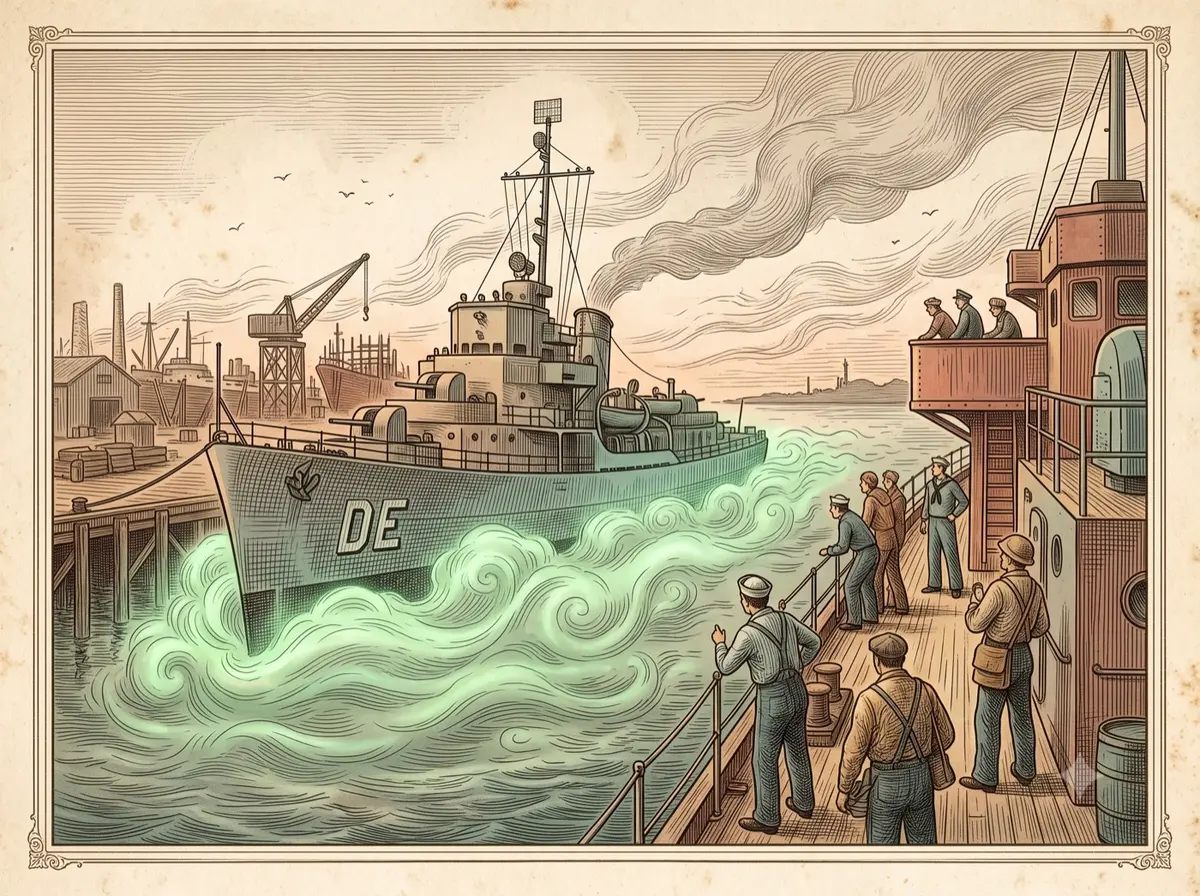
The story starts with a merchant seaman named Carl Meredith Allen, of New Kensington, Pennsylvania. In late 1955, using the name “Carlos Miguel Allende,” Allen began writing letters to Morris K. Jessup, an amateur astronomer and author of a book called The Case for the UFO. Allen’s letters described a secret 1943 experiment at the Philadelphia Naval Shipyard, supposedly built on an unfinished “unified field theory” by Albert Einstein. According to Allen, he had watched from the deck of another ship, the SS Andrew Furuseth, as the Eldridge disappeared in a green fog, briefly reappeared in Norfolk, and then popped back to Philadelphia — with crewmen left screaming, insane, or, in later retellings, partially merged with the ship’s hull.
In January 1956, an unsigned package showed up at the Office of Naval Research: a copy of Jessup’s own book, annotated throughout with cryptic marginalia about UFOs, alien cultures, and methods of propulsion. Two ONR officers took a personal interest, noticed the handwriting matched Allen’s letters, and — in a decision that did more than anything else to make this story feel official — had the annotated book retyped and reproduced in about 25 copies through a Texas defense contractor called Varo Manufacturing. Copies of this “Varo edition” circulated for years afterward, carrying an unearned whiff of government authentication. In 1957, Jessup was invited to ONR and shown the book; he recognized the annotator’s handwriting as Allen’s.
Jessup never got to see how far his own book would travel. His marriage had recently ended, and he was still recovering from a car accident when, on April 20, 1959, he was found dead in his car in Dade County, Florida, a hose running exhaust fumes into the back seat. It was ruled a suicide, consistent with the depression friends said he’d struggled with for months. Conspiracy writers later folded his death into the story anyway, suggesting he’d been silenced — a claim with no evidence behind it.
The tale might have stayed a UFO-community curiosity if not for authors Charles Berlitz and William Moore, whose 1979 book The Philadelphia Experiment: Project Invisibility presented it as a factual cover-up, adding graphic new embellishments about sailors fused into bulkheads. A 1984 film adaptation cemented it in pop culture.
Two separate investigations then dismantled the story. In 1980, a writer named Robert Goerman, digging into unrelated family history, discovered that “Carlos Allende” was Carl Allen — a man his own family had known personally, with a documented history of sending strange, imaginative letters and struggling with mental illness. Allen’s father described him, to Goerman, as someone who “loves to play games with those foolish enough to play audience.” Allen himself confessed to fabricating the story at least once, in 1969, before later recanting and reasserting it again.
More decisively, the Navy’s own paperwork settled where the Eldridge actually was. The ship’s deck log and war diary, preserved on microfilm, show it in New York and Long Island Sound until mid-September, then off Bermuda for training until mid-October, then back in New York harbor through November 1. It was never in Philadelphia during the claimed window, and it was nowhere near Norfolk at the same time as the Andrew Furuseth, the ship Allen claimed to be watching from. The Furuseth’s own master later wrote a letter flatly denying that he or his crew saw anything unusual.
Why it was strange: The Philadelphia Experiment
What makes this story unusual isn’t just that it’s false — it’s how it was built. It wasn’t invented from nothing. It borrowed real ingredients that happened to be lying around: a genuine, still-unfinished area of physics research Einstein really was working on late in his career; a wartime shipyard that really did keep secrets; and a Navy office that, through two officers’ personal curiosity, accidentally laundered a stranger’s letters into something that looked like an official document. Each piece was true or plausible on its own. Stitched together, they produced something no single piece of evidence could support.
Another claim that stuck harder than the correction: The Bumblebee That Science Supposedly Proved Couldn’t Fly.
What scientists learned: The Philadelphia Experiment
There’s no physics — then or now — that would let an electromagnetic field render a battleship and its crew invisible to the eye, let alone teleport it. The Office of Naval Research said as much in its own information sheet, noting that Einstein’s unified field theory (an attempt to describe gravity and electromagnetism within a single framework) was never completed, and that ONR itself wasn’t even established until 1946 — three years after the experiment was supposed to have happened. More interesting is where the legend likely came from. Wartime shipyards, including Philadelphia’s, really did run degaussing operations — wrapping ships in electrical cable to cancel out their magnetic field, making them “invisible” to magnetic mines, not to human eyes. Separately, in the 1950s, the destroyer USS Timmerman tested a high-frequency electrical generator that produced visible corona discharge — glowing arcs of ionized air — around its rigging, with no harm to the crew. Either or both of these ordinary, real experiments plausibly seeded the myth once retold a few times over.
Another story that outran the evidence: The Duck Borrowed From a Farm to Prove That Quacks Do Echo.
How it reaches us today: The Philadelphia Experiment
The Philadelphia Experiment is now a stock reference in science fiction and conspiracy culture, from novels to a 1984 film to a Loki episode. It also serves as a teaching example of how historians debunk claims — not by arguing physics in the abstract, but by pulling a ship’s actual deck log and checking where it was. Degaussing, the real technology tangled up in the myth, remains standard practice on naval vessels today, protecting ships from magnetic mines using the same principle refined during World War II.
A close cousin: The Park Ranger Struck by Lightning Seven Times.
Fun fact: The Philadelphia Experiment
The retyped “Varo edition” of Jessup’s annotated book — the one that gave the whole story its false patina of government sanction — is still traded among UFO collectors today, decades after the man who wrote the annotations admitted, more than once, that he made the whole thing up.
Sources: The Philadelphia Experiment
- Philadelphia Experiment; UFO’s — Office of Naval Research Information Sheet (primary source)
- USS Eldridge — Wikipedia
- Philadelphia Experiment — Naval History and Heritage Command
- Carl Meredith Allen — Wikipedia
- Morris K. Jessup — Wikipedia
A note: this article references a real suicide. If you or someone you know is struggling, the 988 Suicide & Crisis Lifeline (call or text 988 in the U.S.) is available any time.
Related stories: The Philadelphia Experiment
- Spontaneous Human Combustion: The Myth That Refused to Burn Out — The myth of people bursting into flame, and the physics behind it
- The Newspaper Hoax That Put Bat-People on the Moon — A newspaper reported bat-winged people living on the Moon
- The Million-Dollar Space Pen Myth — and the $128.89 Pencils NASA Actually Bought — NASA never spent millions on a zero-gravity pen