Science Gone Wrong · Engineering
The Time Oregon Blew Up a Whale With Half a Ton of Dynamite
In November 1970, a highway engineer in Oregon faced a problem no manual covered: a rotting 45-foot sperm whale on a public beach. His solution was to bury it in dynamite and hope the seagulls handled the rest. It did not go as planned.
By the Curiosities Desk · · 4 min read · Filed under Engineering · Today’s round
Part of When the Experiment Left the Lab
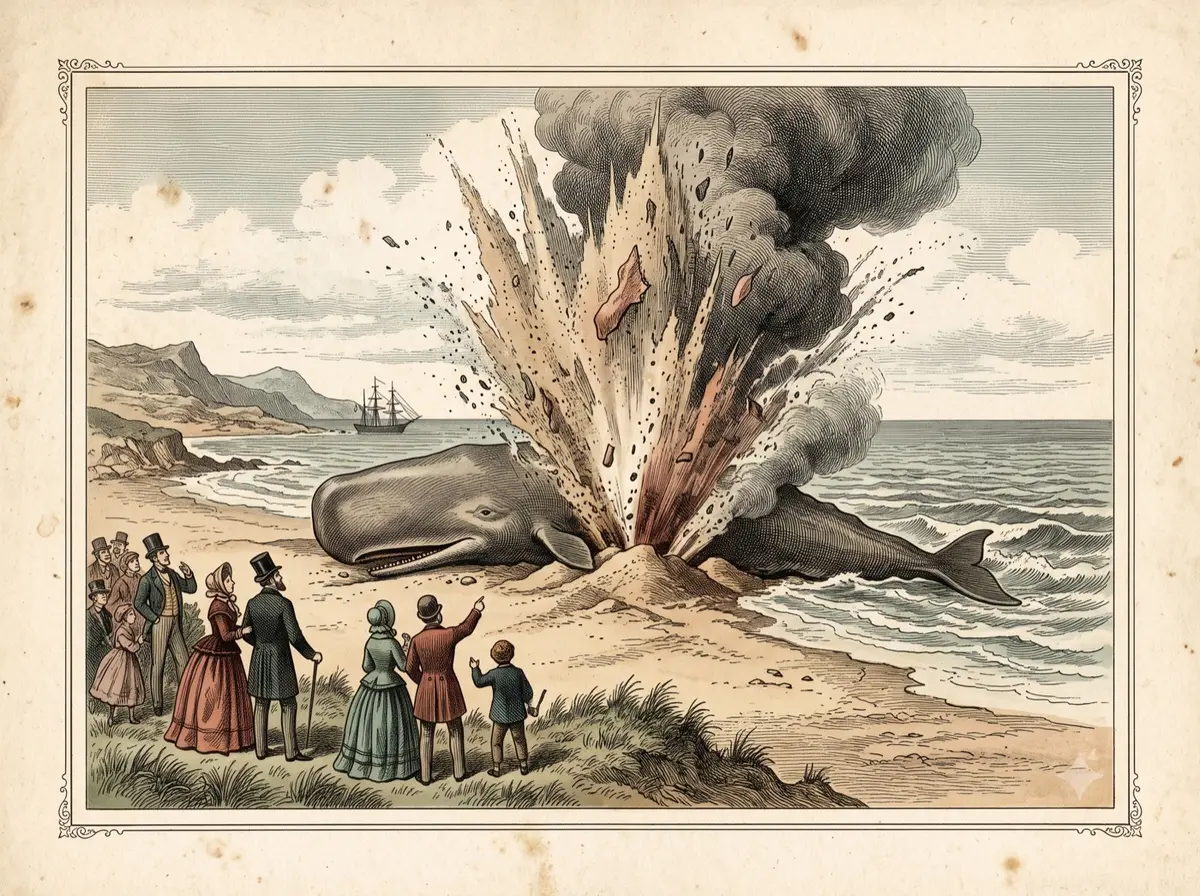
What happened: The Oregon Whale Explosion
On November 9, 1970, a dead sperm whale — about 45 feet long and estimated at eight short tons — washed ashore near Florence, on the central Oregon coast. At the time, Oregon’s beaches fell under the jurisdiction of the state Highway Division, and the carcass was decomposing fast.
The engineer in charge, George Thornton, later admitted he wasn’t sure how much dynamite the job required, explaining that he’d been handed the task because his supervisor had gone hunting. After consulting with the Navy, the crew settled on roughly half a short ton — about 1,000 pounds — of dynamite. The theory was that the blast would scatter the whale into pieces small enough for scavenger birds to clean up. A military veteran with explosives training who happened to be nearby warned that this was wildly too much, and that 20 sticks would have done the job. He was ignored.
On November 12 at 3:45 p.m., they lit it. A wall of sand and whale erupted into the sky. Blubber rained down roughly 800 feet away, and a large falling chunk flattened a parked car in a lot well back from the beach. Much of the whale didn’t disintegrate at all — large chunks simply remained on the sand for crews to haul off by hand. And the birds, which the entire plan depended on? They’d been scared off by the explosion.
Why it was strange: The Oregon Whale Explosion
It’s the rare engineering failure that doubled as slapstick. A local news crew from Portland’s KATU filmed the whole thing, and reporter Paul Linnman delivered an instantly quotable line about “blubber blasted beyond all believable bounds.” The footage was so absurd that it became one of the internet’s earliest viral videos decades later — by 2006 it had reportedly been viewed hundreds of millions of times. Humorist Dave Barry resurrected the story in a 1990 column, and so many people assumed it was recent news that Oregon transportation officials spent years fielding calls from confused reporters.
Another good intention with a bad landing: The Thirty Men Who Ran Back and Forth Across a Warship to See If It Would Tip Over.
What scientists learned: The Oregon Whale Explosion
The practical takeaway was immediate and lasting: don’t blow up whales. When 41 sperm whales beached near the same area in 1979, officials burned and buried them instead. Today, standard policy in Oregon and many other places is to bury whale carcasses where they land, or relocate them to another beach — no explosives involved. The episode is also a tidy case study in decision-making under pressure: an unfamiliar problem, a guessed-at solution, and an expert warning that went unheeded.
Another time it went sideways: The Drilling Rig That Pulled the Plug on a Lake — and Then Got Sucked Down the Drain.
How it reaches us today: The Oregon Whale Explosion
The exploding whale endures as a beloved cautionary tale in engineering and management circles about overconfidence and ignoring the specialist in the room. Florence has fully embraced it: in 2020, residents voted to name a new recreation area “Exploding Whale Memorial Park,” and the town now marks an annual Exploding Whale Day.
A close cousin: The Skyscraper That Melted a Jaguar — and Fried an Egg on the Pavement.
Fun fact: The Oregon Whale Explosion
Days before the blast, a local man had bought a new car through a dealership’s “Get a Whale of a Deal” promotion. A falling chunk of blubber crushed it.
Sources: The Oregon Whale Explosion
- “Exploding whale,” Wikipedia — https://en.wikipedia.org/wiki/Exploding_whale
- Finn J.D. John, “Oregon’s world-famous exploding whale,” Offbeat Oregon — https://offbeatoregon.com/1608bT.exploding-whale.404.html
- Stuart Tomlinson, “The man behind Oregon’s exploding whale dies at 84,” The Oregonian, Oct. 31, 2013
- Bryan Pietsch, “‘Exploding Whale’ Park Memorializes Blubber Blast 50 Years Later,” The New York Times, June 20, 2020
Related stories: The Oregon Whale Explosion
- The Day a 25-Foot Wave of Molasses Flooded a Boston Neighborhood — A storage tank burst and sent a molasses wave through Boston
- Galloping Gertie: The Bridge That Taught Engineers to Fear the Wind — A bridge that twisted itself apart in a moderate wind
- The Weedkiller That Made New Zealand’s Trousers Explode — A weedkiller that turned New Zealand’s farm trousers into fire hazards