Science Gone Wrong · Engineering
The Thirty Men Who Ran Back and Forth Across a Warship to See If It Would Tip Over
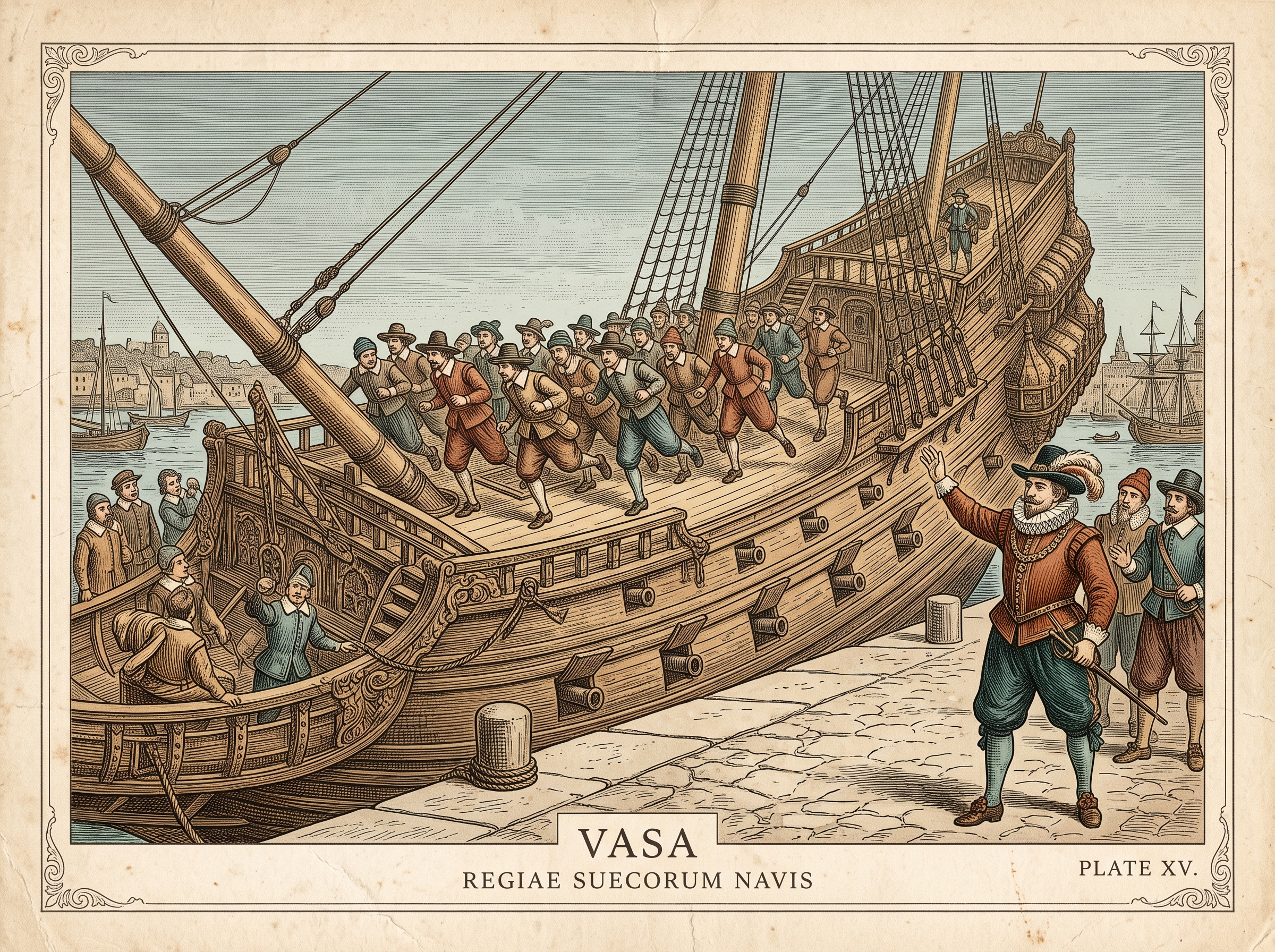
On a July day in 1628, thirty sailors lined up shoulder to shoulder on the deck of Sweden's newest warship and, on command, ran to the other side. Then back. Then across again. Still tied to the quay, the ship rolled harder with each pass, until the admiral watching ordered them to stop before they capsized the most expensive object in the kingdom. A month later, the ship sailed anyway.
By the Curiosities Desk · · 5 read · Filed under Engineering · Today’s round
What happened?
The ship was Vasa, meant to be the pride of Gustav II Adolf’s navy — a 69-metre warship carrying 64 bronze guns on two full gun decks, her stern crawling with hundreds of carved lions, emperors, and mermaids. Her builder, the Dutch-born master shipwright Henrik Hybertsson, signed the contract in January 1625 and died in 1627, before she was finished; his colleague Hein Jacobsson carried the work to completion.
Nobody in 1628 could calculate whether a hull would float upright; the mathematics did not exist yet. Shipwrights worked from proportions that had succeeded before, and Vasa was larger and more heavily armed than anything Hybertsson had built. When a new warship turned out to be tippy — the period word was crank, or tender — that was a known and usually fixable problem. You removed a deck, moved guns, or added planking at the waterline.
So the test was reasonable. Captain Söfring Hansson arranged for Vice Admiral Klas Fleming, second-in-command of the navy, to come watch. Thirty men running from rail to rail was a way to pump energy into the ship’s roll and see how far she went over. She went over a long way. The Vasa Museum’s account, drawn from the later inquest, says the demonstration was halted “after just a few trips” for fear the ship would roll onto her side at the dock; several retellings put it at three runs. The ship’s master, Jöran Matsson, later testified that he overheard Fleming say, “If only His Majesty were at home!”
His Majesty was not at home. Gustav Adolf was in Prussia running a war against Poland-Lithuania, sending letters demanding to know why his flagship was not at sea. Fleming reported nothing.
Sunday, 10 August 1628 drew a crowd. Crews had been allowed to bring their families aboard for the first leg, and the quays were packed. Between four and five in the afternoon Vasa caught the current, set four of her ten sails, and fired a salute. A first gust laid her over and she slowly came back up. A second, stronger gust pushed her far enough that water poured through the open lower gunports. Within minutes she was on the bottom in 32 metres of water, masts still above the surface, having sailed barely a kilometre.
Of roughly 150 people aboard, about 30 died, most trapped below decks. (Older accounts say fifty; the museum’s figure of around thirty is the one the record supports.)
Why was it strange?
The strange part is not that a 17th-century ship was unstable. Plenty were. The strange part is that the Swedish navy ran the test, got the answer, and sailed anyway.
This was not a subtle signal buried in data. Thirty men nearly tipped a warship over while it was moored, in front of the deputy commander of the fleet. The failure was not one of measurement. It was a failure to act on a measurement everyone present understood perfectly well.
At the inquest — convened 5 September 1628 at the Tre Kronor palace and chaired by the king’s half-brother, Admiral of the Realm Karl Karlsson Gyllenhielm — officer after officer claimed to have known nothing. Then Matsson described the running test, and the room learned the ship’s fatal flaw had been demonstrated in public a month before it killed anyone. Nobody was punished: the design had been approved by the king, and blaming the design meant blaming him. Everyone questioned was eventually promoted.
Another good intention with a bad landing: The Skyscraper That Melted a Jaguar — and Fried an Egg on the Pavement.
What did scientists learn?
A floating ship is a contest between two points. Gravity pulls down through the centre of gravity, the average location of all the ship’s weight. Water pushes up through the centre of buoyancy, the centre of the underwater part of the hull. When a ship heels, the submerged shape changes and the centre of buoyancy slides toward the low side, so the two forces either right the ship or roll it further. Naval architects capture this with the metacentric height — roughly, how far the centre of gravity sits below the pivot point of that righting action. Positive, and the ship pushes back upright. Small or negative, and it keeps going.
Vasa had two decks of heavy bronze cannon and towering carved upperworks over a hull that was too narrow underneath, with only 120 tons of stone ballast in the bottom. Her weight was too high and her underwater body too small. The expert shipwrights and captains appended to the 1628 inquest got this right in plain language, with no calculus available to them: the ship, one said, lacked enough “belly.” The formal theory arrived more than a century later, when Pierre Bouguer published the metacentre in his Traité du Navire in 1746.
Another time it went sideways: The Time Oregon Blew Up a Whale With Half a Ton of Dynamite.
How does it affect us today?
Every large ship built today undergoes an inclining experiment before it enters service. Known weights are moved across the deck in a measured sequence, the resulting heel is recorded with pendulums or electronic inclinometers, and the centre of gravity is calculated from the response. It is, structurally, the same experiment as thirty men running from rail to rail — with the crucial addition that the number it produces is binding. A ship that fails does not sail.
The story also escaped into business schools: in 2001, researchers writing in the Academy of Management Executive coined “Vasa syndrome” for projects that fail in this exact pattern — requirements shifting from the top, a schedule nobody dares question, a bad test result quietly filed away.
And Vasa herself is still here. Located by Anders Franzén in 1956, she was lifted in eighteen stages beginning in August 1959 and broke the surface at 09:03 on 24 April 1961, after 333 years in the dark. She is now the best-preserved 17th-century ship in the world and the centrepiece of the most-visited museum in Scandinavia — famous entirely because she failed.
A close cousin: The Day a 25-Foot Wave of Molasses Flooded a Boston Neighborhood.
Fun fact
Once Vasa became a national celebrity, the public flooded the salvage team with ideas for raising her. Two of the more memorable: fill the hull with ping-pong balls until it floated, or freeze the whole wreck into a giant ice cube and let it bob up. The Neptune Diving and Salvage Company agreed to do the job for free on one condition — that they use a method they already trusted. They dug six tunnels under the hull and lifted her in a basket of steel cables.
Sources
- The Vasa Museum, “The Disaster”
- The Vasa Museum, “The Inquest” — the museum’s account of the 1628 tribunal, including Jöran Matsson’s testimony about the stability demonstration
- The Vasa Museum, “The Salvage”
- “Vasa,” Encyclopædia Britannica
- Kessler, Bierly & Gopalakrishnan, “Vasa syndrome: Insights from a 17th-century new-product disaster,” Academy of Management Executive 15:3 (2001)
A note: about thirty people died when Vasa sank, and five of them were still aboard when she was raised. If that sits heavily, it’s fine to leave it there — the history keeps.
Related stories
- Galloping Gertie: The Bridge That Taught Engineers to Fear the Wind — A bridge that twisted itself apart in a moderate wind
- The Windows That Took the Blame for a Plane Crash They Didn’t Cause — When the obvious culprit turns out to be innocent
- The Aircraft Carrier Britain Tried to Build Out of Ice — Another navy, another very confident hull