Science Gone Wrong · Engineering
Galloping Gertie: The Bridge That Taught Engineers to Fear the Wind
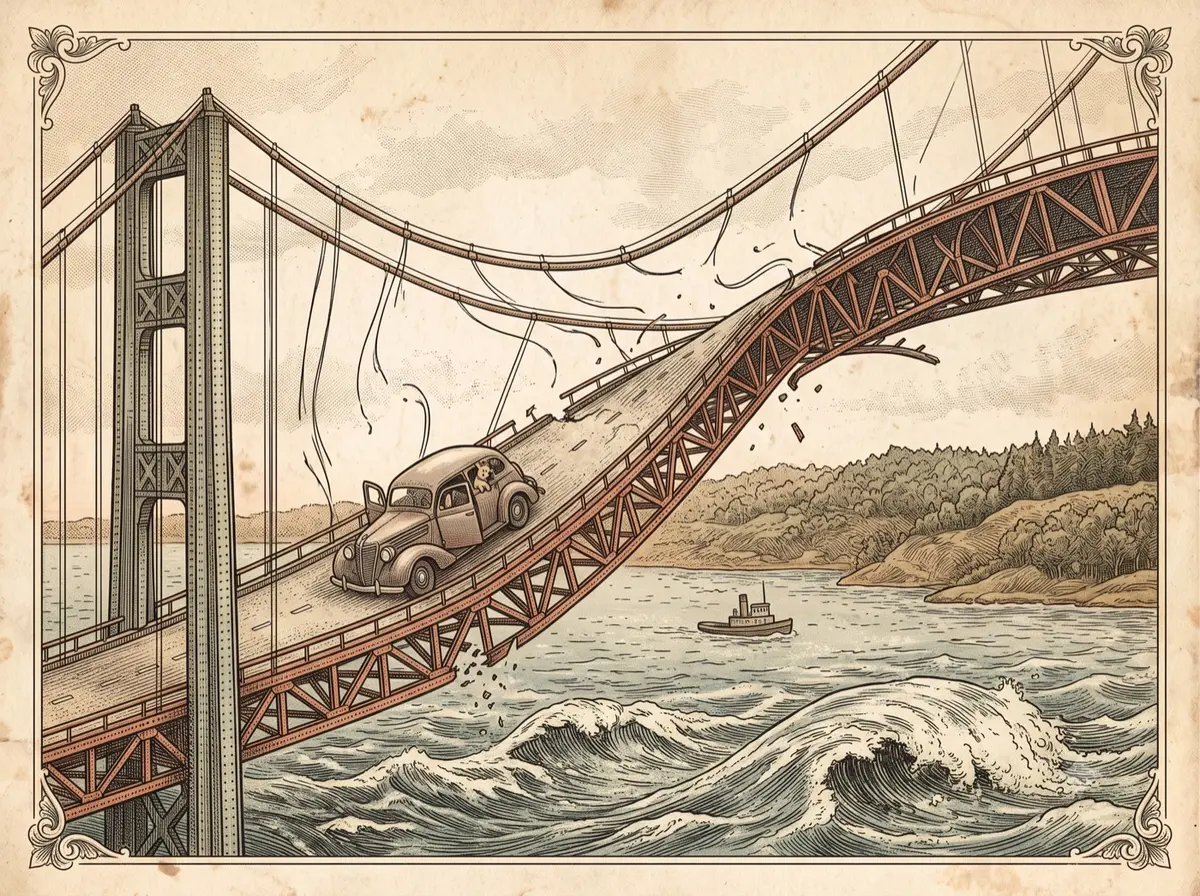
On the morning of November 7, 1940, Leonard Coatsworth was driving across the Tacoma Narrows Bridge when the roadway began to heave so violently that he abandoned his car mid-span and crawled to shore on his hands and knees, his daughter's cocker spaniel, Tubby, left whimpering on the back seat. Forty minutes later, the bridge — a $6.4 million marvel that had opened just four months earlier — twisted itself apart and dropped into Puget Sound, all of it captured on film by two camera-shop owners who happened to be nearby.
By the Curiosities Desk · · 6 min read · Filed under Engineering · Today’s round
Part of When the Experiment Left the Lab
What happened: Galloping Gertie
The Tacoma Narrows Bridge was supposed to be a triumph. At 2,800 feet, its main span was the third-longest suspension bridge in the world, trailing only the Golden Gate and George Washington bridges. It opened to traffic on July 1, 1940, connecting Tacoma, Washington, to the Kitsap Peninsula across the strait known as the Narrows.
The design had a contested history. Washington’s state highway engineer, Clark Eldridge, had proposed a conventional bridge stiffened by 25-foot-deep trusses beneath the roadway. New York bridge engineer Leon Moisseiff — a respected consultant who had worked on the Golden Gate Bridge — argued for something sleeker and cheaper: a deck stiffened by solid plate girders only 8 feet deep, just 39 feet wide, running the length of a roadway more than half a mile long. Moisseiff’s “deflection theory” held that a suspension bridge’s cables could absorb wind loads on their own, without a deep truss. Federal funders liked the lower price tag, and his design won out.
The problem showed up before the bridge even opened. During construction, workers noticed the deck rippling in the wind — rising and falling several feet in long, rolling waves — and nicknamed it “Galloping Gertie.” Engineers tried several fixes: tie-down cables anchored to 50-ton concrete blocks (they snapped), diagonal cable stays (little effect), and hydraulic buffers between the towers and the deck (disabled, it turned out, when sandblasting damaged their seals before painting). None of it stopped the motion. Commuters came to treat the sway as a novelty, some driving across just to feel the road rise and fall like a slow-motion wave.
The Washington State Toll Bridge Authority eventually brought in Frederick Farquharson, a University of Washington engineering professor, to study the problem in a wind tunnel using scale models of the bridge. His team finished its analysis on November 2, 1940, recommending modifications to let air flow through the deck more cleanly. Five days later, before any fix could be built, a sustained 38–42 mph wind — nothing close to a hurricane — set off a new kind of motion nobody had seen before: instead of rippling up and down, the deck began twisting, one side rising as the other fell.
At around 9:45 a.m. that day, two vehicles were caught on the swaying bridge. A delivery truck tipped over; its occupants fled on foot. Coatsworth’s car began sliding side to side, and he escaped on foot as well, unable to retrieve Tubby. Farquharson himself climbed onto the heaving bridge in an attempt to rescue the dog and was bitten for his trouble. Around 11:00 a.m., the twisting grew so extreme that suspender cables began snapping one by one, dumping the load onto their neighbors until nearly the entire center span tore loose and fell into the water. Tubby was the only fatality. No humans died, though several were injured escaping the collapsing structure.
Why it was strange: Galloping Gertie
This was not an old, neglected bridge failing after decades of wear. It was one of the most modern suspension bridges on Earth, engineered by a man who had helped build the Golden Gate, and it came apart in wind conditions its designers considered routine. It had also been visibly, famously misbehaving for months — swaying enough to earn a nickname and attract sightseers — yet the very people responsible for it assumed its mass alone would keep it structurally sound. One critic, engineer David Steinman, had reportedly predicted the bridge’s failure at a 1938 engineering conference, with Moisseiff himself in the audience. Confidence in a slender, elegant design overrode the plain evidence rippling across the roadway every windy day.
The same thread — Bridges — continues in The Wobbly Bridge That Closed Two Days After Opening — Because People Walked on It.
What scientists learned: Galloping Gertie
The board that investigated the collapse — engineers Othmar Ammann, Theodore von Kármán, and Glenn Woodruff — concluded the cause was aerodynamic instability, not any flaw in the steel or concrete itself. The specific mechanism is called aeroelastic flutter: a feedback loop in which wind striking a flexible structure changes the airflow around it, and that altered airflow pushes back harder, amplifying the structure’s motion instead of damping it out. In the Tacoma Narrows Bridge, the solid, shallow plate girders blocked wind from passing through the deck the way an open truss would have, forcing air to pile up above and below the roadway and twist it — a torsional oscillation that fed on itself until the suspender cables gave way.
For decades afterward, physics textbooks described the collapse as a simple case of mechanical resonance, comparing it to an opera singer shattering a wine glass by matching its natural frequency. In a widely cited 1991 paper, engineers K. Yusuf Billah and Robert Scanlan showed this explanation was wrong: measurements taken at the time showed the destructive twisting frequency did not match the bridge’s natural resonant frequency or the frequency of ordinary wind vortices. Flutter is a distinct, self-reinforcing phenomenon, not classic resonance — a distinction that mattered enough that physics curricula have since been revised to describe it more accurately.
Another good intention with a bad landing: The Day a 25-Foot Wave of Molasses Flooded a Boston Neighborhood.
How it reaches us today: Galloping Gertie
The collapse reshaped how bridges, and eventually buildings and aircraft, get built. Wind tunnel testing of scale models — the very method Farquharson used just days too late — became standard practice for any long-span bridge, and remains a requirement for federally funded bridge projects in the United States. The replacement bridge, opened in 1950 on the original towers, was built with deep, open steel trusses that let wind pass through rather than push against a solid wall. A second, parallel span was added in 2007, and both still stand today. Aeroelasticity — the study of how flexible structures interact with moving air — grew into its own engineering discipline, now applied to skyscrapers, wind turbine blades, and airplane wings, all of which must be designed to resist the same kind of self-feeding vibration that tore Galloping Gertie apart.
Another time it went sideways: The Drilling Rig That Pulled the Plug on a Lake — and Then Got Sucked Down the Drain.
Fun fact: Galloping Gertie
The dramatic black-and-white footage of the collapse, filmed by camera-shop owners Barney Elliott and Harbine Monroe, is famous enough to have been added to the National Film Registry in 1998 — but most copies shown today play about 50 percent faster than what actually happened. The footage was shot at 16 frames per second, and later transfers assumed the standard 24 fps, subtly speeding up one of engineering’s most-replayed cautionary tales.
Sources: Galloping Gertie
- Billah, K. Yusuf, and Robert H. Scanlan. “Resonance, Tacoma Narrows Bridge Failure, and Undergraduate Physics Textbooks.” American Journal of Physics 59, no. 2 (1991): 118–124.
- Washington State Department of Transportation, “Tacoma Narrows Bridge History: Lessons from Failure”
- Wikipedia, “Tacoma Narrows Bridge (1940)”
- American Physical Society, “November 7, 1940: Collapse of the Tacoma Narrows Bridge”
- American Society of Civil Engineers, “Professor Farquharson’s Dog”
Related stories: Galloping Gertie
- The Windows That Took the Blame for a Plane Crash They Didn’t Cause — Square windows took the blame for crashes they did not cause
- The Day a 25-Foot Wave of Molasses Flooded a Boston Neighborhood — A storage tank burst and sent a molasses wave through Boston
- The Time Oregon Blew Up a Whale With Half a Ton of Dynamite — Oregon dynamited a dead whale and it rained blubber