Science Gone Wrong · Engineering
The Skyscraper That Melted a Jaguar — and Fried an Egg on the Pavement
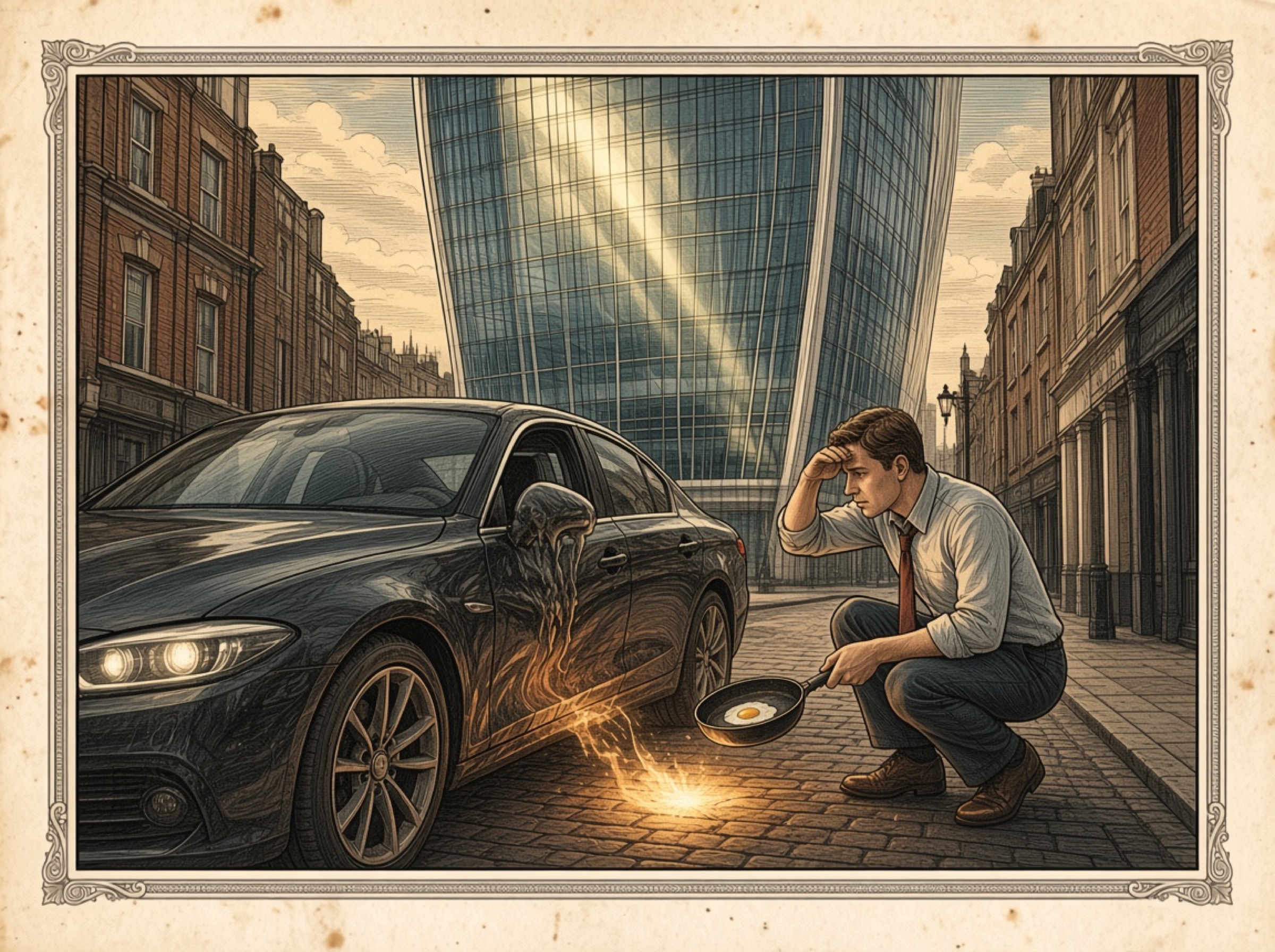
In late August 2013, businessman Martin Lindsay parked his Jaguar XJ on Eastcheap, a street in the City of London, and came back to find the car had partly melted. The wing mirror had sagged. The Jaguar badge had warped. Panels along one side were twisted out of shape. Nobody had touched it. The culprit was standing right across the street: a half-finished, 37-storey glass skyscraper that had quietly learned to focus sunlight like a giant magnifying glass.
By the Curiosities Desk · · 5 min read · Filed under Engineering · Today’s round
What happened?
The building was 20 Fenchurch Street, designed by the Uruguayan-born architect Rafael Viñoly. Londoners had nicknamed it the “Walkie-Talkie” because its top-heavy shape, wider at the top than at the bottom, looks a bit like a chunky old handset. Its south face doesn’t run straight up and down. It curves inward, like the inside of a bowl, and it is covered in highly reflective glass.
Through the summer of 2013, workers were still adding glass panels to that curved face. As more panels went up, the curve became a better and better mirror. By the end of August, on clear days, it was gathering sunlight from across its wide face and dropping it in a concentrated hot patch onto the street below. The hotspot lasted for up to about two hours a day and crept along the pavement as the sun moved.
On 2 September 2013, the City A.M. newspaper ran the story of Lindsay’s car under the headline “Walkie Scorchie melted my Jag.” Lindsay said the damage had happened in about an hour. Other drivers came forward with similar complaints, and a barbershop on the street said the beam had set its carpet alight. Within days the building had picked up new nicknames: the “Walkie-Scorchie” and the “Fryscraper.”
Then the press did what the press does. City A.M. staff set a frying pan down on the pavement in the glare and fried an egg. Jim Waterson, the reporter who broke the story, said he ate it for lunch. “It is hotter than anywhere I’ve ever been,” he told NBC News, adding that standing in the beam for just ten minutes was “deeply unpleasant.” Spot temperature readings reported at the time ranged from about 70°C (158°F) up to 91°C (196°F), with one reading of 117°C (243°F). These were improvised measurements by reporters and passers-by, not lab data, so treat the exact numbers loosely. The heat itself was not in doubt.
The developers, Land Securities and Canary Wharf Group, paid £946 to repair Lindsay’s Jaguar. The City of London suspended three parking bays, and a large black netted screen was hung over part of the facade as a stopgap.
On 6 September, Viñoly spoke to the Guardian’s architecture critic Oliver Wainwright. He said his team had spotted the reflection risk during design and estimated the hotspot would reach about 36°C. “But it’s turned out to be more like 72 degrees,” he said. He explained that horizontal sun louvres (slatted shades) in the original design had been removed to cut costs, and he was candid: “We made a lot of mistakes with this building, and we will take care of it.” He also floated a more surprising theory. “When I first came to London years ago, it wasn’t like this,” he said. “Now you have all these sunny days.”
Why was it strange?
Skyscrapers aren’t supposed to cook things. A flat glass tower bounces glare away in a spread-out wash. A curved one can do something very different, and the principle is centuries old. A concave mirror, one that curves inward like a spoon, bends incoming parallel rays of light toward a single region called the focus. It is the same idea behind solar cookers and satellite dishes, and behind the legend (never confirmed) that Archimedes set Roman ships on fire with mirrors.
And this wasn’t even the architect’s first encounter with the problem. In 2010, guests at the Vdara hotel in Las Vegas, another Viñoly building with a curved, south-facing glass face, complained that sunlight bouncing onto the pool deck had singed their hair and melted plastic bags. Staff there reportedly called it the “Vdara death ray.”
The same thread — London — continues in The Wobbly Bridge That Closed Two Days After Opening — Because People Walked on It.
What did scientists learn?
In 2018, Jiajie Zhu, Wolfram Jahn, and Guillermo Rein of Imperial College London published a study in the Journal of Building Performance Simulation that rebuilt the 2013 event inside a computer. They used ray tracing, a technique that follows the paths of individual light rays as they bounce off surfaces, along with the building’s geometry, the neighbouring buildings, the sun’s position, and London’s actual weather that summer.
Their simulation found that at its peak, the reflected beam delivered up to 15 times more solar radiation than a normal London street would receive. That is roughly twice what a person can tolerate for about 30 minutes before skin damage starts.
The more surprising finding was how lucky London had been. The beam was at its strongest when it was aimed at rooftops rather than the pavement, and cloud cover weakened it for much of the rest of the time. “By sheer luck, the beam didn’t cause anyone serious harm,” Rein said. In a worst case, the researchers concluded, the intensity could have hurt people’s skin and eyes or charred the contents of nearby flats.
Another good intention with a bad landing: The Flake of Chipped Paint That Made a $1.5 Billion Telescope Nearsighted.
How does it affect us today?
The fix arrived in 2014: a permanent sunshade of horizontal fins fitted across the south face of the upper floors, essentially the louvres that had been cut from the original plan. The hotspot vanished.
The lesson spread further than one building. Architects and planners now commonly run solar glare and reflection studies on curved or highly reflective designs before construction, using the same kind of ray-tracing simulation the Imperial team used to reconstruct the incident afterward. The Walkie-Scorchie became the go-to example in those conversations.
The building was completed in 2014 and, in 2015, won the Carbuncle Cup, a tongue-in-cheek prize for the UK’s worst new building. Its rooftop Sky Garden is now one of London’s most popular free viewpoints, and most of the visitors queuing to get in have no idea the building once cooked lunch.
Another time it went sideways: The Drilling Rig That Pulled the Plug on a Lake — and Then Got Sucked Down the Drain.
Fun fact
City A.M. published its skyscraper egg as a recipe, “Oeuf à la Walkie Scorchie.” The ingredients included one free-range egg, one white bap, one “ancient IKEA frying pan,” and one street lit by a beam from “a superstar architect’s skyscraper.” Cooking time was about five minutes, and the verdict was one of the best egg sandwiches the writer had made, “although a little too well done.”
Sources
- Zhu, J., Jahn, W., & Rein, G. (2018). “Computer simulation of sunlight concentration due to façade shape: application to the 2013 Death Ray at Fenchurch Street, London.” Journal of Building Performance Simulation.
- Imperial College London (2019). “Did British weather save the day from Walkie Talkie ‘death ray’?”
- Wainwright, O. (6 September 2013). “Walkie Talkie architect ‘didn’t realise it was going to be so hot’.” The Guardian (summarized by Dezeen).
- NBC News (3 September 2013). “‘It is hotter than anywhere I’ve ever been’: London skyscraper melts cars, fries eggs.”
- City A.M. “Eggsclusive: We use the Walkie Scorchie light beam to fry an egg.”