Science Gone Wrong · Engineering
The Drilling Rig That Pulled the Plug on a Lake — and Then Got Sucked Down the Drain
On the morning of November 20, 1980, three men were fishing on Lake Peigneur, a shallow Louisiana lake, when the water started moving the wrong way. "I seen this wave coming by," Leonce Viator Jr. told a reporter two days later, "and I told him, 'You'd better get out of here. The end of the world is coming.'" By the time they tried to leave, there was nowhere to go. The lake was draining out from under their boat, and they were sitting on mud.
By the Curiosities Desk · · 5 min read · Filed under Engineering · Today’s round
What happened?
Lake Peigneur sits in Iberia Parish, in south-central Louisiana, about nine miles west of New Iberia. Before November 20, 1980, it was an unremarkable freshwater lake — roughly ten feet deep, good for fishing, ringed by cypress and by Live Oak Gardens, a botanical garden and tourist attraction on neighboring Jefferson Island.
Jefferson Island is not really an island. It’s the top of a salt dome — a plug of rock salt, buoyant compared to the sediment around it, that has slowly shouldered its way upward over millions of years and pushed the ground into a low hill. Salt domes are useful twice over: you can mine the salt, and the tilted rock layers they shove aside make excellent traps for oil. So there were two industries operating at Lake Peigneur at once, one directly above the other. The Diamond Crystal Salt Company had been mining the dome since 1919, working tunnels roughly 100 by 80 feet across on levels reaching 1,500 feet down. And Texaco, holding a state lease covering the lakebed, had hired the Wilson Brothers Corporation to drill an exploratory oil well from a floating platform on the surface.
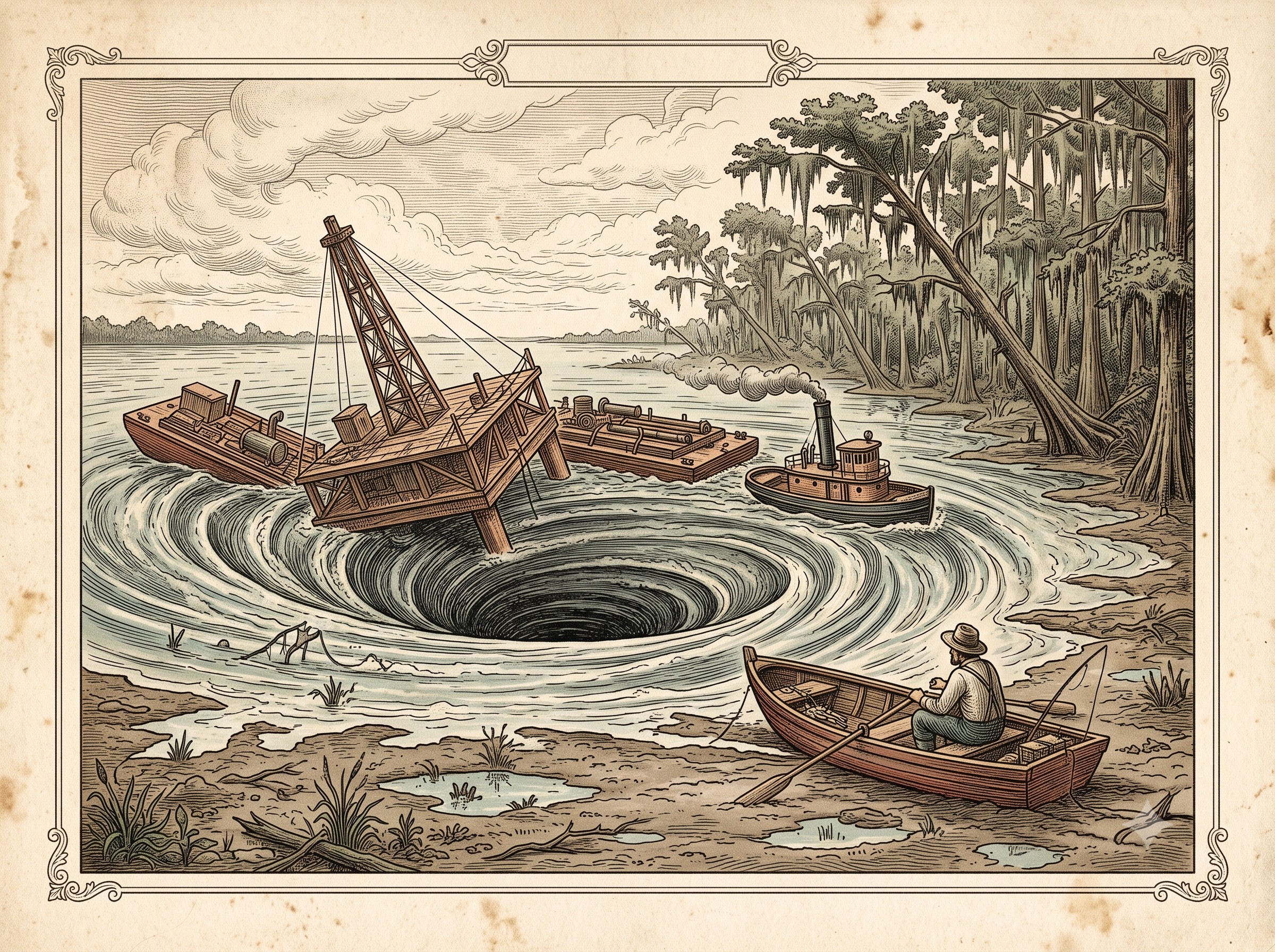
At around 4:30 that Thursday morning, the drilling crew’s 14-inch drill assembly stopped turning. It had jammed at about 1,228 feet. The men spent two and a half hours trying to work it free. Then they heard loud popping noises from below, and the platform — a structure anchored in ten feet of water — began to tilt. Seven men walked off it. Minutes later it was gone.
What they had done, almost certainly, was drill into the mine. Fresh lake water poured down the borehole into a tunnel that had been kept dry for sixty years, and because the tunnel walls were made of salt, the water widened the hole as fast as it fell through it. Within hours a whirlpool had opened in the middle of the lake. It took the drilling platform, eleven barges, a tugboat, a second rig, trees off the shoreline, and about 65 acres of surrounding land, including a large piece of Live Oak Gardens. Water drained toward Vermilion Bay through the Delcambre Canal; when the lake emptied, the canal simply reversed and ran backward, carrying Gulf saltwater inland to fill the hole. The temporary drop at the canal’s edge is usually cited at 164 feet, which made it, briefly, the tallest waterfall in Louisiana. Air shoved out of the flooding tunnels blew back up the mine shafts and, by several accounts, threw geysers hundreds of feet into the sky.
Underground, about fifty-five miners were at work, some of them 1,500 feet down. An electrician saw water coming and raised the alarm. Every one of them got out, up a single elevator, in an orderly evacuation that later earned six employees commendations for heroism from the company. Viator and his nephews made it to shore. Nobody was killed.
Days later, once the pressure underground had equalized, nine of the eleven swallowed barges popped back to the surface and floated calmly on the lake, like corks.
Why was it strange?
Industrial accidents usually destroy a thing. This one destroyed a landscape feature and then replaced it with a different one. Lake Peigneur did not recover; it was overwritten. The ten-foot freshwater lake is now a brackish lake with a maximum depth of 200 feet — the deepest in Louisiana — with a different chemistry, different fish, and a different shoreline.
The other strange part is how little force was involved. Nobody detonated anything. A 14-inch hole was made in the wrong place, and gravity did the rest. Ten feet of water over roughly 1,300 acres is an enormous volume, and a mined-out salt dome is an enormous empty space, and the only thing separating them was a few hundred feet of rock that a drill bit can pass through in an afternoon.
Another time it went sideways: The Time Oregon Blew Up a Whale With Half a Ton of Dynamite.
What did scientists learn?
The most useful finding was an uncomfortable one: nobody could prove what went wrong. The Mine Safety and Health Administration published a report on the Jefferson Island inundation in August 1981 and declined to assign a cause, noting that it was impossible to inspect flooded workings and that the available information was circumstantial. Either the rig was drilling in the wrong spot or the mine’s maps were wrong, and the evidence for deciding which had been washed into the mine. Texaco and Diamond Crystal engineers, working together afterward, could only estimate where the hole probably was — somewhere in a mined-out section of the 1,300-foot level.
The physical lesson was about salt itself. Rock salt is strong enough to hold up a ceiling for decades and dissolves readily in fresh water, which is a fine combination right up until the two facts meet. Once water entered, the salt pillars left standing to support the tunnels began going into solution, and the tunnels collapsed. The event also arrived at an awkward moment for federal policy: Louisiana’s senator immediately asked the Department of Energy what it implied for storing crude oil — and, at the time, nuclear waste — in salt domes.
Another good intention with a bad landing: Galloping Gertie: The Bridge That Taught Engineers to Fear the Wind.
How does it affect us today?
Lake Peigneur is now a standard case study in mine inundation and in the hazards of stacking incompatible operations on the same piece of ground. Modern practice leans hard on surveying and on formal barrier pillars: a legally defined thickness of untouched rock that must be left between any borehole and a known working, precisely because maps and coordinates can disagree.
The salt mine never reopened and closed for good in December 1986; the miners who lost their jobs were not part of the settlements, which in 1983 sent $32 million from Texaco and Wilson Brothers to Diamond Crystal and $12.8 million to Live Oak Gardens. The dome itself is still in industrial use — since the 1990s it has stored pressurized natural gas in hollowed-out caverns beneath the lake, an arrangement local residents have repeatedly asked hard questions about.
A close cousin: The Day a 25-Foot Wave of Molasses Flooded a Boston Neighborhood.
FAQ
What happened at Lake Peigneur?
On November 20, 1980, a Texaco drill crew on Lake Peigneur in Iberia Parish, Louisiana, bored into a salt mine under the lake. Fresh water poured down the hole, dissolved the salt, and the lake drained into the mine, taking the drilling platform, barges, and a stretch of shoreline with it. The Delcambre Canal reversed and refilled the hole with salt water from the Gulf. Nobody was killed.
Where is Lake Peigneur?
Lake Peigneur is in Iberia Parish, south-central Louisiana, about nine miles west of New Iberia. Before 1980 it was a freshwater lake about ten feet deep. After the drill pierced the Diamond Crystal salt mine, it became a much deeper saltwater lake.
Fun fact
For a few days in November 1980, the state of Louisiana — whose highest natural point rises all of 535 feet — had a 164-foot waterfall, running backward, into a lake that had just disappeared.
Sources
- Mine Safety and Health Administration, The Jefferson Island Mine Inundation (report, August 13, 1981) — full text via HathiTrust
- John Pope, “An ‘End of the World’ Scene: Earth Swallows Lake, Oil Rig,” The Washington Post, November 22, 1980
- Jacob Gautreaux, “Lake Peigneur Drilling Accident,” 64 Parishes, Louisiana Endowment for the Humanities
- “Settlement Reached in Jeff Island Accident,” United Press International, July 7, 1983
- John K. Warren, Evaporites: Sediments, Resources and Hydrocarbons (Springer, 2006), pp. 928–930