Science Gone Wrong · Engineering
The Day a 25-Foot Wave of Molasses Flooded a Boston Neighborhood
A little after 12:30 in the afternoon on January 15, 1919, the people working along Boston's waterfront heard a sound like a machine gun — the rivets of a fifty-foot steel tank firing out one after another — followed by a deep, ground-shaking roar. Then a molasses wave, dark and glistening and roughly two and a half stories tall, came sweeping down Commercial Street at about 35 miles an hour. It picked up a firehouse, shoved a loaded truck into the harbor, and buckled the steel supports of an elevated railway. Twenty-one people did not survive it.
By the Curiosities Desk · · 6 min read · Filed under Engineering · Today’s round
Part of When the Experiment Left the Lab
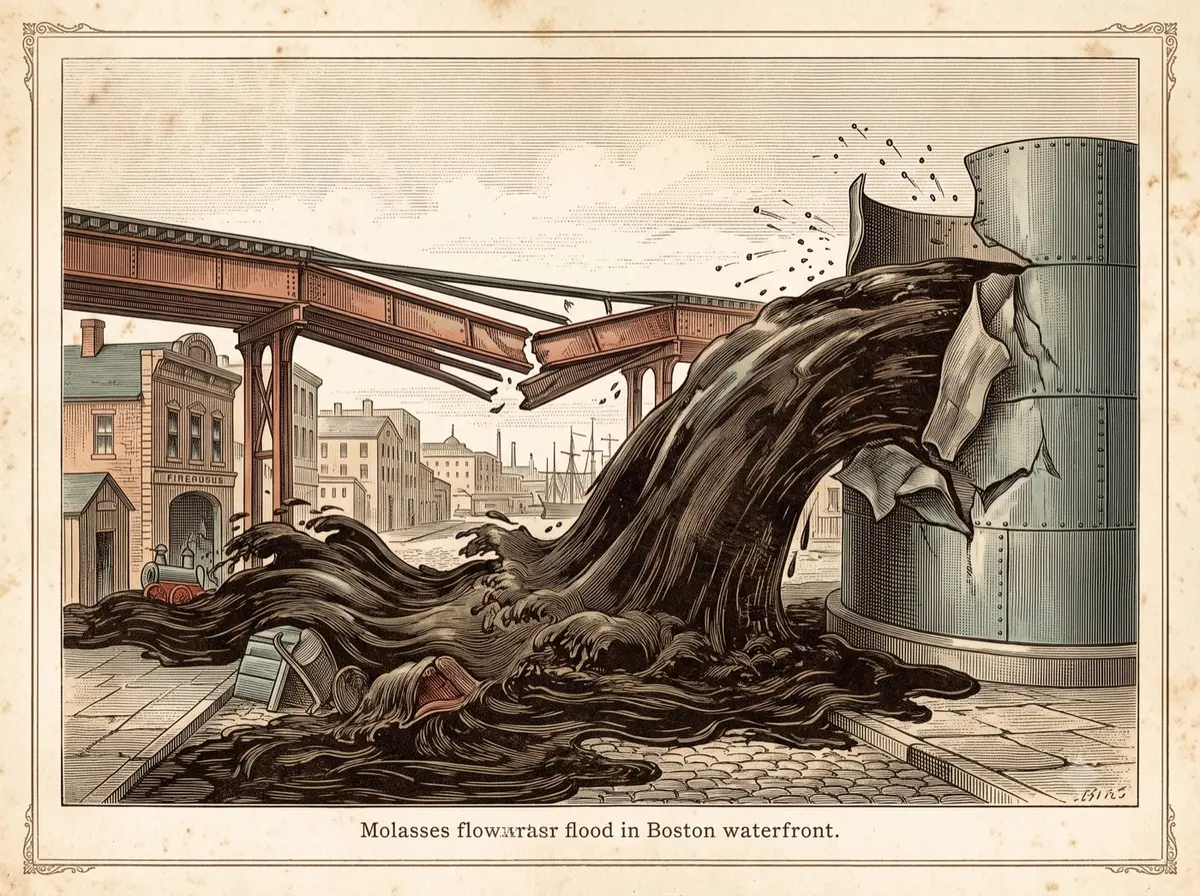
What happened: The Great Molasses Flood
In Boston’s crowded North End sat a giant storage tank belonging to the Purity Distilling Company, a subsidiary of the United States Industrial Alcohol Company (USIA). The tank stood 50 feet tall and 90 feet across, and on that January day it held as much as 2.3 million U.S. gallons of molasses — roughly 13,000 tons of it. Molasses wasn’t just for baking. Fermented, it yields ethanol, which went into liquor and, during the First World War, into munitions. The tank was a link in that chain, filled from ships in the harbor and drained by pipeline to a distillery in Cambridge.
Two days earlier, a fresh shipment of warm molasses had been pumped in on top of the colder, older molasses already there. Just after midday on the 15th, the tank tore itself apart. Witnesses described a thunderclap, a rumble like a passing elevated train, and the rivets popping loose like gunfire. The molasses burst free as a wave that reached about 25 feet at its peak and fanned out through the streets, flooding several blocks two to three feet deep.
Because molasses is about 40 percent denser than water — roughly 1.4 tons per cubic meter — the wave carried enormous force. It swept buildings off their foundations, crushed them, and tipped a streetcar off its tracks. People and horses were knocked down, dragged, and pinned. Ten-year-old Anthony di Stasio, walking home from school, was carried on the crest “almost as though he were surfing,” then rolled “like a pebble” as it settled — and survived. Others drowned or suffocated in the thickening syrup, or were killed by hurled debris. In all, 21 people died and about 150 were injured. Some victims were swept into the harbor and not recovered for months.
Rescue was agonizingly slow. Cadets from a nearby training ship, the USS Nantucket, waded in first, followed by police, the Red Cross, and Army and Navy personnel. But the molasses cooled as it spread through the winter air, growing more viscous by the minute, gluing rescuers and victims alike in place. Cleanup crews eventually blasted the streets with saltwater from a fireboat, and Boston Harbor ran brown into the summer.
Why it was strange: The Great Molasses Flood
Disasters usually announce themselves with fire, water, or wind. This one arrived as dessert. A flood of syrup sounds almost comic — until you do the physics. The strangeness of the molasses flood is that it violated everyone’s intuition about how a slow, sticky substance should behave. “Slow as molasses in January” was already a proverb. Yet this molasses moved faster than a car through a city street and hit with the force of a tsunami.
That contradiction — sluggish syrup behaving like a wrecking ball — is exactly what makes the event more than a grim curiosity. It sits at the intersection of two failures: a badly built tank, and a fluid that does not play by ordinary rules.
The same thread — Structural Failure — continues in Galloping Gertie: The Bridge That Taught Engineers to Fear the Wind.
What scientists learned: The Great Molasses Flood
Molasses is a non-Newtonian fluid, meaning its viscosity — its resistance to flowing — changes depending on the forces acting on it. Under sudden stress it can thin out and rush; left to sit, it thickens and clings. This “shear-thinning” behavior helps explain how the flood could be devastatingly fast at first and then, moments later, an inescapable trap.
In 2016, a team at Harvard led by fluid-dynamics researcher Nicole Sharp, with student Jordan Kennedy and physicist Shmuel Rubinstein, put the old eyewitness accounts to the test. They dug through 1919 newspapers, weather records, and maps, then flooded a scale model of the neighborhood with cold corn syrup to watch how it moved. Their conclusion: the reports of a 35-mile-per-hour wave were entirely credible. The warm molasses added two days before had lowered the fluid’s viscosity, letting it surge when the tank failed — but as it spread into the frigid January streets, it cooled fast and thickened dramatically. The physics of that cooling, the team argued, is precisely why so many victims could not be pulled free in time.
The engineering lessons were more damning. An inquiry found that USIA’s treasurer, Arthur Jell, had overseen the tank’s construction with no architectural or engineering training. He skipped basic safety checks — including filling the tank with water to test for leaks — and ignored the groaning noises it made each time it was loaded. The tank leaked so persistently that the company painted it brown to hide the seepage; neighborhood residents reportedly collected the drips. Later analysis found the steel walls were about half as thick as they should have been even by 1919 standards, and the steel lacked manganese, making it brittle. Cracks had formed at the rivet holes, and that is where the failure began.
Another good intention with a bad landing: The Skyscraper That Melted a Jaguar — and Fried an Egg on the Pavement.
How it reaches us today: The Great Molasses Flood
The 119-plaintiff class-action suit that followed became one of the first of its kind in Massachusetts and a landmark in corporate accountability. USIA tried to blame anarchist saboteurs, but after roughly three years of hearings a court-appointed auditor found the company responsible. It paid out around $628,000 in damages — well over $11 million in today’s money.
More lasting was the effect on the built world. The disaster helped push jurisdictions to require that major construction be signed off by licensed architects and engineers, with real inspection and testing rather than one man’s word — the origin of a norm we now take for granted every time a building permit is stamped by a certified professional.
Another time it went sideways: The Thirty Men Who Ran Back and Forth Across a Warship to See If It Would Tip Over.
Fun fact: The Great Molasses Flood
For decades afterward, North End residents swore that on hot summer days the neighborhood still smelled faintly of molasses. The tank was never rebuilt; its site is now Langone Park, home to a Little League field, a playground, and bocce courts. In 2019, on the flood’s 100th anniversary, ground-penetrating radar located the tank’s original concrete base about 20 inches beneath the baseball diamond, and mourners gathered in a circle marking its rim to read the names of the 21 dead.
Sources: The Great Molasses Flood
- Great Molasses Flood — Wikipedia (cross-referenced against its underlying citations)
- Ferris Jabr, “The Science of the Great Molasses Flood,” Scientific American (2013)
- Erin McCann, “Solving a Mystery Behind the Deadly ‘Tsunami of Molasses’ of 1919,” The New York Times (2016)
- Sharp, Kennedy & Rubinstein, “In a sea of sticky molasses: The physics of the Boston Molasses Flood,” Bulletin of the American Physical Society (2016)
- Stephen Puleo, Dark Tide: The Great Boston Molasses Flood of 1919 (Beacon Press, 2004)
This story involves loss of life. If it brings up difficult feelings, it’s okay to step away — the history keeps.
Related stories: The Great Molasses Flood
- The Time Oregon Blew Up a Whale With Half a Ton of Dynamite — Oregon dynamited a dead whale and it rained blubber
- Lake Peigneur — A drill crew pulled the plug on a Louisiana lake in 1980
- Galloping Gertie: The Bridge That Taught Engineers to Fear the Wind — A bridge that twisted itself apart in a moderate wind
- The Weedkiller That Made New Zealand’s Trousers Explode — A weedkiller that turned New Zealand’s farm trousers into fire hazards