Science Gone Wrong · Engineering
The Wobbly Bridge That Closed Two Days After Opening — Because People Walked on It
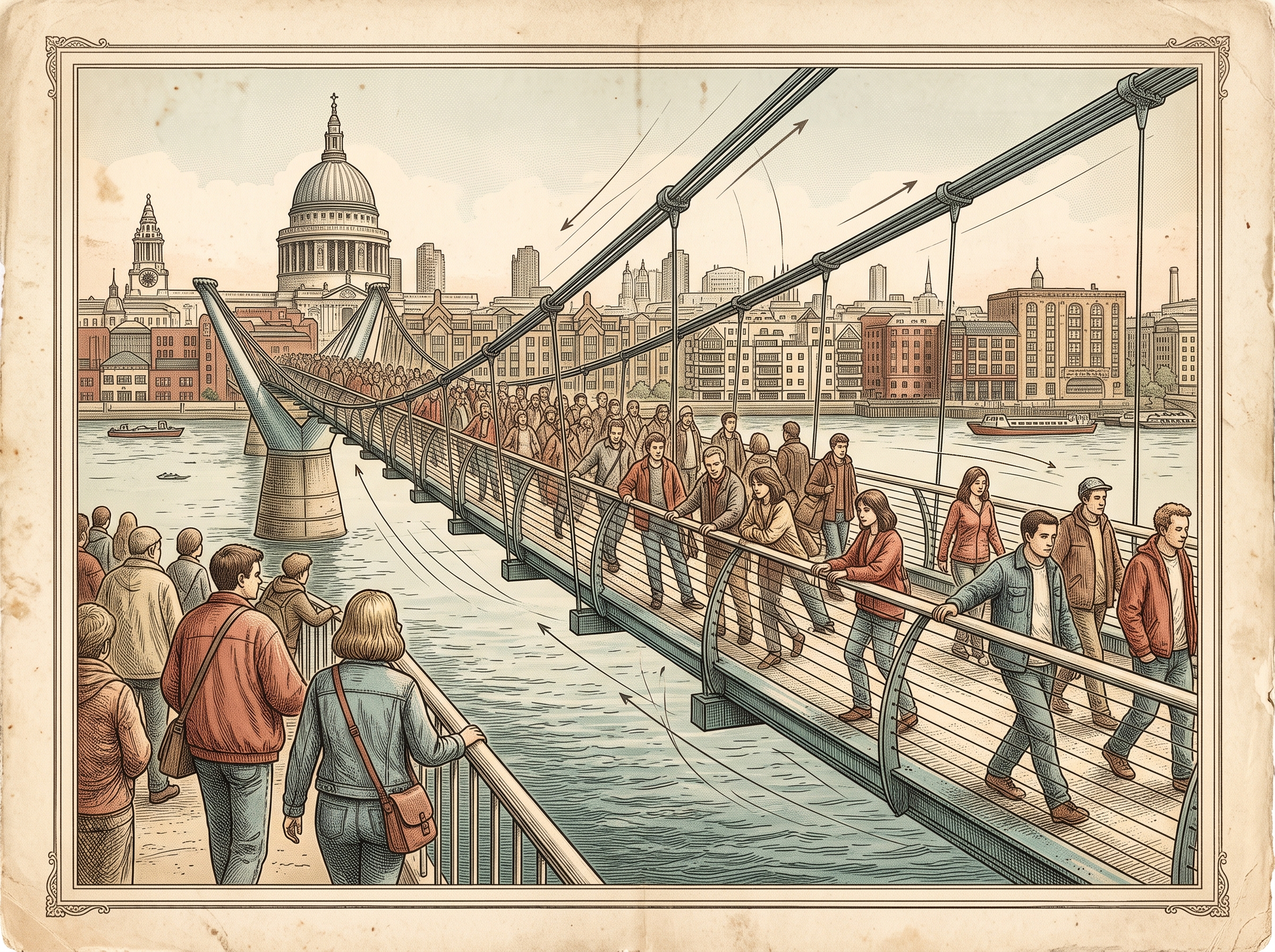
On June 10, 2000, London opened its sleek new Millennium Bridge, the first new bridge across the Thames since Tower Bridge in 1894, and tens of thousands of people strolled out onto it. Within hours, the deck was swaying from side to side under their feet. Walkers lurched along like passengers on a rolling ship, and many grabbed the railings just to stay upright. By Monday evening the bridge was shut, and the cause turned out to be nothing more exotic than people walking.
By the Curiosities Desk · · 5 min read · Filed under Engineering · Today’s round
What happened?
A bridge on this spot had been proposed since the 1850s, but the version that got built began with a 1996 design competition launched by the Millennium Bridge Trust and promoted by the Financial Times, the Royal Institute of British Architects, and the London Borough of Southwark. More than 200 teams entered. The winners were the engineering firm Arup, the architects Foster and Partners, and the sculptor Sir Anthony Caro, who together proposed something unusually delicate. Foster’s first sketch was for “a blade of light”: a thin, tower-less span linking St Paul’s Cathedral on the north bank to the Tate Modern gallery on the south.
To keep the bridge low and slim, the designers made it a very shallow suspension bridge. Its cables sag just 2.3 meters (about 7.5 feet) across a 144-meter (472-foot) central span, which is far flatter than a classic suspension bridge like the Golden Gate. Pulled that tight, the cables themselves provide most of the bridge’s stiffness. The whole thing runs 333 meters (about 1,090 feet) in three spans.
Opening day drew an enormous crowd. According to Arup’s engineers, up to 100,000 people crossed on June 10, with as many as 2,000 on the bridge at once. When the crowd got thick, the deck began to sway sideways. The movement came and went: it built up when lots of people were walking and died away when the crowd thinned out or stopped moving. At its worst, people found it hard to walk normally and held on to the balustrades, the low walls along the edges.
The vertical bounce was fine; the bridge behaved exactly as predicted for up-and-down motion. It was the side-to-side sway nobody had expected. Opening day was a Saturday. On Sunday, access was restricted. On Monday, June 12, the bridge was closed indefinitely so engineers could figure out what was going on. Londoners had already given it a nickname that would stick for decades: the Wobbly Bridge.
Why was it strange?
Bridges are designed to carry crowds. A packed footbridge is about as ordinary a load as engineering gets. The surprise was that the crowd wasn’t just weighing the bridge down. It was pushing it.
When you walk, your body sways slightly left and right with each step, and your feet push sideways on the ground. On a normal bridge, thousands of people’s sideways pushes happen at random moments and cancel each other out. But on the Millennium Bridge, a small chance sway turned into a feedback loop. Once the deck started moving, people unconsciously adjusted their steps to keep their balance, widening their stance and timing their footfalls to the motion under them. That timing made their sideways pushes line up with the bridge’s sway, which made the sway bigger, which made even more people fall into step.
Nobody was trying to shake anything. Each person was simply trying not to fall over, and together they rocked a steel bridge.
The same thread — Bridges — continues in Galloping Gertie: The Bridge That Taught Engineers to Fear the Wind.
What did scientists learn?
Arup ran a research program through the summer of 2000. It included lab tests in which people walked on moving platforms, and crowd tests on the closed bridge itself, beginning with 100 volunteers in July 2000.
They found that the sideways force from each walker rose in step with how fast the bridge was moving sideways. In effect, the pedestrians were acting as “negative dampers.” A damper normally soaks up vibration. These walkers were adding energy instead. Below a certain number of people, the bridge’s own damping won and nothing much happened. Above that critical number, the crowd’s push beat the bridge’s damping and the sway grew quickly. Later tests and calculations put that threshold at roughly 160 people.
The engineers also found the effect wasn’t caused by anything novel in the Millennium Bridge’s design. It could happen on any bridge whose natural side-to-side frequency was below about 1.3 cycles per second, which is roughly the pace of human walking, so long as enough people were on it. They even found an earlier case: Auckland’s Harbour Bridge, a conventional road bridge, was filmed swaying under a crowd of demonstrators in 1975.
In 2005, mathematician Steven Strogatz and colleagues published a model in Nature treating the crowd like other systems that fall into sync, such as fireflies flashing together. In their model, the wobble and the synchronized walking switch on together once the crowd passes a critical size. The details are still being debated. A 2017 study in Science Advances by Igor Belykh and colleagues suggested the wobble may start slightly before walkers lock into step, with synchrony acting as an amplifier rather than the initial trigger.
Another time it went sideways: The Skyscraper That Melted a Jaguar — and Fried an Egg on the Pavement.
How does it affect us today?
The fix was not to make the bridge stiffer, which would have required a huge amount of extra structure. Instead, engineers added damping. They fitted 37 fluid-viscous dampers, which work like a car’s shock absorbers, most of them mounted on V-shaped steel braces beneath the deck, along with dozens of tuned mass dampers (weights on springs that vibrate against the bridge’s motion to cancel it). The work cost about £5 million, raised largely by the Millennium Bridge Trust, and the bridge reopened on February 22, 2002. The first member of the public across was 91-year-old Emma Drake, who had been forced to turn back on her first attempt in 2000. It hasn’t wobbled since, not even in 2007, when 600 people bounced on space hoppers on the bridge for 60 seconds to set a world record.
The bigger legacy is in how bridges are designed. “Synchronous lateral excitation,” the engineering name for what happened, went from an obscure footnote to a standard check. Footbridge designers around the world now calculate whether a crowd could tip their structure into a sideways sway, and add damping before opening day rather than after.
Another good intention with a bad landing: The Thirty Men Who Ran Back and Forth Across a Warship to See If It Would Tip Over.
Fun fact
London had been warned about walking in step long before 2000. The Albert Bridge in Chelsea, which earned the nickname “the Trembling Lady” for vibrating under crowds, still carries signs ordering troops from the nearby barracks to “break step” when crossing. The rule dates to 1831, when soldiers marching in step over the Broughton Suspension Bridge near Manchester brought it down. Remarkably, no one was killed.
Sources
- Fitzpatrick, Tony, and Roger Ridsdill Smith (Arup). “Stabilising the London Millennium Bridge.” Ingenia, Royal Academy of Engineering, Issue 9 (August 2001).
- Strogatz, S. H., D. M. Abrams, A. McRobie, B. Eckhardt, and E. Ott. “Crowd synchrony on the Millennium Bridge.” Nature 438 (2005): 43–44.
- Belykh, I., R. Jeter, and V. Belykh. “Foot force models of crowd dynamics on a wobbly bridge.” Science Advances 3, no. 11 (2017): e1701512.
- City Bridge Foundation, “It’s 25-up for London’s iconic Millennium Bridge” (2025).
- Institution of Civil Engineers, “Albert Bridge.”