Strange Animals Scientists Studied · Space
The Teenager Who Sent Two Spiders to Spin Webs in Space
Two hundred and seventy miles above Earth, astronaut Owen Garriott opened a small plastic box and released a spider into zero gravity. She drifted, legs curled, unable to tell up from down — and then she started, haltingly, to spin.
By the Curiosities Desk · · 5 min read · Filed under Space · Today’s round
Part of Creatures That Changed Science
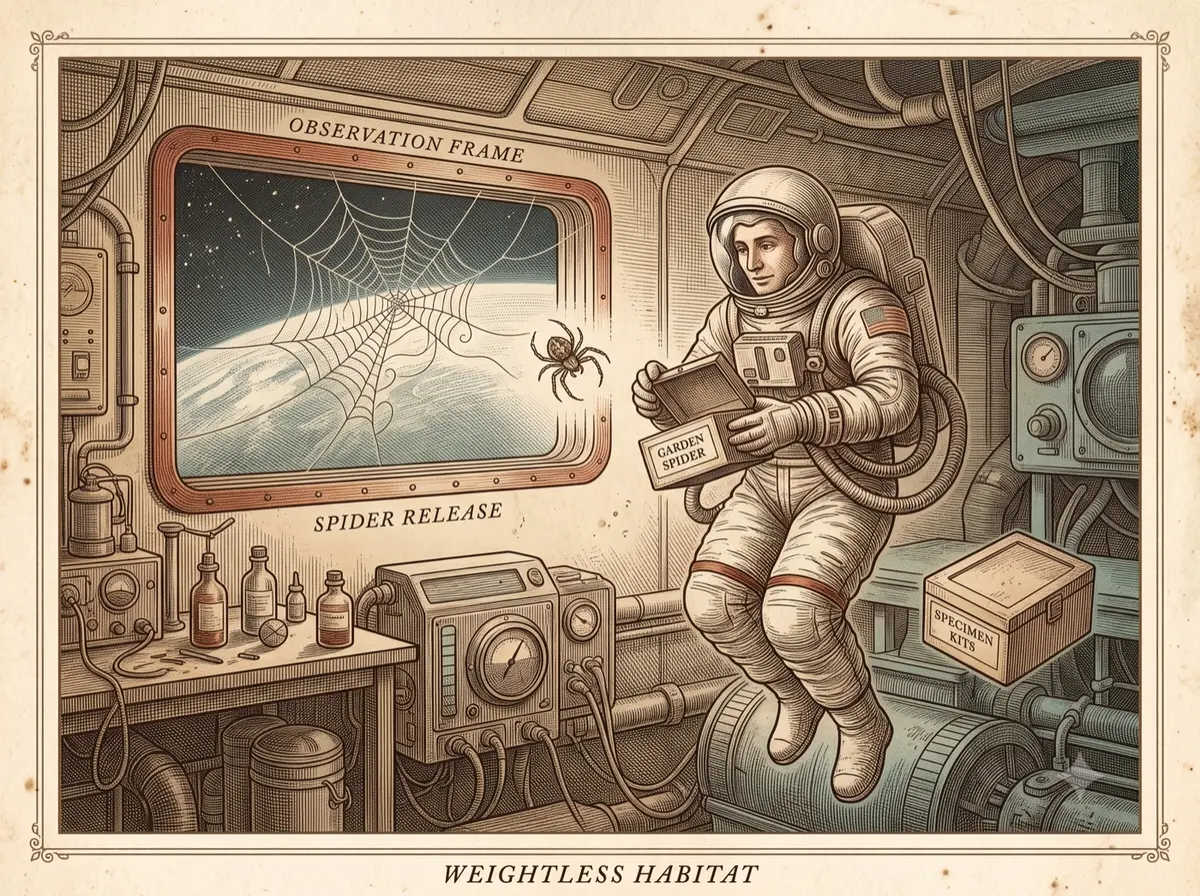
What happened: The Teenager Who Sent Two Spiders to Spin Webs in Space
The spider’s name was Arabella, and she owed her trip to space to a National Geographic article and a Massachusetts teenager’s curiosity. In 1972, Judith Miles, a high school student from Lexington, Massachusetts, read about how orb-weaving spiders build their webs and wondered what would happen if a spider couldn’t feel gravity at all. Spiders use their own weight, along with wind, to judge how thick to spin their silk and how to orient a web. Take gravity away, Miles reasoned, and the spider’s whole construction process might fall apart — or reveal something new about how it works.
Miles submitted her idea, “Web Formation in Zero Gravity,” to a nationwide competition NASA ran to find student experiments for Skylab, the United States’ first space station. Hers was one of a few dozen selected to fly aboard Skylab 3, the station’s second crewed mission, which launched on July 28, 1973, and kept astronauts Alan Bean, Owen Garriott, and Jack Lousma in orbit for 59 days.
Two female European garden spiders — commonly called cross spiders — went up with the crew. Miles and NASA researchers named them Arabella and Anita. Garriott released Arabella first, into a specially built frame that resembled a window, with a camera mounted to record her behavior. At first, weightlessness seemed to overwhelm her. She could not orient herself and produced only a tangled, incomplete scrap of silk. But after about a day, something shifted: she began spinning a genuine web. By the next day, she had completed it.
The web looked strange compared to her work on Earth — asymmetric, with threads spun much finer than usual and, oddly, uneven in thickness along their length. Researchers on the ground, watching the film, removed that first web on August 13 so Arabella could try again. She initially refused to spin a second one. When the crew gave her more water, she resumed and produced an even more elaborate web than her first. Anita, introduced to the experiment partway through the mission, went through a similar process of adjustment. Both spiders survived for weeks aboard Skylab, cared for by the crew between their other duties, but both eventually died during the mission — most likely from dehydration, according to later accounts of the experiment, since keeping a spider properly watered in microgravity turned out to be its own unsolved problem.
Why it was strange: The Teenager Who Sent Two Spiders to Spin Webs in Space
Nobody was sure a spider could spin a web at all without gravity to help it. Web-building looks purely mechanical from the outside, but it’s a deeply physical act: a spider uses its own body weight as a plumb line, letting gravity help pull strands taut and guide the asymmetric shape of a typical orb web, which is usually built with the hub off-center and lower than the geometric middle. Take that reference point away entirely, and by most expectations, the spider should have been lost. Instead, after a rough start, Arabella adapted and built something recognizably web-shaped — just different. That a creature with a nervous system smaller than a pinhead could recalibrate its most basic instinctive behavior, in real time, in an environment nothing in its evolutionary history had prepared it for, was the genuinely surprising part.
It shares a shelf with The Naked Mole-Rat: The Cold-Blooded Mammal That Lives Like an Ant and Won’t Age on Schedule, in Creatures That Changed Science.
What scientists learned: The Teenager Who Sent Two Spiders to Spin Webs in Space
The experiment worked because a spider’s web is, in effect, a printout of its nervous system. Researchers already knew — from earlier ground-based work by the German pharmacologist Peter Witt in the 1940s and '50s — that drugs like caffeine or sedatives visibly distort the geometry of a spider’s web, making it a sensitive, low-cost way to study effects on motor control. NASA’s Skylab experiment applied that same logic to weightlessness itself, treating web geometry as a readout of how the spider’s motor responses held up without gravity as a cue.
The immediate finding was that spiders could still build serviceable webs in microgravity, but the silk was thinner and less uniform than on Earth, suggesting the spider’s usual method for judging thread tension had been disrupted, even if the overall behavior persisted. It would take decades to get the full explanation. In a 2020 study published in The Science of Nature, researchers who sent two more spiders to the International Space Station found that the animals could build normal, asymmetric webs in zero gravity after all — but only when a directional light source was present. Without gravity, it turned out, light could serve as a substitute orientation cue. Arabella and Anita’s uneven, asymmetric webs likely reflected the fact that their box was lit evenly from all sides.
Also in Creatures That Changed Science: The Baby-Blue Blood of the Horseshoe Crab That Keeps Every Vaccine Safe.
How it reaches us today: The Teenager Who Sent Two Spiders to Spin Webs in Space
Nearly fifty years after Arabella spun her first strand in orbit, scientists are still using spiders to answer the same underlying question: how do animals build internal maps of “up” and “down” when the physical cue for gravity disappears? The 2020 ISS follow-up experiment showed that spiders don’t have one fixed way of orienting themselves — they can flexibly substitute one sensory cue for another, a finding relevant to how scientists think about balance and orientation systems generally, including in humans adapting to long-duration spaceflight. Student-designed biology experiments also became a lasting fixture of NASA’s programming; the format Miles helped pioneer, in which young researchers propose questions that professional astronauts carry out in orbit, continues through NASA’s current education programs.
Another from Creatures That Changed Science: The Astronomer With a Metal Nose and a Beer-Drinking Elk.
Fun fact: The Teenager Who Sent Two Spiders to Spin Webs in Space
Arabella’s remains were returned to Earth at the end of the Skylab 3 mission and are now preserved in the Smithsonian’s National Air and Space Museum collection — making her one of the very few spiders in history with an accession number in a national museum.
Sources: The Teenager Who Sent Two Spiders to Spin Webs in Space
- Judith’s Web – Student Experiment Aboard Skylab 3, NASA
- Skylab 3, Wikipedia (cross-referenced with cited primary sources)
- Spider, “Arabella,” Skylab 3, Smithsonian National Air and Space Museum
- Spiders in space—orb-web-related behaviour in zero gravity, Zschokke, Countryman & Cushing, The Science of Nature (2020)
- Arabella and Anita: Two Spiders Sent to Space in NASA’s Web-Spinning Skylab 3 Experiment, IFLScience
Related stories: The Teenager Who Sent Two Spiders to Spin Webs in Space
- Part of Creatures That Changed Science
- Laika: The Moscow Stray Who Orbited Earth, and the Truth Hidden for 45 Years — A Moscow stray orbited Earth, and the truth took 45 years
- The Two Tortoises That Flew Around the Moon Before Any Human Did — Two tortoises rounded the Moon before any human did
- The Water Bears That Survived Naked in Open Space — Tardigrades survived unprotected exposure to open space