Accidental Discoveries · Space
The Pigeon Mess That Turned Out to Be the Echo of the Big Bang
Two physicists climbed inside a giant metal horn pointed at the sky, scraped out the pigeon droppings, swept the inside clean, and waited for the irritating hiss in their antenna to disappear. It didn't. The faint static they were trying to get rid of turned out to be the oldest light in the universe — the leftover glow of the Big Bang itself.
By the Curiosities Desk · · 6 min read · Filed under Space · Today’s round
What happened: The Pigeon Mess That Turned Out to Be the Echo of the Big Bang
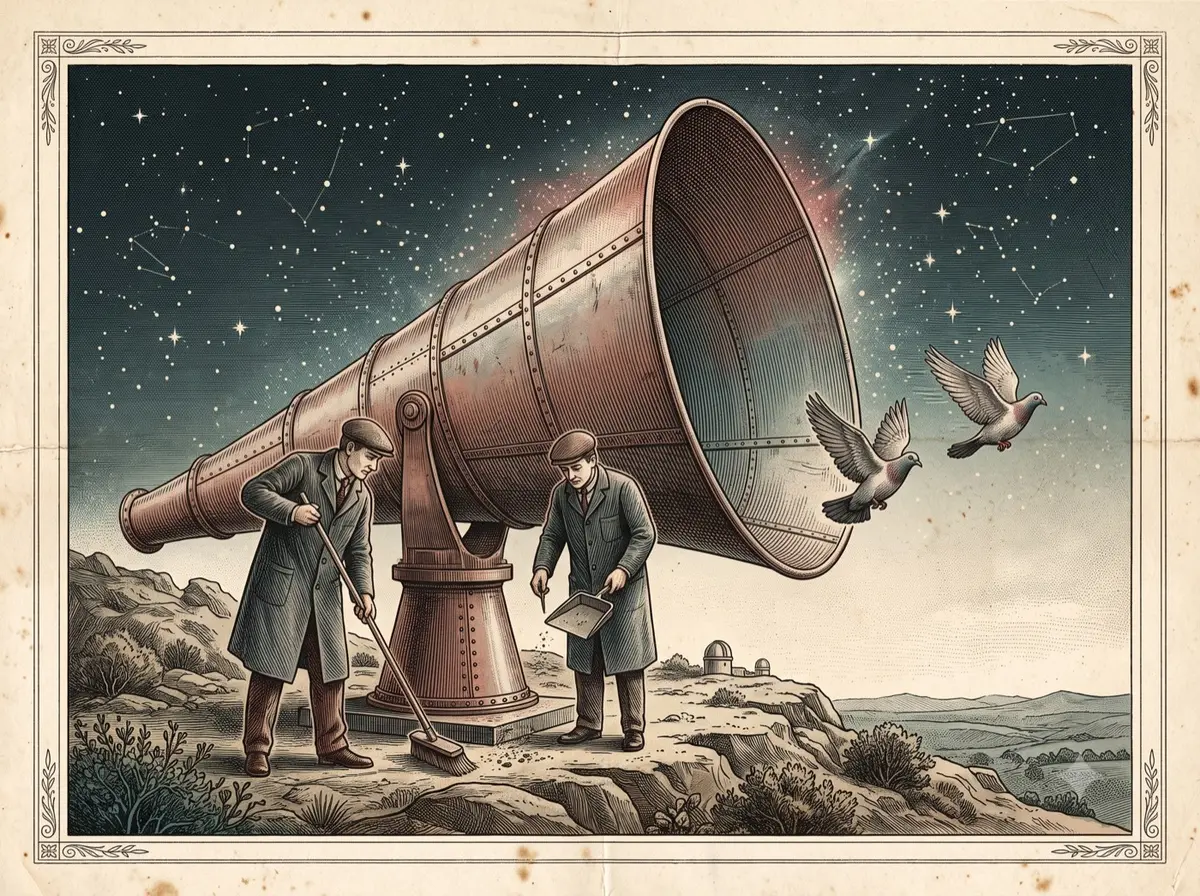
In 1964, Arno Penzias and Robert Woodrow Wilson were working at Bell Telephone Laboratories on Crawford Hill in Holmdel, New Jersey. Their instrument was the Holmdel Horn Antenna, a 50-foot, 18-ton aluminum trumpet built in 1959 to catch radio signals bounced off NASA’s early Project Echo communication satellites. By the time Penzias and Wilson got their hands on it, they wanted to repurpose the exquisitely sensitive horn for radio astronomy.
There was a problem. No matter where they pointed the antenna, a faint background hiss refused to go away. It showed up day and night, in every season, from every direction in the sky. In the language of their field, it registered as an “excess antenna temperature” — about 3.5 degrees above absolute zero — that they simply could not account for.
The pair spent the better part of a year hunting the culprit. They checked their electronics. They considered radio interference from nearby New York City and ruled it out. They even found a pair of pigeons roosting inside the horn and coating it with what Penzias politely called “white dielectric material” — bird droppings. Suspecting the mess might be radiating warmth into the receiver, they cleaned it all out and shooed the birds away. (The pigeons, stubbornly, kept coming back.) The hiss remained.
Meanwhile, about 30 miles away at Princeton University, a team led by physicist Robert Dicke was doing something remarkable: building their own antenna specifically to look for the radiation that ought to be left over from a hot, dense early universe. When Penzias heard about Dicke’s work and phoned him, the conversation famously ended with Dicke hanging up and telling his colleagues, “Boys, we’ve been scooped.” The annoying noise Penzias and Wilson couldn’t get rid of was exactly what the Princeton group had been hoping to find.
In 1965 the two groups published back-to-back papers in The Astrophysical Journal. Penzias and Wilson’s was modestly titled “A Measurement of Excess Antenna Temperature at 4080 Mc/s” and described only what they had measured. The companion paper, by Dicke and his colleagues, explained what it meant: the signal was the cosmic microwave background, the afterglow of the Big Bang. In 1978, Penzias and Wilson shared the Nobel Prize in Physics for the discovery.
Why it was strange: The Pigeon Mess That Turned Out to Be the Echo of the Big Bang
The strangeness here isn’t a melted candy bar or an exploding whale — it’s the staggering mismatch between cause and consequence. Two engineers were trying to eliminate a technical nuisance, the kind of stray noise that any careful experimentalist wants gone. They treated it as a maintenance problem, right down to evicting birds and scrubbing droppings out of a metal cone.
What they had actually stumbled onto was a message from roughly 13.8 billion years ago. The hiss came from everywhere because it fills the entire universe. It was the same in every direction because the early cosmos was almost perfectly smooth. The men who found the single most important piece of evidence for how the universe began first assumed they had a dirty antenna.
The same thread — Nobel Prize — continues in The Glow Across the Room That Let Us See Inside the Body.
What scientists learned: The Pigeon Mess That Turned Out to Be the Echo of the Big Bang
The Big Bang theory predicts that the early universe was unimaginably hot and dense — so hot that atoms couldn’t hold together and light couldn’t travel freely. About 380,000 years after the beginning, the universe cooled enough for electrons and nuclei to combine into atoms, and light was suddenly free to stream across space. That ancient light has been traveling ever since, stretched by the expansion of the universe from a fierce glow into faint microwaves.
That is the cosmic microwave background (CMB), and its existence had been predicted years earlier by physicists including George Gamow, Ralph Alpher, and Robert Herman. Penzias and Wilson’s measurement turned a theoretical prediction into an observed fact. It tipped the long-running argument between the Big Bang model and the rival “steady state” theory decisively toward the Big Bang, because a steady, eternal universe had no good reason to be bathed in this particular relic radiation.
Crucially, the discovery moved cosmology from speculation toward measurement. The CMB is not just a yes-or-no checkmark for the Big Bang; it is a detailed snapshot of the infant universe that scientists can read like a fossil.
Elsewhere in the space stories: The Graduate Student, the ‘Little Green Men,’ and the Nobel That Got Away.
How it reaches us today: The Pigeon Mess That Turned Out to Be the Echo of the Big Bang
Everything we now claim to know about the universe’s age, composition, and shape leans heavily on that faint hiss. Later missions measured it with extraordinary precision: NASA’s COBE satellite confirmed in the early 1990s that the CMB has an almost perfect “blackbody” spectrum at about 2.725 degrees above absolute zero — work that earned John Mather and George Smoot the 2006 Nobel Prize. Follow-up missions like WMAP and the European Space Agency’s Planck mapped tiny temperature ripples across the sky, and those ripples are the seeds from which galaxies eventually grew. From them, cosmologists pin the age of the universe at roughly 13.8 billion years and estimate how much of it is ordinary matter, dark matter, and dark energy.
You have even seen the CMB yourself, in a small way. On an old analog television tuned to a dead channel, a tiny fraction of the snowy static is microwave radiation from the early universe leaking into your living room — the same signal Penzias and Wilson tried to scrub out of their horn.
Another accident worth keeping: The Doorstop That Fell From Space — and Spent 30 Years Holding Open a Shed Door.
Fun fact: The Pigeon Mess That Turned Out to Be the Echo of the Big Bang
The Holmdel Horn Antenna still stands in New Jersey, and it was named a National Historic Landmark in 1989. In 2023 and 2024, when the surrounding land was at risk of being sold for housing development, a public campaign gathered thousands of signatures to save it, and the township ultimately bought the antenna and surrounding acreage to preserve it as a park — a monument to the day a piece of cosmic litter turned out to be the universe’s birth announcement.
Sources: The Pigeon Mess That Turned Out to Be the Echo of the Big Bang
- Penzias, A. A., & Wilson, R. W. (1965). “A Measurement of Excess Antenna Temperature at 4080 Mc/s.” The Astrophysical Journal, 142, 419–421. https://doi.org/10.1086/148307
- “The Holmdel Horn Antenna.” National Park Service / National Historic Landmark nomination. https://en.wikipedia.org/wiki/Holmdel_Horn_Antenna
- “The Cosmic Microwave Background.” NASA Science. https://science.nasa.gov/universe/overview/
- Hafner, Katie (January 22, 2024). “Arno A. Penzias, 90, Dies; Nobel Physicist Confirmed Big Bang Theory.” The New York Times. https://www.nytimes.com/2024/01/22/science/space/arno-penzias-dead.html
- “The Nobel Prize in Physics 1978.” Nobel Foundation. https://www.nobelprize.org/prizes/physics/1978/summary/
Related stories: The Pigeon Mess That Turned Out to Be the Echo of the Big Bang
- The Kitchen Microwave That Impersonated a Signal From Deep Space — A mystery space signal that was staff opening the microwave early
- The Graduate Student, the ‘Little Green Men,’ and the Nobel That Got Away — She found pulsars; the Nobel went to her supervisor
- Nikola Tesla and the Pigeon He Loved — The inventor of AC power fell in love with a pigeon