Accidental Discoveries · Space
The Planet Galileo Drew in His Notebook 234 Years Before Anyone Discovered It
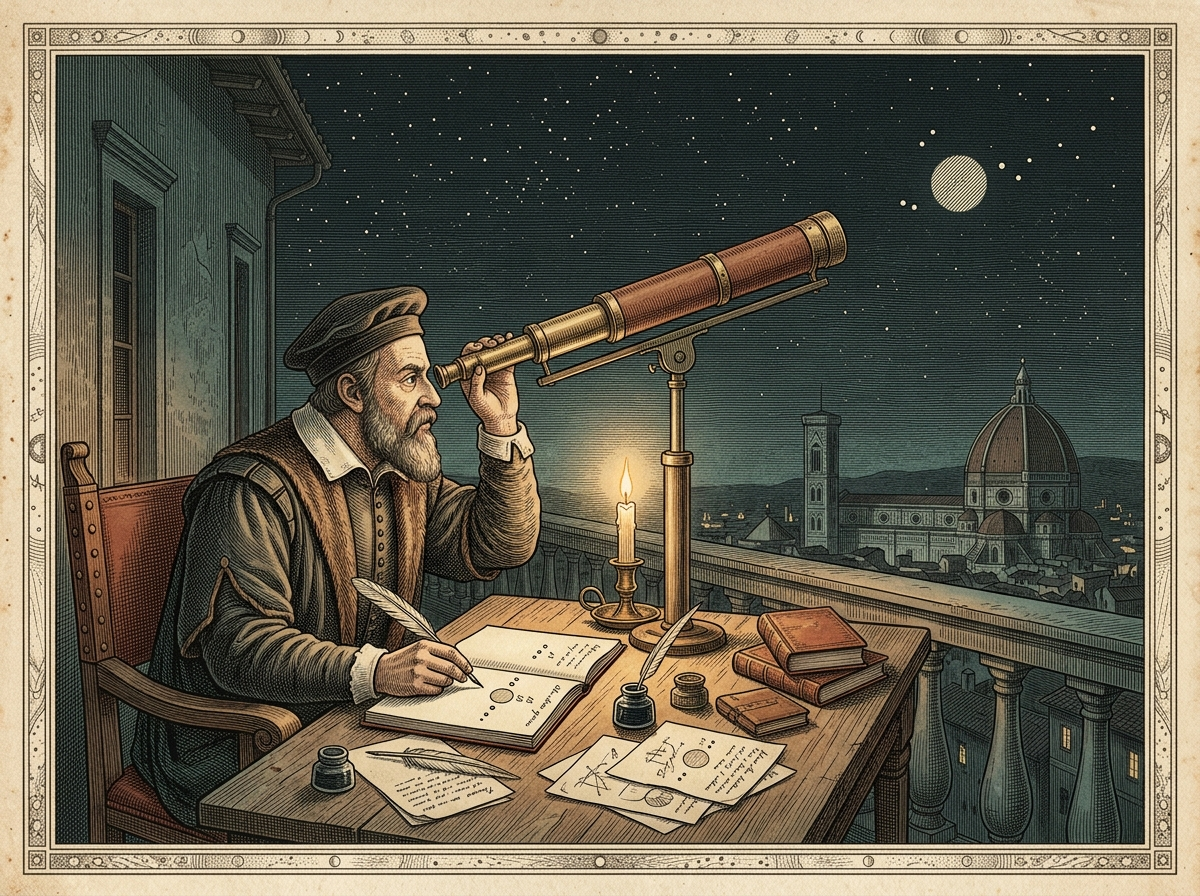
On the night of December 28, 1612, Galileo Galilei pointed his telescope at Jupiter, as he had on hundreds of nights before, and sketched its moons. Off to one side he drew a faint "fixed star." A month later he drew it again, and jotted that it seemed to have shifted. Then he moved on. That dot was Neptune, a planet nobody would officially discover for another 234 years.
By the Curiosities Desk · · 5 min read · Filed under Space · Today’s round
What happened?
In 1610, Galileo found four moons circling Jupiter, the first objects ever seen orbiting another planet. He spent the next few years tracking them night after night, trying to work out their timing well enough to predict where each would be. His notebooks, which survive in Florence, are full of small diagrams: a circle for Jupiter, dots for the moons, and now and then a dot for a background star he used as a reference point.
In 1980, the Caltech astronomer Charles Kowal and the Galileo historian Stillman Drake of the University of Toronto published a short paper in Nature with a startling claim. Two of those reference “stars” were not stars at all. By working out where Neptune must have been in the winter of 1612–13, they showed that Galileo had recorded the planet on December 28, 1612, and again on January 28, 1613.
The coincidence that put Neptune in his sketches is almost too neat. Neptune moves so slowly across the sky that it stays near the same stars for months, and in those weeks it happened to sit just beside Jupiter. Kowal and Drake found that Jupiter actually passed in front of Neptune in January 1613, an event astronomers call an occultation. Galileo was staring right at the one planet that, for a few days, was hiding another.
The second sighting is the one that makes historians lean in. On January 28, Neptune sat near a real star, and Galileo drew both, with a scale showing the gap between them. According to Kowal and Drake’s account, he noted that the separation was smaller than on the night before. A “star” that changes position against other stars is behaving like a planet. Galileo seems to have noticed the shift. He did not chase it, and he never published it.
He was not the last to look straight at Neptune and miss it. On May 8 and May 10, 1795, astronomers working for Jérôme Lalande in Paris logged the planet’s position while building an enormous star catalogue. The two measurements didn’t agree, because the object had moved, so the entry was treated as doubtful. In 1847, the American astronomer Sears Cook Walker went digging through Lalande’s published catalogue and realized the “faulty” star was Neptune all along.
By then the planet had finally been caught on purpose. Uranus, discovered in 1781, kept drifting off its predicted path, as if something unseen were tugging on it. The French mathematician Urbain Le Verrier worked out where that something should be and, after failing to interest French observers, mailed his prediction to Johann Galle at the Berlin Observatory. Galle received it on September 23, 1846. That night, with the student Heinrich d’Arrest comparing star positions against a fresh star chart, they found an object that wasn’t on the map, less than one degree from where Le Verrier had said it would be.
Why was it strange?
Galileo was the person most famous for trusting what his telescope showed him over what everyone expected to see. He saw moons around Jupiter, phases of Venus, and mountains on the Moon. And yet here was a planet in his own handwriting, with a note that it had moved, and it slipped by.
That isn’t really a failure of genius. Neptune was far too faint to see with the naked eye, and too small for his telescope to show as a disk rather than a point. He was busy with a different problem, and a dot that drifted a little looked a lot like a measuring error. Discovering something takes more than seeing it. You also have to suspect it matters. More pre-discovery confusion: The Planet That Was Officially Named ‘George’ for 67 Years.
What did scientists learn?
Old observations like these are surprisingly useful. Neptune takes about 165 years to go around the Sun, so in 1846 astronomers had watched only a tiny slice of its orbit. Lalande’s 1795 positions stretched that record back more than 50 years, and Walker used them to pin down the planet’s path far better than a few months of new data could.
Kowal and Drake hoped Galileo’s sketches could do the same thing on an even longer timescale. They reported that his January 1613 position differed from Neptune’s calculated position by about 1 arc minute, a tiny angle, roughly the width of a coin seen from 80 meters away, and suggested the drawing might be precise enough to be worth using.
In 2009, the University of Melbourne physicist David Jamieson went further. He pointed to an unlabeled dot in Galileo’s notes from January 6, 1613, roughly where Neptune would have been, and suggested Galileo may have gone back later to mark where he had seen the moving “star” earlier. If so, Galileo may have suspected he had found something new. Jamieson proposed testing the ink to date the dot. That idea remains a hypothesis, not a settled finding. Another astronomer undone by timing: The Astronomer Who Spent Eleven Years at Sea to Watch Venus Cross the Sun — and Missed It Anyway.
How does it affect us today?
Searching old records for objects that were seen but not recognized is now a routine tool. Astronomers call these “precoveries,” short for pre-discovery observations. When a new asteroid or comet turns up, researchers often comb through older photographs and survey data to find earlier images of it, which lets them work out its orbit much faster.
Neptune’s discovery also set a template. It was the first planet found mainly by mathematics, by predicting a hidden body from the pull it exerted on something visible. Astronomers still use that same logic to look for unseen planets and other hidden masses. Another discovery that started as something odd in the data: The Graduate Student, the ‘Little Green Men,’ and the Nobel That Got Away.
Fun fact
Neptune is so slow that it only finished its first full lap around the Sun since its discovery in July 2011, a year when the Hubble Space Telescope marked the occasion with new portraits of the planet.
Sources
- Kowal, C. T., and Drake, S., “Galileo’s observations of Neptune”, Nature 287 (1980): 311–313 — the paper identifying Neptune in Galileo’s notebooks.
- California Institute of Technology, “Galileo saw Neptune” news release (November 1980) — Kowal’s own account of the drawings and the shrinking separation.
- Walker, S. C., “Ephemeris of Neptune for comparison with the ancient Lalande observations”, Smithsonian Contributions to Knowledge 2 (1849) — Walker’s work on the 1795 sightings.
- University of Melbourne via ScienceDaily, “Galileo’s notebooks may reveal secrets of new planet” (2009) — David Jamieson’s hypothesis about the January 6 dot.
- Astronomy, “Neptune completes its first circuit around the Sun since its discovery” (2011).