Accidental Discoveries · Space
The Planet That Was Officially Named 'George' for 67 Years
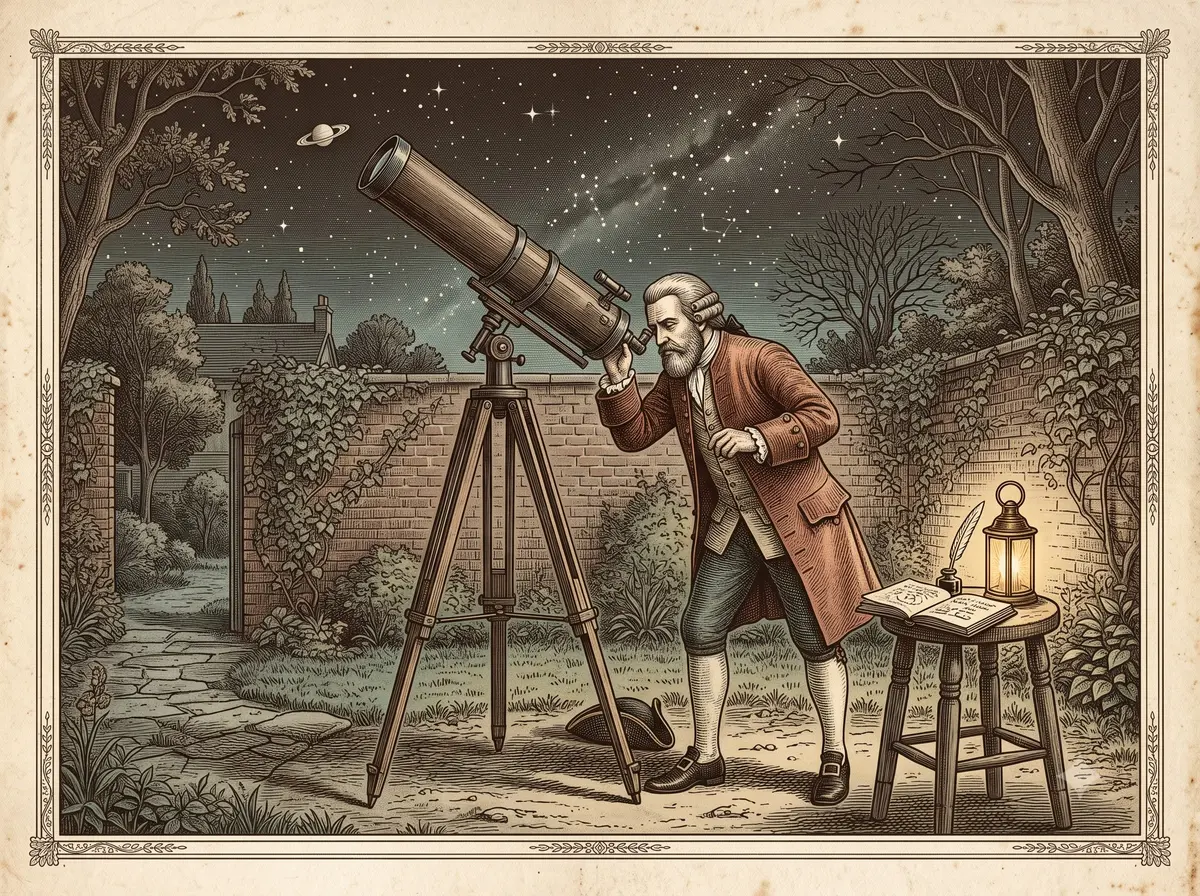
On a March night in 1781, a church organist in Bath aimed a telescope he had ground and polished himself at a faint speck in the constellation Gemini, swapped in a stronger eyepiece, and watched the speck get bigger. Stars don't do that. He had just found the first new planet in recorded history — and within two years he would name it after his king.
By the Curiosities Desk · · 5 min read · Filed under Space · Today’s round
What happened: The Planet That Was Officially Named 'George' for 67 Years
William Herschel was, by trade, a musician. Born in Hanover in 1738 and working in England from 1759, he played oboe, composed, and served as organist at the Octagon Chapel in Bath. Astronomy was the obsession he funded with music lessons. Telescopes were beyond his means, so he built his own, casting and polishing the mirrors at home after reportedly hundreds of failed attempts.
He was midway through a long survey of faint stars when it happened. In his own account, read to the Royal Society on 26 April 1781:
“On Tuesday, the 13th of March, between ten and eleven in the evening, while I was examining the small stars in the neighbourhood of H Geminorum, I perceived one that appeared visibly larger than the rest.”
What he did next is the whole story. He was using an eyepiece that magnified 227 times. He swapped it for 460, then 932. The object grew. The stars around it didn’t.
That test works because of how far away things are. A star is so distant that even enormous magnification can’t spread it into a visible disk — it stays a point of light. Anything close enough to show a real disk, however small, gets visibly wider as you magnify it. Herschel knew this from thousands of nights at the eyepiece, and the object failed the star test badly.
So he wrote it up — as a comet. His paper is titled “Account of a Comet.” On 6 April he noted the object “appeared perfectly sharp upon the edges… without the least appearance of any beard or tail,” a polite way of saying it looked nothing like a comet. He kept the cautious label anyway and handed it off: “I failed not to give immediate notice of this moving star, and was happy to surrender it to the care of the Astronomer-Royal and others.”
Those others did the math. Comets travel on long, stretched-out ellipses. This object’s orbit came out very nearly circular, at roughly twice Saturn’s distance from the Sun. It wasn’t a comet. It was a seventh planet, the first found since antiquity, and the first found with a telescope.
Honours arrived fast. In 1782 George III made Herschel his court astronomer with a salary of £200 a year, and Herschel gave up music for good. The Astronomer Royal, Nevil Maskelyne, pressed him to name the thing. Herschel obliged, and in a letter to Royal Society president Sir Joseph Banks published in 1783 he explained his reasoning:
“In the fabulous ages of ancient times the appellations of Mercury, Venus, Mars, Jupiter, and Saturn, were given to the planets, as being the names of their principal heroes and divinities. In the present more philosophical era, it would hardly be allowable to have recourse to the same method… if in any future age it should be asked, when this last-found planet was discovered? It would be a very satisfactory answer to say, ‘In the reign of King George the Third.’”
He proposed Georgium Sidus — George’s Star. Britain adopted it. Almost nobody else did.
The German astronomer Johann Bode had already floated an alternative in a treatise of March 1782: Uranus, after the Greek sky god, on the grounds that the new planet should match the family the others belonged to. Saturn’s father, for the planet beyond Saturn. Elsewhere, astronomers dodged the fight entirely and just called it “Herschel.”
Three names circulated for decades. Britain held out longest: HM Nautical Almanac Office, publisher of the official British astronomical tables, kept printing Georgium Sidus until 1850.
Why it was strange: The Planet That Was Officially Named 'George' for 67 Years
For most of a century, the seventh planet had a nationality. Which name you used told people where you stood — and this was the era of the American Revolution, when continental astronomers were not keen to write an English king permanently into the sky.
There’s a second oddity. Herschel’s argument was the modern-sounding one: naming planets after gods was a leftover from “fabulous ages,” and a scientific age should encode useful information instead — when and where the discovery happened. It’s a reasonable position, and it lost completely. Every planet, moon, and dwarf planet named since has followed the tradition Herschel tried to retire.
Another time the mistake was the invention: The Nuclear Watchdog Satellites That Caught the Universe Exploding Instead.
What scientists learned: The Planet That Was Officially Named 'George' for 67 Years
The technical lesson is the one Herschel demonstrated at the eyepiece: appearance alone can’t classify an object. A disk that swells under magnification tells you something is close; only an orbit tells you what it is. Comet or planet was settled not by looking harder, but by weeks of position measurements fed into orbital mathematics.
The bigger shift was one of scale. Before 1781, Saturn marked the edge of the known solar system, about 9.5 times Earth’s distance from the Sun. Uranus sits at roughly 19. The solar system doubled overnight, and the assumption that the planets were simply “the ones you can see” quietly died.
Another accident worth keeping: The Doorstop That Fell From Space — and Spent 30 Years Holding Open a Shed Door.
How it reaches us today: The Planet That Was Officially Named 'George' for 67 Years
Bode’s victory left fingerprints all over modern science. In 1789 the chemist Martin Heinrich Klaproth found a new element in pitchblende and named it uranium, after the planet — deliberately siding with Bode, sixty-one years before Britain conceded. When later chemists made the elements past uranium, they kept walking outward: neptunium and plutonium, for the next two planets. An enormous chunk of twentieth-century vocabulary rests on a naming argument won in 1782.
Herschel’s other legacy is quieter. A king paying a man £200 a year purely to look at the sky was close to unprecedented — and it worked. Freed from music, he catalogued thousands of nebulae and found moons of Uranus and Saturn.
The planet itself takes about 84 Earth years to circle the Sun, so it has managed roughly three orbits since Herschel spotted it. Exactly one spacecraft has ever visited: Voyager 2, in 1986.
A close cousin: The Hot Soldering Iron That Bumped a Syringe of Ink — and Invented the Inkjet Printer.
Fun fact: The Planet That Was Officially Named 'George' for 67 Years
Uranus was hiding in the star catalogues for 91 years before anyone noticed. In 1690 the first Astronomer Royal, John Flamsteed, logged it as a fixed star and gave it the name 34 Tauri. He recorded it again in 1712 and 1715, and his successor James Bradley caught it in 1748, 1750, and 1753. Six sightings, six times filed as a star, because nobody thought to check whether it had moved.
Sources: The Planet That Was Officially Named 'George' for 67 Years
- Herschel, W. “Account of a Comet.” Philosophical Transactions of the Royal Society of London, vol. 71 (1781), pp. 492–501 — the primary source, read 26 April 1781. Full text via Internet Archive
- Herschel, W. “A Letter from William Herschel, Esq. F.R.S., to Sir Joseph Banks, Bart. P.R.S.” Philosophical Transactions, vol. 73 (1783), pp. 1–3 — the Georgium Sidus naming argument. Royal Society, Science in the Making
- Royal Museums Greenwich, “The Discovery of Uranus” — on Flamsteed’s 34 Tauri, Maskelyne’s role, and Bode’s proposal.
- NASA Science, “Uranus Facts” — distance, orbital period, and the Voyager 2 flyby.
- Linda Hall Library, “Scientist of the Day: Martin Klaproth” — on the 1789 naming of uranium after the planet.
Related stories: The Planet That Was Officially Named 'George' for 67 Years
- The Farm Boy Who Discovered Pluto — and Now Sails Past It Forever — A farm boy found Pluto, and his ashes later flew past it
- The Astronomer With a Metal Nose and a Beer-Drinking Elk — A gold nose, a private island, and a beer-drinking elk
- The Element Discovered on the Sun 27 Years Before Anyone Found It on Earth — Helium was found in sunlight 27 years before anyone found it here