Accidental Discoveries · Space
The Nuclear Watchdog Satellites That Caught the Universe Exploding Instead
On July 2, 1967, a pair of American satellites built to catch the Soviet Union cheating on a nuclear treaty recorded exactly the kind of thing they were designed to find: a sudden, sharp flash of gamma rays. Except it didn't look like a bomb. It didn't come from Earth. It didn't come from the Sun. It took scientists at Los Alamos six years to say publicly what they suspected — that the "explosion" their Cold War watchdogs had spotted was happening somewhere out in the cosmos, and that nobody on the planet knew what it was.
By the Curiosities Desk · · 5 min read · Filed under Space · Today’s round
What happened?
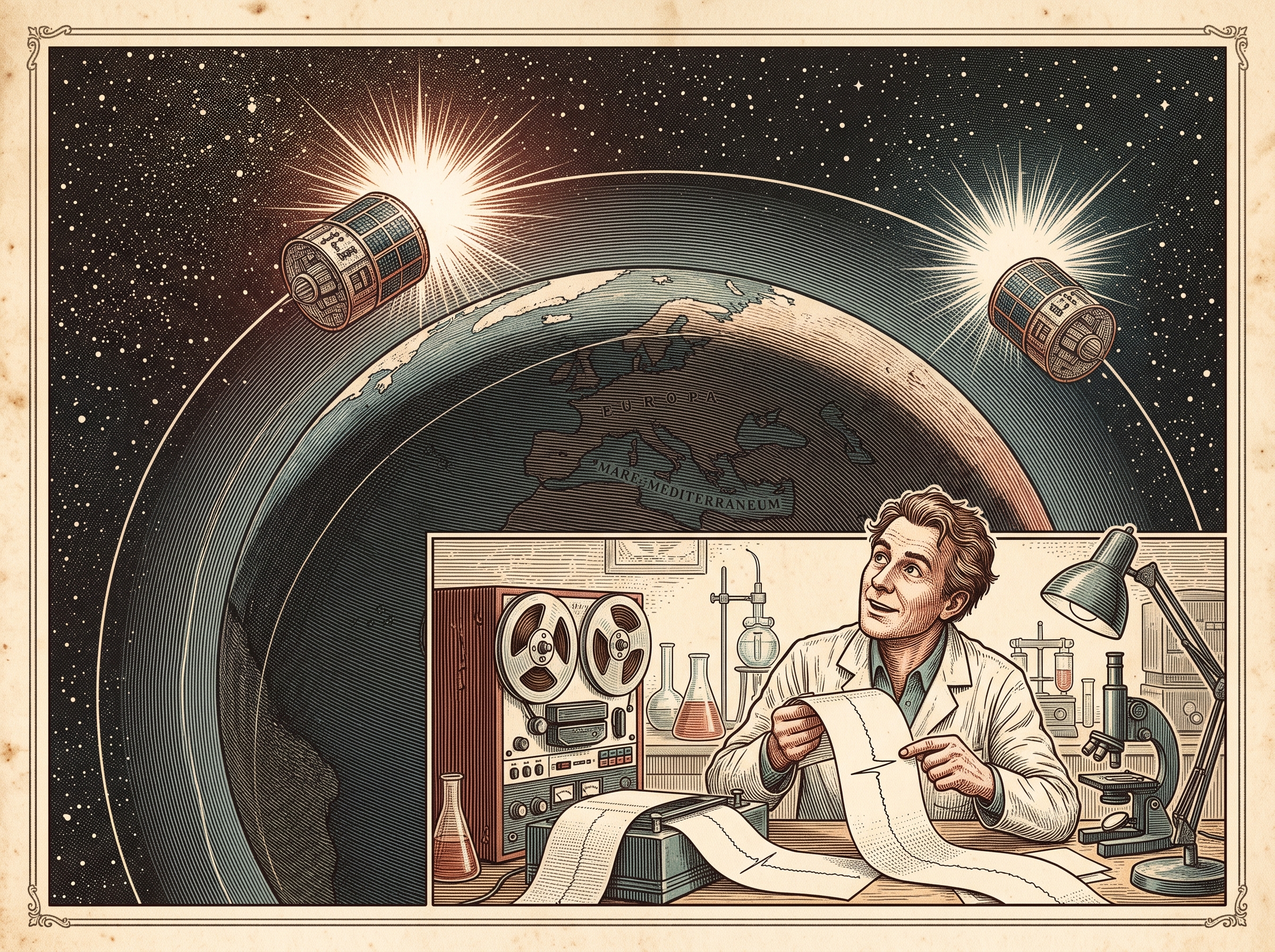
In August 1963, the United States, the Soviet Union, and the United Kingdom signed the Partial Test Ban Treaty, agreeing to stop testing nuclear weapons in the atmosphere, underwater, and in outer space. A treaty is only as good as your ability to check it, so two months later, in October 1963, the US Air Force launched the first of a series of satellites called Vela — from the Spanish verb velar, “to watch.”
The Velas flew in pairs, on opposite sides of a huge orbit roughly 250,000 kilometers across, so that together they could keep the whole Earth in view. They carried detectors for X-rays, gamma rays (the most energetic form of light), and neutrons — the telltale byproducts of a nuclear blast. The instruments were designed and built by teams at the Los Alamos Scientific Laboratory and Sandia Laboratories in New Mexico.
In 1965, Los Alamos physicist Ray Klebesadel took charge of the X-ray and gamma-ray instruments. He made one quietly important decision: any time the detectors were triggered by something that clearly wasn’t a nuclear explosion, the data got filed away for later study rather than thrown out.
In 1969, while combing back through older data from the Vela 4 satellites, Klebesadel and his colleague Roy Olson found an event recorded on July 2, 1967. Both Vela 4 satellites had registered it, and so had the older Vela 3 pair. “It was an electromagnetic phenomenon, but it wasn’t a nuclear event,” Klebesadel later told Los Alamos. “It was something remarkable.”
A nuclear blast in space would leave a recognizable signature across the detectors. This flash simply didn’t fit it. But the 1967 satellites couldn’t time events precisely enough to work out where it had come from.
Newer satellites could. Vela 5 and Vela 6, launched in 1969 and 1970, had clocks precise enough to measure the tiny difference in when a flash hit each spacecraft. Light takes about a second to cross the pair’s orbit, so comparing arrival times let the team triangulate a rough direction in the sky. In 1972, Los Alamos physicist Ian Strong joined Klebesadel and Olson to analyze the pile of unexplained events. The directions ruled out Earth and ruled out the Sun.
In 1973, once the work had been cleared for release, the three published “Observations of Gamma-Ray Bursts of Cosmic Origin” in The Astrophysical Journal Letters. It described 16 bursts caught between July 1969 and July 1972, lasting anywhere from under a tenth of a second to about 30 seconds. The July 1967 flash, now known as GRB 670702, is considered the first gamma-ray burst ever recorded.
Why was it strange?
The satellites were looking down at Earth for human-made explosions. What they found was coming from above, from nature, and on a scale no one had imagined.
Worse, nobody could explain it. The bursts appeared at random, lasted seconds, and then vanished without a trace. By 1994, astronomer Robert Nemiroff counted more than 100 different published theories for what caused them, ranging from comets smashing into neutron stars to far more exotic ideas.
The deepest argument was over distance. Were the bursts coming from our own galaxy, relatively close by? Or from billions of light-years away — in which case they had to be almost unimaginably powerful? In April 1995 the question was important enough to get its own formal public debate in Washington, D.C., where astronomer Bohdan Paczyński argued for the far-away side.
Another accident worth keeping: The Doorstop That Fell From Space — and Spent 30 Years Holding Open a Shed Door.
What did scientists learn?
Two clues settled it. NASA’s Compton Gamma Ray Observatory, launched in 1991, carried an instrument called BATSE that logged about 2,700 bursts over nine years. They were scattered evenly across the entire sky, not bunched along the band of the Milky Way — a hint that they came from far outside our galaxy.
Then in 1997 the Italian-Dutch satellite BeppoSAX caught the fading “afterglow” of a burst, GRB 970228, in X-rays, letting telescopes on the ground find it in visible light too. A few months later, astronomers measured the redshift of another burst’s afterglow, GRB 970508. Redshift is the stretching of light by the expansion of the universe, and it works as a cosmic tape measure. The answer placed that burst billions of light-years away. The distance debate was over.
We now know there are at least two main kinds of gamma-ray bursts. Long bursts, lasting more than about two seconds, happen when a massive star collapses into a black hole and fires narrow jets of material outward at nearly the speed of light. Short bursts come from the collision of two neutron stars, the ultra-dense remnants of dead stars. They are among the most powerful explosions known in the universe.
Another time the mistake was the invention: The Planet That Was Officially Named ‘George’ for 67 Years.
How does it affect us today?
Gamma-ray bursts became a field of their own. NASA’s Swift and Fermi spacecraft now catch bursts regularly and alert telescopes around the world within seconds. Because bursts are so bright, astronomers use them as flashlights to study the early universe and the gas between galaxies.
In 2017, a short gamma-ray burst arrived about 1.7 seconds after gravitational waves from two colliding neutron stars, confirming what causes short bursts and opening the era of “multi-messenger” astronomy, where the same event is studied through both light and ripples in space-time.
The Vela program also did its original job: it helped make nuclear test monitoring from space possible, a mission that continues on modern satellites today.
A close cousin: The Pigeon Mess That Turned Out to Be the Echo of the Big Bang.
Fun fact
On March 19, 2008, a gamma-ray burst named GRB 080319B was briefly bright enough to see with the naked eye — for about 30 seconds — even though the star that exploded was roughly 7.5 billion light-years away. NASA noted that for that moment, the single dying star shone as bright as 10 million galaxies.
Sources
- Klebesadel, R. W., Strong, I. B., & Olson, R. A. (1973). “Observations of Gamma-Ray Bursts of Cosmic Origin.” The Astrophysical Journal, 182, L85. NASA ADS
- Bonnell, J. T. “A Brief History of the Discovery of Cosmic Gamma-Ray Bursts.” NASA Goddard Space Flight Center. NASA Science
- Grant, V. (2020). “The mystery flash that changed astrophysics.” National Security Science, Los Alamos National Laboratory. LANL
- Nemiroff, R. J. (1994). “A Century of Gamma Ray Burst Models.” Comments on Astrophysics, 17, 189. arXiv
- NASA (2008). “‘Naked-Eye’ Gamma Ray Burst Was Aimed Squarely at Earth.” NASA