Accidental Discoveries · Space
The Doorstop That Fell From Space — and Spent 30 Years Holding Open a Shed Door
In January 2018, David Mazurek walked into Central Michigan University carrying a lumpy, rust-dark rock he had used for three decades to keep a door from swinging shut. Geologist Mona Sirbescu had spent 18 years gently telling visitors that their "space rocks" were ordinary Earth rocks. This time she picked it up, felt the weight of it, and realized the doorstop had once been part of an asteroid.
By the Curiosities Desk · · 5 min read · Filed under Space · Today’s round
What happened?
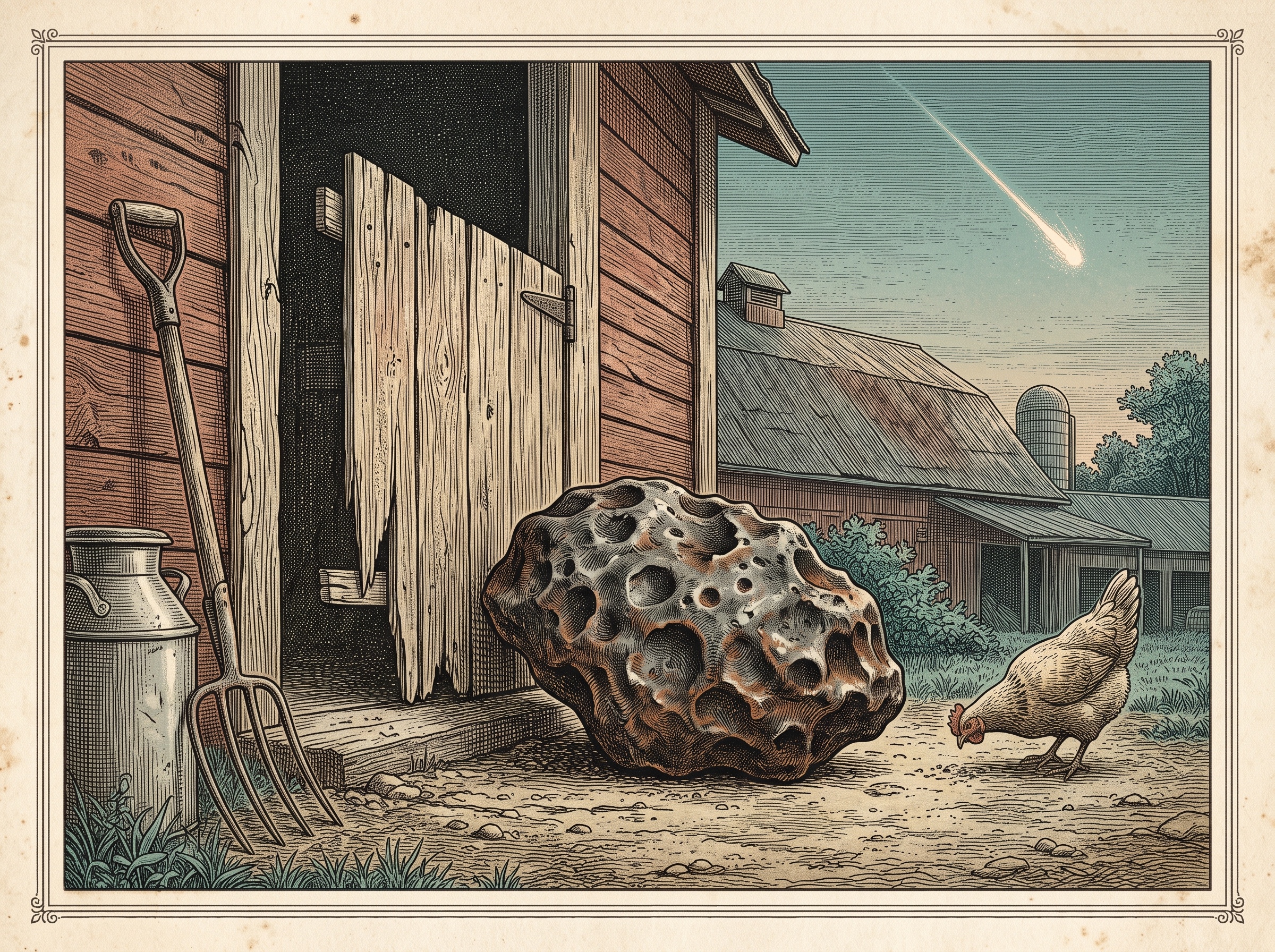
The rock’s story starts, according to the family that owned it, on a farm near Edmore, a small town in central Michigan, sometime in the 1930s. As the farmer later told it, he and his father heard something come down in the night — “it made a heck of a noise when it hit,” he recalled — and the next morning they found a small crater and dug out a heavy, still-warm stone. Michigan State University’s Abrams Planetarium, which owns the rock today, describes the fall year as “supposedly” 1939. No one wrote the event down at the time, so the fall itself rests on that family account.
What happened next is better documented. In 1988, Mazurek, from the Grand Rapids area, bought the property. While walking the farm with the previous owner, he asked about a large rock propping open a door. The farmer told him it was a meteorite and that it now came with the place.
Mazurek took it at its word, more or less. He kept the rock when he moved away a few years later, and for roughly 30 years it did the job it had been given: it held a door open. Every so often it got a second gig. His children took it to school for show-and-tell.
Then, in January 2018, a bright fireball streaked over southeastern Michigan and scattered meteorites near the town of Hamburg. Mazurek saw reports of meteorite pieces selling for thousands of dollars. “I said, ‘Wait a minute. I wonder how much mine is worth,’” he told reporters.
He brought it to Sirbescu, a geology professor at Central Michigan University. People had been bringing her suspected meteorites for years, and the answer had always been no. “For 18 years, the answer has been categorically ‘no’ — meteor-wrongs, not meteorites,” she said. This one was different. “I could tell right away that this was something special,” she said.
The rock weighed about 22.5 pounds (10 kilograms), and testing showed it was roughly 88.5% iron and 11.5% nickel. Sirbescu sent small slices to the Smithsonian Institution in Washington, D.C., which confirmed it was a meteorite. When the university announced the find that October, it estimated the rock could be worth up to $100,000 and ranked it the sixth-largest meteorite ever found in Michigan. “It’s the most valuable specimen I have ever held in my life, monetarily and scientifically,” Sirbescu said.
Mazurek was ready to retire it. “I’m done using it as a doorstop,” he said. The Smithsonian and a mineral museum in Maine looked at buying it. In the end, Michigan State University’s Abrams Planetarium bought it for a reported $75,000, and Mazurek gave 10% of the proceeds to Central Michigan University’s earth and atmospheric sciences program.
Why was it strange?
Meteorites are supposed to be rare treasures, and in one sense this one was: experts confirm only a small fraction of the rocks people bring them. Sirbescu’s 18-year streak of rejections shows how often hopeful finds turn out to be slag from old furnaces, iron-rich Earth rocks, or plain rocks that happen to be heavy.
But the Edmore rock was never truly hidden. The person who found it said it was a meteorite. The man who inherited it was told it was a meteorite. It went to school as a meteorite. What it lacked was not a discoverer but a test. For about eight decades, a piece of the early solar system sat in plain sight, doing the humblest job a heavy object can do, because nobody had asked a scientist to look.
Another accident worth keeping: The Nuclear Watchdog Satellites That Caught the Universe Exploding Instead.
What did scientists learn?
The clue that caught Sirbescu’s attention was the metal. Rocks that form on Earth’s surface almost never contain chunks of natural iron-nickel metal; the iron in them is usually locked into minerals such as oxides. Iron meteorites, by contrast, are mostly metal, typically with a few percent to more than 10% nickel. Edmore’s makeup fit that pattern.
Iron meteorites are thought to come from the metal cores of asteroids — small early planets, called planetesimals, that grew hot enough inside for molten metal to sink to the center. Those bodies cooled over millions of years, and later collisions broke some of them apart. A fragment can wander the solar system for a very long time before Earth’s gravity happens to pull it in.
When many iron meteorites are sliced, polished and etched with acid, they reveal a crisscross of metal crystals called a Widmanstätten pattern. It forms only when the metal cools extraordinarily slowly — over millions of years inside an asteroid — so it is very hard to fake in a lab or a furnace. That makes iron meteorites a kind of sample from deep inside a world, a place no drill on Earth can reach in our own planet.
Another time the mistake was the invention: The Pigeon Mess That Turned Out to Be the Echo of the Big Bang.
How does it affect us today?
Iron meteorites are among the best physical evidence scientists have for what planetary cores are made of. Earth’s own core sits nearly 1,800 miles beneath our feet, so pieces of broken asteroid cores are the closest stand-ins we can hold. NASA’s Psyche mission, launched in 2023, is traveling to a metal-rich asteroid that may be an exposed core, partly to test ideas built on meteorites like this one.
The Edmore story also matters for a simpler reason: many meteorites in museum collections were found by farmers, hikers and curious neighbors, not scientists. Universities and museums identify suspected meteorites because the public is often first to notice an odd rock. Most turn out to be “meteor-wrongs.” Once in a long while, one turns out to be the real thing — even after 30 years of holding a door.
A close cousin: The Planet That Was Officially Named ‘George’ for 67 Years.
Fun fact
People were using space metal long before they knew it came from space. A 2016 chemical study found that the iron blade of a dagger buried with the pharaoh Tutankhamun has the nickel-rich composition of a meteorite.
Sources
- A rock that was used as a doorstop for the past 30 years turns out to be a meteorite valued at $100K — CNN via WTOP, October 2018
- Doorstop turns out to be $100K meteorite; Maine museum among potential buyers — Associated Press via Bangor Daily News, October 5, 2018
- Edmore meteorite — Abrams Planetarium, Michigan State University
- The fall, recovery, classification, and initial characterization of the Hamburg, Michigan H4 chondrite — Meteoritics & Planetary Science
- The meteoritic origin of Tutankhamun’s iron dagger blade — Comelli et al., Meteoritics & Planetary Science, 2016