Accidental Discoveries · Space
The Schoolteacher Who Found a Galaxy-Sized Green Ghost — and Asked the Internet, 'Anyone?'
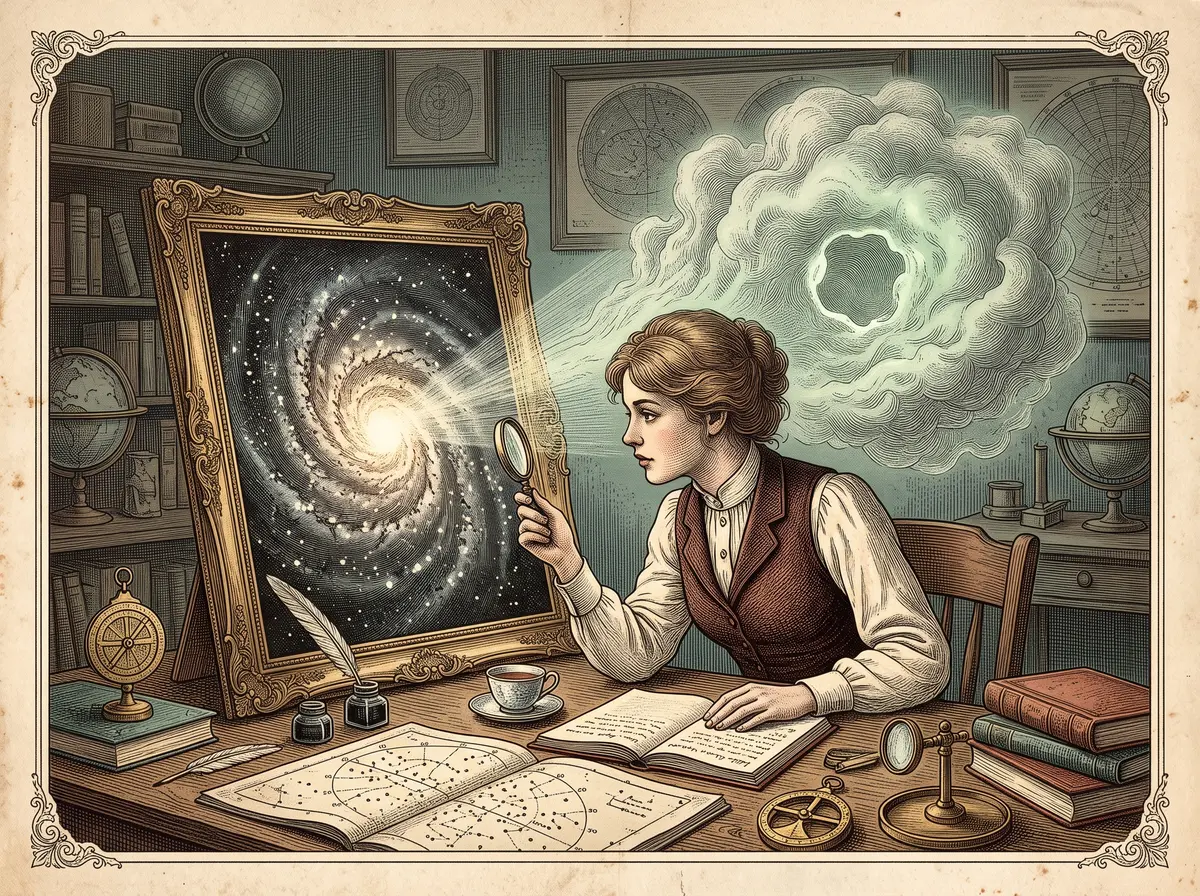
In 2007, a Dutch schoolteacher clicking through galaxy photos in her spare time came across something the tutorial hadn't covered: a glowing blob, roughly the size of the Milky Way, floating beside a galaxy about 650 million light-years away. She posted it to the project's forum and asked, in effect, the most honest question in science: "Anyone?" Nobody knew. It took several telescopes, and eventually Hubble, to work out that she had found a ghost.
By the Curiosities Desk · · 5 min read · Filed under Space · Today’s round
What happened: Hanny's Voorwerp
In July 2007, astronomers at the University of Oxford, led by Chris Lintott and Kevin Schawinski, launched Galaxy Zoo. The Sloan Digital Sky Survey had photographed about a million galaxies, far too many for a few researchers to sort by eye. So Galaxy Zoo put the pictures online and asked the public: Is this galaxy a spiral or an elliptical?
The response was overwhelming. More than 150,000 volunteers submitted around 50 million classifications in the first year.
One of them was Hanny van Arkel, a primary school teacher in the Netherlands. She was not, by her own account, a big galaxy watcher. She was a big Queen fan. When Queen’s guitarist Brian May, who also holds a PhD in astrophysics, promoted Galaxy Zoo, she decided to try it.
A few months in, she clicked on an image of a spiral galaxy catalogued as IC 2497. Below it sat a fuzzy patch that did not look like anything on the classification menu. She later described it as looking like a regular galaxy “but much bluer.” She emailed Lintott and posted about it on the Galaxy Zoo forum. According to the project’s own blog, her post ended with a single word: “Anyone?”
At first, nobody had an answer; forum regulars just agreed it looked odd. Then William “Bill” Keel, an astronomer at the University of Alabama, took a closer look. He enhanced the survey image and noticed something telling: the blob was bright in one color filter and almost missing from the others. Stars shine across a broad range of colors. A cloud of glowing gas, by contrast, gives off light at only a few specific colors, called emission lines. This looked like gas.
The object soon picked up a nickname that stuck: Hanny’s Voorwerp. “Voorwerp” is simply Dutch for “object.”
Follow-up observations piled up. Keel imaged it in several colors with a small telescope at Kitt Peak in Arizona, and the team noted it would look more green than blue to the human eye. A spectrum, a measurement that splits light into its component colors, taken with the 4.2-meter William Herschel Telescope in the Canary Islands showed the cloud sat at the same distance as IC 2497. That meant it wasn’t a small, nearby smudge. It was enormous.
In 2009, the team published their analysis in the journal Monthly Notices of the Royal Astronomical Society. The lead author was Lintott. Among the co-authors: Hanny van Arkel.
Why it was strange: Hanny's Voorwerp
The Voorwerp was glowing, but nothing nearby seemed bright enough to make it glow. To light up a gas cloud that large, you need a tremendous source of energy, the kind of ultraviolet and X-ray radiation produced by a quasar. A quasar is the blazing center of a galaxy, where gas spiraling into a supermassive black hole heats up and shines brighter than all the galaxy’s stars combined.
IC 2497 didn’t look like it had one. Seen from Earth, its core was unremarkable, and X-ray observations didn’t detect the powerful glow the team expected.
The team’s best explanation was a “light echo.” IC 2497, they proposed, had hosted a quasar that recently faded or became hidden. The Voorwerp sits tens of thousands of light-years from the galaxy’s center, so the quasar’s old light is still reaching the cloud and making it glow, even though the source itself has gone quiet. In other words, a volunteer had spotted the afterglow of something that was no longer there. Lucky finds made by people looking for something else are a theme on this site; see Found While Looking for Something Else.
What scientists learned: Hanny's Voorwerp
The Voorwerp turned into a natural time machine. Because light takes time to travel across the cloud, the gas records what the galaxy’s center was doing in the past. Astronomers estimate the quasar dimmed less than 200,000 years ago, an eyeblink in cosmic terms. Before this, it was hard to watch how quickly a quasar could shut down, because astronomers usually see each one at a single moment.
In 2011, the Hubble Space Telescope took a sharp look. The images revealed delicate gas filaments and a region on the side of the cloud facing IC 2497 where stars were forming, the youngest only a couple of million years old. Radio data showed gas flowing out of the galaxy’s core.
The discovery also sent the team hunting for more. Volunteers flagged candidates, and a follow-up study led by Keel found 19 galaxies with giant clouds lit up by an active galactic center, many in galaxies that are interacting or merging. The Voorwerp turned out to be the most dramatic member of a real class of objects, not a one-off. A similar “wait, what’s that?” moment started a different branch of astronomy in The Pigeon Mess That Turned Out to Be the Echo of the Big Bang.
How it reaches us today: Hanny's Voorwerp
Hanny’s Voorwerp became a showcase for citizen science, research in which members of the public contribute real data or analysis. It showed that human eyes, many of them untrained, could catch what automated searches might miss. Galaxy Zoo volunteers kept doing it: in 2009, a forum thread cheerfully titled “Give peas a chance” led to the identification of about 250 small, bright green galaxies, now known as Green Peas, that form stars unusually fast.
The Oxford team’s platform grew into the Zooniverse, which now hosts volunteer projects on everything from penguins to planets.
And van Arkel kept teaching. She has also become the star of a comic book, Hanny and the Mystery of the Voorwerp, created by artists and astronomers to explain the science to young readers. For another young outsider whose odd observation puzzled professionals, read The Schoolboy Whose Hot Ice Cream Froze Faster — and Baffled Physicists for 60 Years.
Fun fact: Hanny's Voorwerp
Hanny’s Voorwerp, the name now found in Hubble press releases and peer-reviewed papers, translates from Dutch to plain English as “Hanny’s Object.” One of the most-studied gas clouds in nearby space is officially, more or less, a thing.
Sources: Hanny's Voorwerp
- Lintott, C. J., et al. (2009), “Galaxy Zoo: ‘Hanny’s Voorwerp’, a quasar light echo?” Monthly Notices of the Royal Astronomical Society 399, 129–140 (arXiv:0906.5304): https://arxiv.org/abs/0906.5304
- ESA/Hubble photo release heic1102 on Hanny’s Voorwerp (January 10, 2011): https://esahubble.org/news/heic1102/
- Galaxy Zoo blog, “What’s the blue stuff below?” (January 11, 2008): https://blog.galaxyzoo.org/2008/01/11/whats-the-blue-stuff-below/
- Keel, W. C., et al. (2012), “The Galaxy Zoo survey for giant AGN-ionized clouds,” Monthly Notices of the Royal Astronomical Society 420, 878–900: https://ora.ox.ac.uk/objects/uuid:f95cabc1-243a-4e02-958a-94fc99f2c64d
- TED Ideas, “Meet the accidental astronomer who inspired a comic book”: https://ideas.ted.com/meet-the-accidental-astronomer-who-inspired-a-comic-book/