Accidental Discoveries · Engineering
The Hot Soldering Iron That Bumped a Syringe of Ink — and Invented the Inkjet Printer
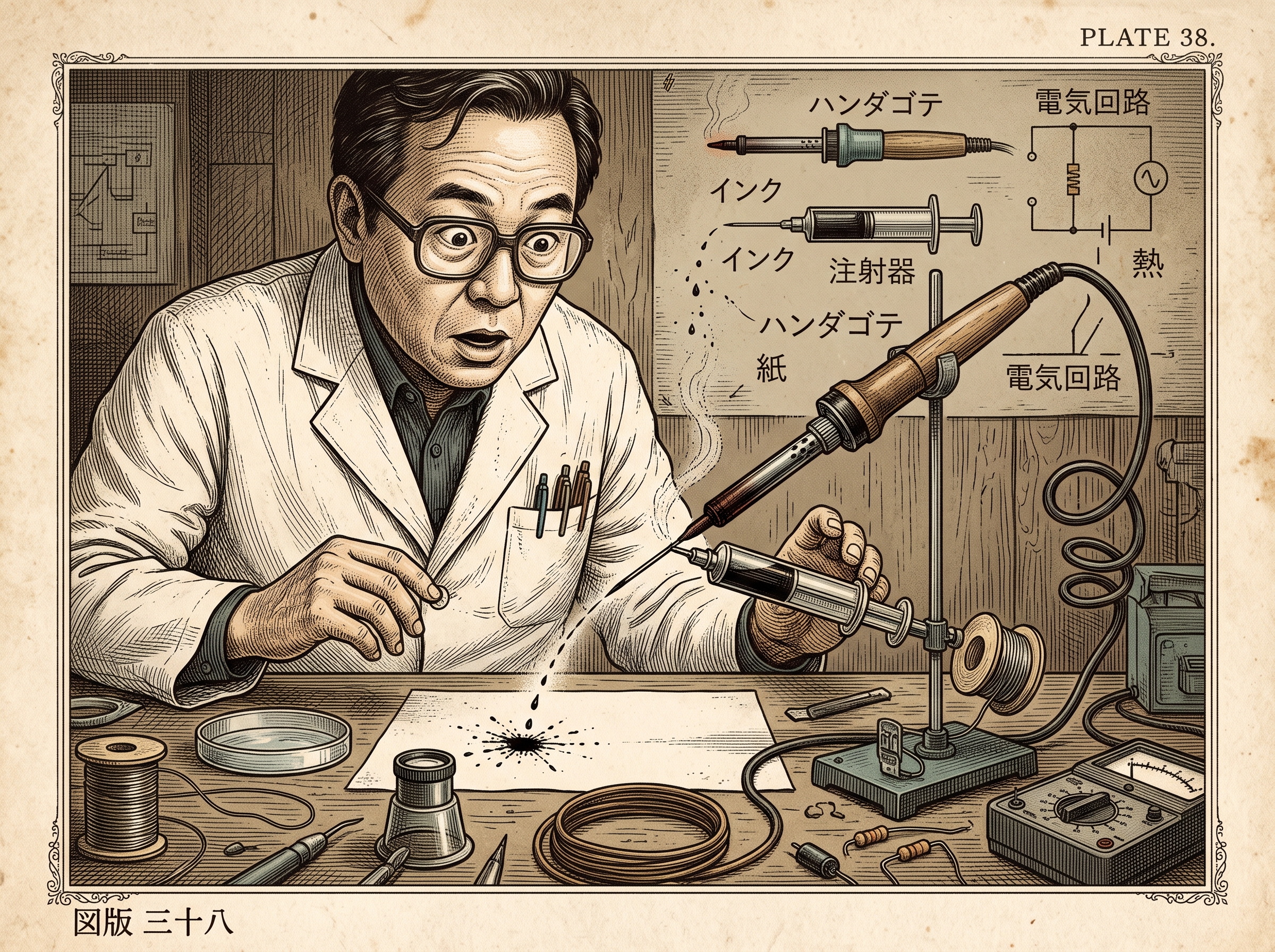
In the mid-1970s, in a Canon research lab in Japan, a hot soldering iron came to rest where it shouldn't have: against the needle of a syringe full of ink. The ink didn't just get warm. It boiled inside the needle, and the expanding bubble shot droplets of ink out of the tip. The engineer watching, Ichiro Endo, didn't see a mess to wipe up. He saw a printer.
By the Curiosities Desk · · 5 min read · Filed under Engineering · Today’s round
What happened?
In the mid-1970s, the office printer was a loud machine. Most computers printed with impact printers such as the dot-matrix, which hammered tiny pins against an inked ribbon, a sound people remember as a long, angry buzz. Engineers had already worked out that you could print more quietly by spraying ink straight onto paper. The hard part was controlling the spray, one tiny droplet at a time.
Canon’s researchers were among the teams trying. According to MIT Technology Review, they were working on a piezoelectric approach. Piezoelectric materials are crystals that flex slightly when you run electricity through them, so a crystal can squeeze ink out of a nozzle like a very small, very fast hand on a tube of toothpaste. It worked, but it was hard to make the nozzles small, cheap, and tightly packed.
Then came the accident. Canon’s own history of the invention says that during an experiment, “a heated soldering iron accidentally touched the needle of a syringe filled with ink,” and droplets “spurted vigorously from the tip of the needle.” Accounts don’t agree on who set the iron down. Canon’s version just calls it an accident, and a biography from Optica (the optics society formerly called the Optical Society of America) says Endo “saw” the syringe get touched. Either way, the heat did something no one had designed it to do. It boiled a sliver of ink inside the needle, and the growing vapor bubble pushed liquid out ahead of it.
Endo realized that heat could replace the crystal entirely. Put a tiny heater behind a tiny nozzle, zap it with a pulse of electricity, and a bubble forms and fires a drop. Cut the power and the bubble collapses, pulling in fresh ink for the next shot. Optica’s biography says he had a working model within days. Canon filed its basic patent in 1977, showed a prototype “Bubble Jet” printer in 1981, and launched its first commercial Bubble Jet printer, the BJ-80, in 1985.
Here’s the twist. Halfway around the world, someone else was having the same idea, and his inspiration came from the breakfast table. At Hewlett-Packard Laboratories in California, an engineer named John Vaught was thinking about how a coffee percolator works. Heat water at the bottom, and a bubble of steam forces it up the tube. According to Technology Review, the HP team “independently hit on the same idea in 1978.” HP’s internal journal later noted that Canon’s work was going on “unknown to HP at the time.”
HP got to market first. In April 1984 it announced the HP 2225 ThinkJet for $495. The Hewlett-Packard Journal explained that its disposable printhead held twelve nozzles, each fired by its own tiny resistor, and that one cartridge was good for about 500 pages. Canon’s BJ-80 followed a year later.
Why was it strange?
Most inventions in printing had been about pushing ink more carefully. The bubble jet works by boiling it on purpose. That sounds like the last thing you’d do to a liquid you want to place precisely on a page.
The soldering iron was also just a workshop tool. It was never meant to touch the ink. Nobody planned the most important experiment in the story; a hot object happened to land in the wrong place, and someone was watching closely enough to notice.
Then there’s the coincidence. Two engineers at two companies on two continents arrived at the same answer within about a year of each other. One got there from a slip at the lab bench, the other from a coffee pot. Neither knew about the other. When the Optical Society (now Optica) awarded its Edwin H. Land Medal in 1995, it honored both men together for their “independent inventions” of the technology.
Another accident worth keeping: The Rocket Scientist Whose Leaky Fridge Idea Became the Super Soaker.
What did scientists learn?
The physics inside a thermal inkjet is fast and violent. The Hewlett-Packard Journal described a heater that warms a thin layer of ink to a temperature “far in excess of the nominal boiling temperature,” close to the ink’s superheat limit of about 330°C (626°F). A superheated liquid is one heated past its normal boiling point without boiling yet. When it finally flashes into vapor, it does so all at once, which is what gives the bubble its punch.
The bubble is gone almost as soon as it appears. HP’s engineers settled on firing pulses about six microseconds long (a microsecond is a millionth of a second), and the bubble collapses microseconds later. Each droplet in the original ThinkJet weighed about three ten-millionths of a gram.
The engineering lesson was just as important as the physics. A heater is only a thin film of metal, and you can make thousands of them on a chip the way you make electronic circuits. That made it cheap enough to build the whole printhead into a throwaway cartridge, so a worn-out or clogged nozzle meant replacing the cartridge instead of repairing the printer.
Another time the mistake was the invention: The Melted Candy Bar That Invented the Microwave.
How does it affect us today?
Inkjets brought quiet, affordable color printing into homes, schools, and small offices, and in 2015 Canon marked the 30th anniversary of the BJ-80, which it calls its first printer to use Bubble Jet technology. The cartridge-based design also shaped the business model printer buyers still argue about: an inexpensive printer and ink you keep buying.
The idea spread well beyond paper. Technology Review reported in 2001 that researchers at Sandia National Laboratories had used an HP inkjet to deposit tiny structures. Since then, labs have adapted inkjet heads to place precise drops of all kinds of materials, from electronic inks to living cells in experimental bioprinting. The principle is the same one Endo saw in that syringe: a little heat, a little bubble, and one drop landing exactly where you want it.
A close cousin: The Schoolboy Whose Hot Ice Cream Froze Faster — and Baffled Physicists for 60 Years.
Fun fact
Every time a thermal inkjet prints a single dot, it heats a speck of ink to roughly 330°C (626°F), hotter than most home ovens go, and the whole thing is over in a few millionths of a second.
Sources
- Canon Global — “Printing Technologies” (Canon intellectual property history: the soldering iron accident, 1977 patent, 1985 BJ-80)
- Hewlett-Packard Journal, May 1985 — ThinkJet thermal ink-jet printhead articles (primary engineering source)
- MIT Technology Review — “Tiny Bubbles” (2001)
- Optica — Biography of Ichiro Endo and Biography of John Vaught
- HP Computer Museum — HP 2225 ThinkJet (1984, $495)