The Scientist Behind It · Space
The Graduate Student, the 'Little Green Men,' and the Nobel That Got Away
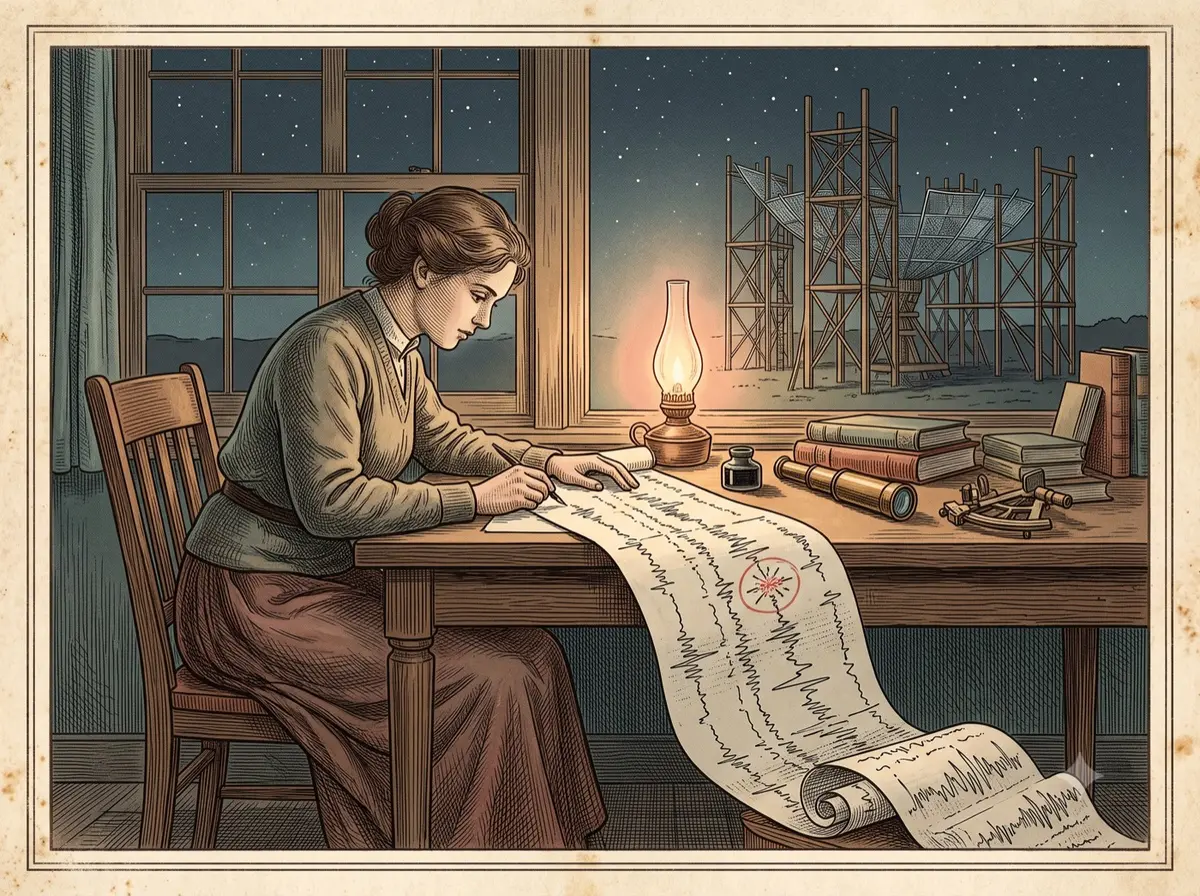
On a chart-recorder trace in the autumn of 1967, Jocelyn Bell Burnell, a 24-year-old PhD student in Cambridge, noticed something the size of a thumbnail — a smudge of ink she later called "a bit of scruff." It flickered past the same spot in the sky night after night, too regular to be a star, too fast to be anything astronomers knew about. For a while, only half-jokingly, she and her supervisor filed it under a name that captured how strange it was: LGM-1. Little Green Men.
By the Curiosities Desk · · 5 min read · Filed under Space · Today’s round
Part of The Person Who Would Not Drop It
What happened: The Graduate Student, the 'Little Green Men,' and the Nobel That Got Away
Susan Jocelyn Bell had come to the University of Cambridge from Northern Ireland to do a doctorate in radio astronomy under Antony Hewish. Her first job was manual labor. Over two years she helped build the Interplanetary Scintillation Array, a sprawling grid of wooden posts and wire covering several acres of field just outside Cambridge, designed to study quasars. When it switched on in July 1967, Bell was the person running it — and reading its output, which arrived as ink squiggles on rolls of paper. She was analyzing something like 96 feet (about 29 meters) of chart paper every night, by eye.
On 28 November 1967, she pinned down the scruff. The signal was pulsing with astonishing regularity: one sharp blip roughly every 1.3373 seconds, steadier than most clocks of the era. Nothing in the sky was supposed to tick like that. Hewish’s first instinct was that it had to be interference — something man-made, a faulty instrument, a passing satellite. Bell kept at it, and she had noticed the source rose and set with the stars, which meant it was out in space, not down on Earth.
The regularity was so eerie that the team briefly, seriously, had to consider the strangest possibility: a beacon from another civilization. As Bell Burnell later recalled, “we had no proof that it was an entirely natural radio emission… if one thinks one may have detected life elsewhere in the universe, how does one announce the results responsibly?” That worry evaporated a few weeks later when she found a second pulsing source, in a completely different part of the sky, ticking at a different rate. Two alien civilizations broadcasting at once, on the same night, was too much to swallow. Whatever this was, nature was making it.
The team published in Nature on 24 February 1968. A Daily Telegraph reporter compressed the clunky phrase “pulsating radio source” into a single word: pulsar. The first one, catalogued as CP 1919, sits in the constellation Vulpecula, and it is still ticking today.
Why it was strange: The Graduate Student, the 'Little Green Men,' and the Nobel That Got Away
Everything about the signal broke the rules. Stars shine steadily; they do not blink. A pulse every 1.3 seconds implied an object switching on and off — or spinning — impossibly fast. For something to rotate that quickly without flying apart, it had to be almost unimaginably small and dense. The astronomers Thomas Gold and Fred Hoyle supplied the answer: a neutron star, the collapsed core left behind when a massive star dies. Cram the mass of the Sun into a ball the width of a city, give it a lighthouse beam of radio waves, and set it spinning, and every time the beam sweeps past Earth you get a blip. The scruff wasn’t a machine or an alien. It was a dead star’s heartbeat.
Another scientist, told from the human side: The Farm Boy Who Discovered Pluto — and Now Sails Past It Forever.
What scientists learned: The Graduate Student, the 'Little Green Men,' and the Nobel That Got Away
Pulsars turned a theoretical curiosity into a hard fact. Neutron stars had been predicted back in the 1930s, but many physicists doubted such absurd objects really existed. CP 1919 proved they did — and handed science a set of natural instruments of exquisite precision. A pulsar is a cosmic clock and a gravity laboratory rolled into one. Because their pulses are so metronomic, pulsars let astronomers test Einstein’s general relativity, weigh distant stars, and hunt for gravitational waves rippling through space. They have even been used as celestial mileposts, plotted on the plaques bolted to the Pioneer spacecraft to show any finder where Earth is.
The same thread — Radio Astronomy — continues in The Pigeon Mess That Turned Out to Be the Echo of the Big Bang.
How it reaches us today: The Graduate Student, the 'Little Green Men,' and the Nobel That Got Away
Bell Burnell’s scruff opened an entire branch of astrophysics. Later astronomers discovered the first planets beyond our solar system by watching a pulsar’s ticks wobble, and today’s efforts to detect low-frequency gravitational waves rely on timing arrays of pulsars scattered across the galaxy. The 1974 Nobel Prize in Physics went to Antony Hewish and Martin Ryle for the work — but not to Bell, the person who built much of the array, spotted the signal, and insisted it was real. The astronomer Fred Hoyle publicly objected to the omission. Bell Burnell, with striking grace, said she thought students generally shouldn’t win Nobels. Decades of debate later, in 2018, she was awarded the $3 million Special Breakthrough Prize in Fundamental Physics — and promptly gave every penny away, to fund women, ethnic-minority, and refugee students trying to become physicists, the kind of outsiders she had once been.
Another person who would not drop the question: The Obituary That Supposedly Created the Nobel Prize — and That Nobody Has Ever Found.
FAQ
Who discovered the pulsar?
Jocelyn Bell Burnell found the first pulsar in 1967, while reading chart paper from a radio telescope at Cambridge that she had helped build. She and her supervisor, Antony Hewish, first labeled the signal LGM-1, for little green men. The 1974 Nobel Prize for the discovery went to Hewish and Martin Ryle, not to Bell Burnell.
What were the little green men?
LGM-1 was the nickname for a radio signal that pulsed every 1.3373 seconds, too regular to look like any star astronomers knew in 1967. A second pulsing source, found a few weeks later, ruled out a beacon from another civilization. The source was a neutron star. A newspaper later shortened “pulsating radio source” to pulsar.
Fun fact: The Graduate Student, the 'Little Green Men,' and the Nobel That Got Away
You have probably seen CP 1919 on a T-shirt. In 1979 the band Joy Division put a stark image of stacked pulses from Bell Burnell’s pulsar on the cover of their debut album, Unknown Pleasures — a diagram lifted from an astronomy textbook. It has since become one of the most reproduced graphics in music history, a dead star quietly ticking away on hoodies and posters worldwide, most of their owners with no idea they’re wearing the first pulsar ever found.
Sources: The Graduate Student, the 'Little Green Men,' and the Nobel That Got Away
- Hewish, A., Bell, S. J., Pilkington, J. D. H., Scott, P. F., & Collins, R. A. (1968). “Observation of a Rapidly Pulsating Radio Source.” Nature, 217, 709–713. https://doi.org/10.1038/217709a0
- Bell Burnell, S. J. “Little Green Men, White Dwarfs or Pulsars?” (after-dinner speech, first published in Annals of the New York Academy of Sciences, 1977). https://www.bigear.org/vol1no1/burnell.htm
- American Physical Society, “February 1968: Discovery of Pulsars Announced.” https://www.aps.org/publications/apsnews/200602/history.cfm
- Breakthrough Prize press release, “Special Breakthrough Prize in Fundamental Physics Awarded to Jocelyn Bell Burnell for Discovery of Pulsars” (6 September 2018). https://breakthroughprize.org/News/45
- “PSR B1919+21” and “Jocelyn Bell Burnell,” Wikipedia (cross-referenced against the cited Nature paper and primary sources above). https://en.wikipedia.org/wiki/PSR_B1919%2B21
Related stories: The Graduate Student, the 'Little Green Men,' and the Nobel That Got Away
- The Corn Geneticist Who Saw Genes Jump — And Waited 32 Years to Be Believed — She watched genes jump and waited 32 years for the field to agree
- The 100-Hour X-Ray Photograph That Revealed the Shape of DNA — The photograph that showed DNA’s shape, and the credit that went elsewhere
- The Pigeon Mess That Turned Out to Be the Echo of the Big Bang — An inexplicable hiss turned out to be the echo of the Big Bang