The Scientist Behind It · Biology
The Corn Geneticist Who Saw Genes Jump — And Waited 32 Years to Be Believed
In the summer of 1951, a 49-year-old geneticist stood up at the Cold Spring Harbor Symposium and told a room full of the world's leading biologists that genes were not fixed in place on a chromosome — some of them could move. She had spent nearly a decade building the case, working alone with nothing but corn kernels, a microscope, and colored pencils. When she finished, the room fell into an awkward, confused silence. Almost no one understood what she'd just shown them. It would be 32 years before the Nobel committee in Stockholm did.
By the Curiosities Desk · · 6 min read · Filed under Biology · Today’s round
Part of The Person Who Would Not Drop It
What happened: Jumping Genes
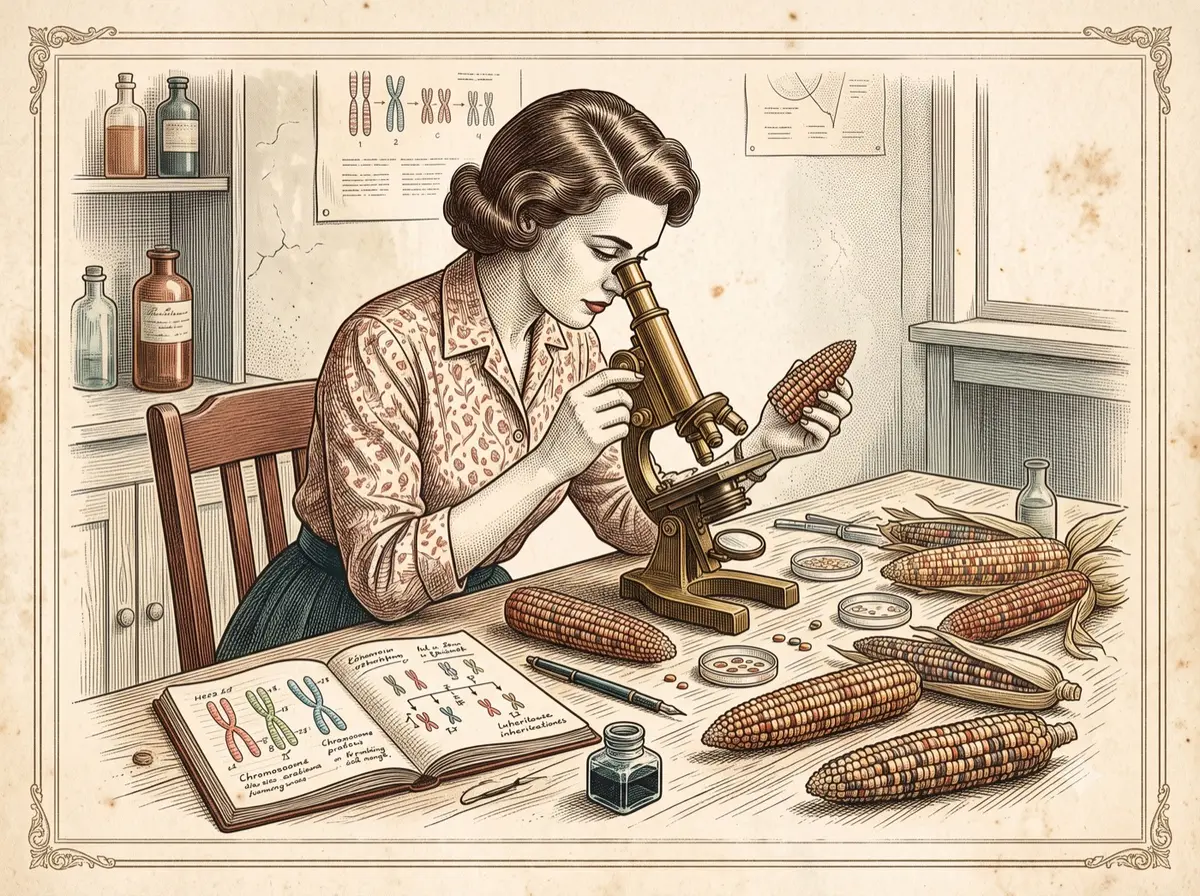
Barbara McClintock had already made her name in genetics before that 1951 talk. In the 1930s and early '40s, working first at Cornell and then at Cold Spring Harbor Laboratory on Long Island — where geneticist Milislav Demerec hired her in 1941 — she had mapped the physical structure of maize (corn) chromosomes in detail no one else had managed, and worked out how chromosomes physically break and rejoin during reproduction, a process now called the breakage-fusion-bridge cycle.
That grounding in chromosome structure is what let her notice something odd in her corn plants. Maize kernels are normally evenly colored, but McClintock kept seeing kernels with irregular streaks and spots of pigment — as if the genetic instructions for color were switching on and off unpredictably in patches of cells. Tracing the pattern back through generations of corn crosses, she identified two genetic elements responsible. One, which she named “Dissociation” (Ds), sat near pigment genes and could disable them, or let them run normally, depending on where it was. The other, “Activator” (Ac), controlled when and whether Ds moved at all. Neither element stayed put. They jumped from one location on a chromosome to another — and sometimes to a different chromosome entirely — and wherever they landed, they could switch a neighboring gene off, or back on. She called them “controlling elements.”
She published the core findings in 1950 in the Proceedings of the National Academy of Sciences, then presented the full picture at the Cold Spring Harbor Symposium the following year. The response was not hostility so much as bewilderment. Genetics in 1951 was still built on the assumption that genes sat at fixed addresses on a chromosome, like houses on a street that never moved. DNA’s double-helix structure hadn’t even been described yet — that was two years off. McClintock’s data, presented through generations of corn-kernel color patterns rather than the language molecular biologists were starting to prefer, struck many in the audience as either wrong or simply impossible to follow. The Nobel committee’s own later account noted that her results were also published in places few geneticists read closely, including the Cold Spring Harbor annual report and newsletters exchanged among corn breeders — hardly the venues that put a discovery in front of the whole field.
Discouraged but not shaken, McClintock scaled back publishing her more speculative interpretations after 1953, though she never stopped doing the underlying research. “If you know you’re right, you don’t care,” she later told biographer Evelyn Fox Keller. “You know that sooner or later it will come out in the wash.” It took most of a generation. In 1960, French biologists François Jacob and Jacques Monod described genetic control mechanisms in bacteria that echoed her ideas, and through the 1960s and '70s researchers began finding mobile genetic elements — soon dubbed “transposons” — in bacteria, fruit flies, and beyond. McClintock’s reputation was fully rehabilitated well before 1983, when the Nobel Assembly at the Karolinska Institute awarded her the Nobel Prize in Physiology or Medicine, unshared, “for her discovery of mobile genetic elements.” She remains the only woman to have won an unshared Nobel in that category.
Why it was strange: Jumping Genes
The strangeness wasn’t just the biology — it was the mismatch between what McClintock was describing and what everyone else believed a genome had to be. Genes were supposed to be stable, like text printed on a page. McClintock was arguing the text could rearrange itself, mid-book, with real consequences: a corn kernel could go from purple to colorless because a piece of DNA had physically relocated. She reached that conclusion using tools that already felt old-fashioned to a field racing toward molecular biology — a light microscope, hand-drawn chromosome maps, and the visible pigment of corn kernels as her readout. The method looked like natural history. The implications were closer to science fiction.
The same thread — Genetics — continues in The 100-Hour X-Ray Photograph That Revealed the Shape of DNA.
What scientists learned: Jumping Genes
McClintock’s controlling elements turned out to be a universal feature of life, not a quirk of corn. Transposons — segments of DNA that can copy or cut themselves out and reinsert elsewhere in the genome — have since been found in essentially every organism studied, from bacteria to humans. They’re a major reason genomes are far less static than mid-20th-century biologists assumed: an estimated 45% or more of the human genome consists of transposons or their evolutionary remnants. In bacteria, transposons carry and spread antibiotic-resistance genes from one microbe to another, which is part of why resistance can move so quickly through a population. In multicellular organisms, they’ve been shown to drive mutations, and — when they misfire — to contribute to some cancers. But they’ve also supplied raw material for evolutionary innovation, occasionally getting co-opted by genomes for entirely new functions.
Another person who would not drop the question: The Scientists Who Sat in a Room Hot Enough to Cook a Steak — and Walked Out Fine.
How it reaches us today: Jumping Genes
The gene-control logic McClintock described — genes switching on and off depending on signals elsewhere in the genome — anticipated ideas now central to modern molecular biology and epigenetics, the study of how gene activity is regulated without changing the underlying DNA sequence. Transposons themselves have become laboratory tools: engineered versions, like the “Sleeping Beauty” transposon system, are used to insert genes into cells for research and experimental gene therapies. Understanding transposon-driven antibiotic resistance also shapes how public health researchers track and try to slow the spread of drug-resistant bacteria. And her career is still cited as a touchstone case in discussions of how scientific communities sometimes need decades to catch up with evidence that arrives ahead of its time.
Another scientist, told from the human side: The Chemist Who Fed the World and Gassed the Trenches.
Fun fact: Jumping Genes
In 1981, two years before her Nobel Prize, McClintock became a member of the first-ever class of MacArthur Fellows — the “genius grant” — for work she’d already been quietly doing for four decades. She’d also been the first woman to win the National Medal of Science, in 1970, back when most of her transposon research was still considered a curiosity rather than a breakthrough.
Sources: Jumping Genes
- The Nobel Prize in Physiology or Medicine 1983 — Press Release, NobelPrize.org
- One experiment: McClintock’s historic discovery, Cold Spring Harbor Laboratory
- Barbara McClintock and the discovery of jumping genes, Proceedings of the National Academy of Sciences
- Barbara McClintock’s Transposon Experiments in Maize (1931–1951), Embryo Project Encyclopedia, Arizona State University
- Barbara McClintock, MacArthur Foundation
Related stories: Jumping Genes
- The 100-Hour X-Ray Photograph That Revealed the Shape of DNA — The photograph that showed DNA’s shape, and the credit that went elsewhere
- The Graduate Student, the ‘Little Green Men,’ and the Nobel That Got Away — She found pulsars; the Nobel went to her supervisor
- From Mendel’s Peas to CRISPR: A Short History of Genetics — Pea plants to gene editing in one long thread