The Scientist Behind It · Biology
The Geologist Who Tried to Eat His Way Through the Entire Animal Kingdom
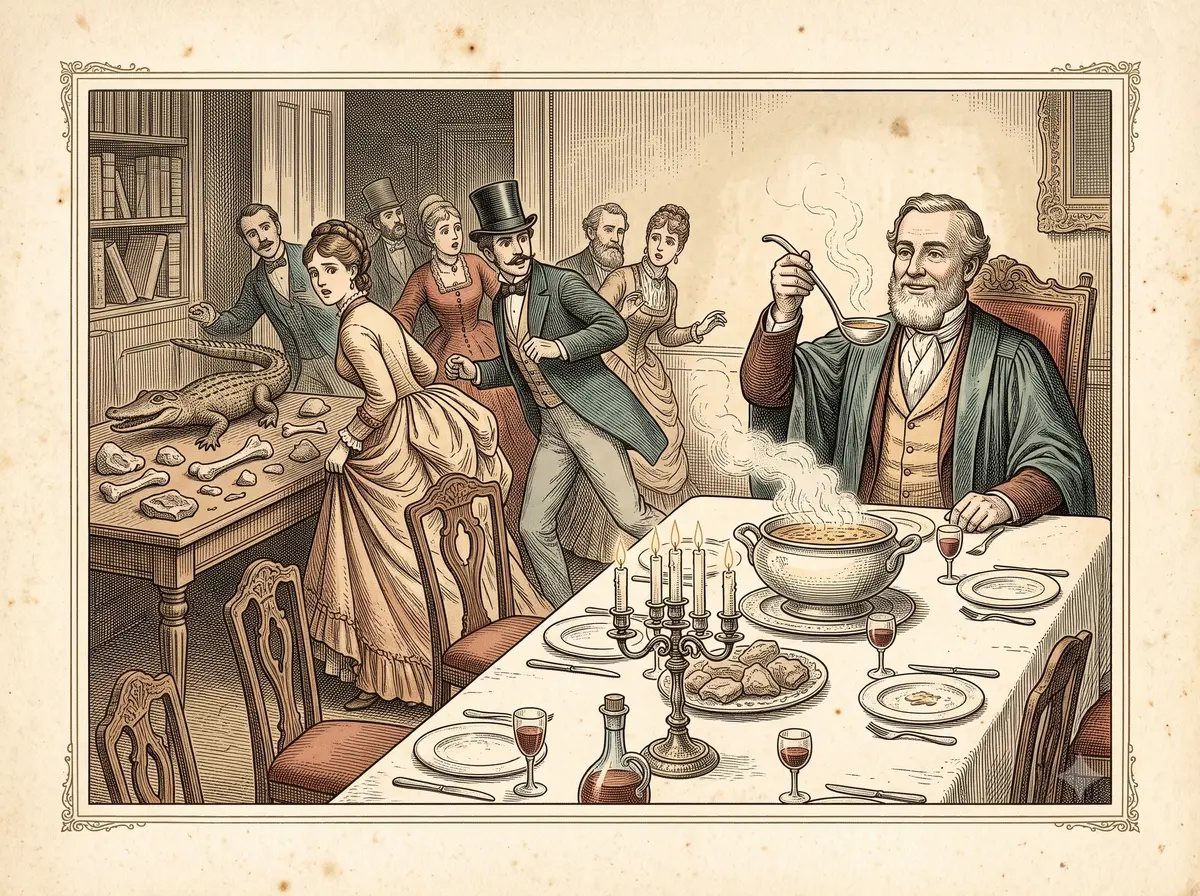
A dinner guest at Oxford is handed a bowl of soup. It is good — rich, faintly musky. Then the host, a clergyman and one of the most celebrated scientists in England, mentions that the animal he dissected that morning is now, more or less, in their bowls. Half the table bolts for the door. William Buckland, delighted, watches them go. He has been trying, quite deliberately, to eat one of every creature on Earth — and the alligator is simply the latest entry on the list.
By the Curiosities Desk · · 5 read · Filed under Biology · Today’s round
Part of The Person Who Would Not Drop It
What happened: The Geologist Who Tried to Eat His Way Through the Entire Animal Kingdom
William Buckland (1784–1856) was not a crank. He was the first Reader in Geology at Oxford, a Fellow of the Royal Society, winner of its Copley Medal, and eventually Dean of Westminster. He wrote the first full scientific account of a dinosaur, naming it Megalosaurus — “great lizard” — in 1824. He proved that a Yorkshire cave had been a prehistoric hyena den by studying the gnawed bones and fossilized droppings inside it, an analysis so careful it became a model for how science could reconstruct the deep past. He coined the word “coprolite” for fossil dung, and was so charmed by the specimens that he had a tabletop inlaid with them.
He also wanted to taste every animal in creation. The practice even had a name — zoophagy, from the Greek for “animal-eating” — and Buckland pursued it with the same appetite he brought to fossils. Guests at his table in Christ Church, and later at the Deanery, were served roast ostrich, hedgehog, tortoise, mice, rats, frogs, snails, and, when a relative’s horse had to be put down, pickled horse tongue (which the diners reportedly enjoyed until they were told what it was). One visitor’s diary famously grumbled: “tripe for dinner… don’t like crocodile for breakfast.”
Asked which animal tasted worst, Buckland had a ready answer: the common mole was “utterly horrible.” He later revised the ruling. There was, he told a friend, one thing even worse than a mole — the bluebottle fly.
The most notorious tale is one Buckland himself is not on record for, and which historians treat with caution. According to a memoir by Augustus Hare, published decades later, Buckland was shown a silver casket at Nuneham House said to hold the preserved heart of a French king, Louis XIV. “I have eaten many strange things,” he supposedly said, “but have never eaten the heart of a king before” — and swallowed it before anyone could stop him. The story is repeated everywhere, including in a sketch by Nathaniel Hawthorne. It may well be embellishment. The Geological Society itself has flagged the account as unverified, and it should be read as legend rather than confirmed fact.
Why it was strange: The Geologist Who Tried to Eat His Way Through the Entire Animal Kingdom
The strangeness is not just the menu. It is that the menu and the science came from the same impulse. This was an era when a gentleman naturalist was expected to observe animals — to classify, sketch, and shelve them. Buckland’s instinct was to observe them from the inside out. Tasting a panther chop or a slice of porpoise was, to him, one more data point about a creature, no different in spirit from measuring a fossil tooth.
That instinct made him a showman, and not everyone approved. A young Charles Darwin, who dined with him, came away unimpressed, calling Buckland a man “incited more by a craving for notoriety… than by a love of science.” But the buffoonery and the brilliance were tangled together. The man who served shock-alligator soup to make a point about prejudice — “See what imagination is!” he crowed after the walkout — was the same man teaching his students that a pile of ancient droppings could reveal who ate whom, a hundred million years ago.
Another scientist, told from the human side: The Corn Geneticist Who Saw Genes Jump — And Waited 32 Years to Be Believed.
What scientists learned: The Geologist Who Tried to Eat His Way Through the Entire Animal Kingdom
Buckland’s real legacy is a way of seeing. Before him, fossils were largely curiosities. He treated them as evidence in a case — testimony about vanished worlds. His study of Kirkdale Cave didn’t just find old bones; it argued, from tooth marks and dung, that hyenas had lived there and dragged in their prey, reconstructing an entire lost ecosystem from the leftovers.
Coprolites — fossilized feces — were central to that method. Guided partly by the fossil collector Mary Anning, who noticed odd stony lumps inside marine-reptile skeletons, Buckland realized these were digested meals turned to stone. Crack one open and you might find fish scales and tiny bones: a preserved menu of who was eating whom in the ancient sea. “Coprolites,” he wrote, “form records of warfare, waged by successive generations of inhabitants of our planet on one another.” It was, in a sense, the same curiosity as his dinner parties — what did this animal eat, and what does that tell us? — turned loose on creatures dead for ages.
Another person who would not drop the question: The Scientists Who Sat in a Room Hot Enough to Cook a Steak — and Walked Out Fine.
How it reaches us today: The Geologist Who Tried to Eat His Way Through the Entire Animal Kingdom
Every time a paleontologist reconstructs a dinosaur’s diet from its fossilized gut contents, or a museum places a Megalosaurus at the head of the family tree of dinosaurs, they are standing on ground Buckland cleared. The word “dinosaur” wouldn’t be coined until 1842, by his colleague Richard Owen, but Buckland’s 1824 description was the first brick in the field. Coprology — the study of fossil dung — remains a real and useful science, letting researchers trace ancient food webs, parasites, and even climate.
His appetite left a fainter but funnier mark: Buckland is the patron saint of a small, persistent tradition of scientists who insist on tasting their subjects, from field biologists sampling ants to researchers gamely chewing on lab-grown meat. His son Frank inherited both the fossils and the fork, hosting his own zoophagous feasts. The lesson, if there is one, is that curiosity rarely stays politely inside the lines.
A close cousin: The 100-Hour X-Ray Photograph That Revealed the Shape of DNA.
Fun fact: The Geologist Who Tried to Eat His Way Through the Entire Animal Kingdom
When Buckland died, the plot chosen for his grave turned out to sit atop a shelf of solid Jurassic limestone — the very rock he’d spent his life studying. The gravediggers had to break it up with explosives to bury him. Friends joked it was the great geologist’s final field experiment.
Sources: The Geologist Who Tried to Eat His Way Through the Entire Animal Kingdom
- William Buckland — Wikipedia (with primary-source citations followed below)
- Augustus Hare, The Story of My Life, Vol. 5 (1900) — the primary source for the “mole,” “bluebottle fly,” and Louis XIV heart anecdotes
- Peter Lund Simmonds, The Curiosities of Food (1859) — the alligator-soup dinner and “calf’s head” retort
- “Door 23: The Heart of a King,” The Geological Society Blog (2014) — examines and questions the veracity of the king’s-heart story
- William Buckland, Westminster Abbey — biography and scientific legacy
Related stories: The Geologist Who Tried to Eat His Way Through the Entire Animal Kingdom
- The Astronomer With a Metal Nose and a Beer-Drinking Elk — A gold nose, a private island, and a beer-drinking elk
- The Doctor Who Ate, Slept, and Worked on a Giant Scale for 30 Years — A doctor who spent 30 years living on a giant weighing chair
- The Student Who Drank Vomit to Prove Yellow Fever Wasn’t Contagious — A student drank black vomit to prove yellow fever was not contagious