The Scientist Behind It · Biology
The Scientists Who Sat in a Room Hot Enough to Cook a Steak — and Walked Out Fine
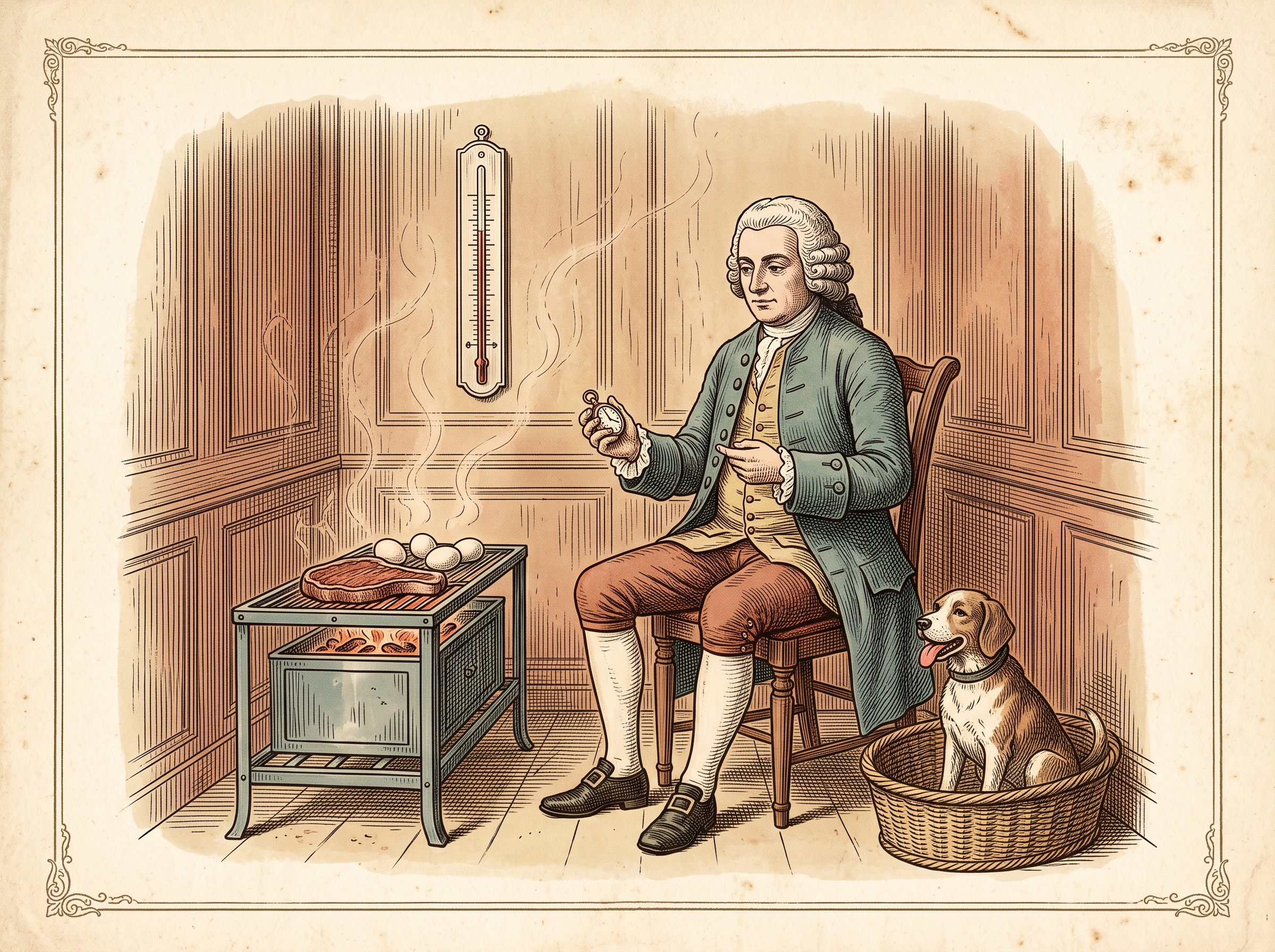
On a tin frame in a small London room, a beefsteak is slowly turning brown. A few feet away, a fully dressed man checks his pulse. The thermometer on the wall reads well past the boiling point of water. After a while the steak is "rather overdone," the eggs beside it are roasted hard, and the man — physician Charles Blagden — strolls out to write it all down. In the mid-1770s, he and a handful of Royal Society friends made a habit of this, all to answer one question: how much heat can a living body take?
By the Curiosities Desk · · 5 read · Filed under Biology · Today’s round
What happened?
The story begins with an invitation. “About the middle of January,” Blagden wrote in his account for the Royal Society’s journal, Philosophical Transactions, he and “several gentlemen” were invited by Dr. George Fordyce, a London physician and chemistry lecturer, to watch him test the effects of extremely hot air on the human body. Fordyce had already been trying it on himself, sitting for about twenty minutes in a room at 120°F. Afterward, a thermometer under his tongue and in his urine read roughly 100°F — barely above normal.
There was Joseph Banks, the botanist home from Captain Cook’s first voyage, who would later lead the Royal Society for over forty years. There was Daniel Solander, the Swedish naturalist who had sailed with him. There was Captain Constantine Phipps, a naval officer who had just led an expedition toward the North Pole. And there was Blagden, a young Edinburgh-trained doctor with a habit of measuring everything.
The men went in fully dressed and took turns. The air was so hot that, as Blagden put it, “even our watch-chains, felt so hot, that we could scarcely bear to touch them.” Their own breath, by contrast, felt cool on their fingers — the first sign that their bodies were somehow staying far colder than the air around them. In one session, Banks and Solander recorded readings around 210°F, within a degree or two of boiling water.
A few months later, the group went further, and Blagden published a second paper, “Further Experiments and Observations in an Heated Room,” in the same 1775 volume. This time the main thermometer climbed to one or two degrees above 260°F (about 127°C). Blagden also tried sitting in nearly 220°F heat with his upper body bare, shielded from the hot iron by a hanging cloth. After five or six minutes, he wrote, “a profuse sweat broke out, which gave me instant relief.” His pulse hit 136 beats a minute, but his body temperature barely moved.
Then came the kitchen experiments. Worried that his thermometers might be lying, Blagden added what amounted to a control group made of groceries. “We put some eggs and a beef-steak upon a tin frame,” he wrote. The eggs were “roasted quite hard” in about twenty minutes. One steak was “rather overdone” in thirty-three minutes; another was “almost dry” after forty-seven. A third, fanned with a pair of bellows to push hot air across it, was “pretty well done in thirteen minutes.” The men, sitting in the same air, stayed perfectly raw.
They even brought a dog — a 32-pound female, kept in a basket. She spent about half an hour in air around 220°F, panting, and by Blagden’s account was “not in the least injured by the heat.”
Why was it strange?
At the time, many physicians thought of the body as a kind of machine that simply took on the temperature of its surroundings, the way a stone warms in the sun. If that were true, a person in 260°F air should cook just like the steak.
Instead, the steak — a piece of dead muscle with no way to fight back — cooked, while the living people next to it held steady near 98°F. Whatever was keeping Blagden cool, the steak didn’t have it.
Blagden himself wasn’t sure what that something was. He correctly spotted that sweating mattered — it gave him “instant relief” — but he didn’t think it explained everything. He concluded that the body had a “power of destroying heat,” which he linked to life itself. It was an honest guess at a mystery nobody yet had the tools to solve.
Another person who would not drop the question: The Geologist Who Tried to Eat His Way Through the Entire Animal Kingdom.
What did scientists learn?
Blagden is now credited as one of the first scientists to clearly recognize the role of perspiration in thermoregulation — the body’s system for keeping its internal temperature steady. When sweat evaporates, it carries heat away from the skin, because turning liquid water into vapor takes a lot of energy.
His mystery “power” turned out to be mostly that, plus a few other tricks: extra blood pumped to the skin to shed heat (which explains the racing pulse) and the simple fact that dry air is a poor conductor of heat. Air touching your skin doesn’t hand over its warmth nearly as fast as hot water or hot metal would — which is why the watch-chains burned and the air merely felt awful.
The steak lacked all three defenses. It couldn’t sweat, had no circulation, and just sat there absorbing heat until it was done.
Another scientist, told from the human side: The Priest Who Put Tiny Taffeta Pants on Frogs to Find Out Where Babies Come From.
How does it affect us today?
Anyone who has sat in a sauna has repeated Blagden’s experiment. Traditional Finnish saunas often run near 175–195°F, and people tolerate them for the same reasons he did: the air is dry, and sweat evaporates fast.
The flip side is the more urgent lesson. Sweat only cools you if it can evaporate, and in very humid air it can’t. That’s why scientists today study heat stress using “wet-bulb temperature,” a measure that combines heat and humidity. A widely cited 2010 study in the Proceedings of the National Academy of Sciences proposed a wet-bulb temperature of 35°C (95°F) as a rough upper limit for human survival over several hours — a far lower number than Blagden’s 260°F, because humidity takes away the body’s best cooling tool.
A close cousin: The 100-Hour X-Ray Photograph That Revealed the Shape of DNA.
Fun fact
To Blagden, the best evidence that the hot room was real wasn’t the thermometer — it was dinner. The steak, he figured, couldn’t be fooled.
A note on heat safety: Blagden’s group were healthy adults in very dry air for short stretches, and even they came out with racing hearts. Heat illness is serious and can come on fast, especially for older adults, children, and anyone with heart conditions. On hot days, drink water, find shade or air conditioning, and if someone seems confused or stops sweating in the heat, call emergency services.
Sources
- Charles Blagden, “Experiments and Observations in an Heated Room,” Philosophical Transactions of the Royal Society 65 (1775): 111–123 (JSTOR) (primary source)
- Charles Blagden, “Further Experiments and Observations in an Heated Room,” Philosophical Transactions of the Royal Society 65 (1775): 484–494 (JSTOR) (primary source)
- “Experiments and Observations in a Heated Room (1774),” The Public Domain Review
- “Don’t try this at home: scientific injuries in the Royal Society archives,” The Royal Society blog
- Steven C. Sherwood and Matthew Huber, “An adaptability limit to climate change due to heat stress,” PNAS 107, no. 21 (2010): 9552–9555