The Scientist Behind It · Biology
The Priest Who Put Tiny Taffeta Pants on Frogs to Find Out Where Babies Come From
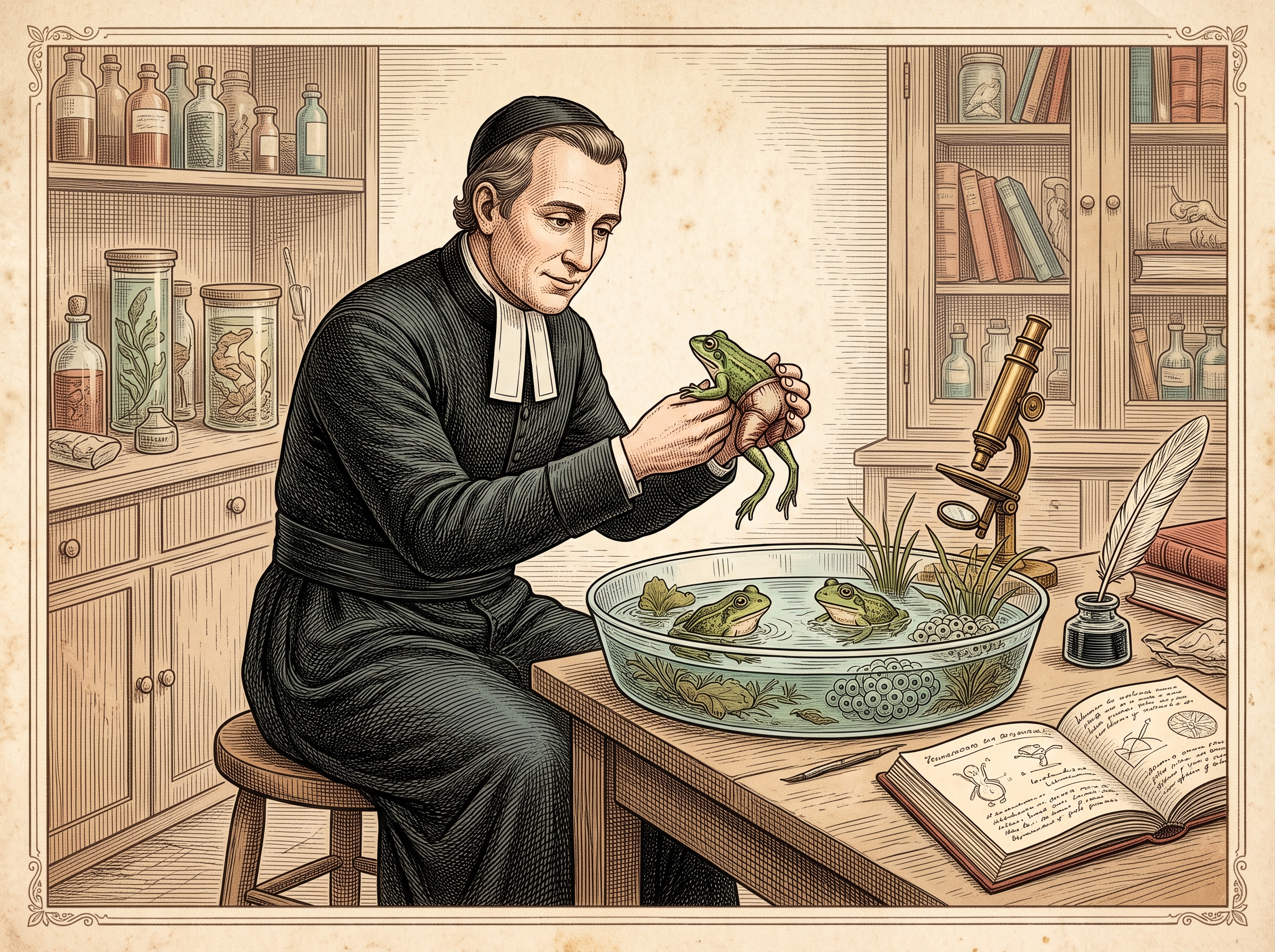
In the late 1770s, the Italian priest and naturalist Lazzaro Spallanzani carefully fitted a male green frog with a snug little pair of waxed-taffeta breeches, then set him loose among the females. The frog did not seem to mind the outfit at all. He courted, clasped, and did his best. And when it was over, Spallanzani peered into the tiny trousers, found a few precious drops inside, and used them to answer one of the oldest questions in biology.
By the Curiosities Desk · · 5 min read · Filed under Biology · Today’s round
What happened?
Lazzaro Spallanzani (1729–1799) was an ordained Catholic priest who spent most of his career as a professor of natural history at the University of Pavia, in northern Italy. He was restless and wildly productive. He attacked the idea of spontaneous generation (the belief that life could arise on its own from broth or rotting meat), studied how animals regrow lost tails and heads, and investigated how bats find their way in the dark.
In the 1770s he turned to a question that sounds almost too basic to need asking: how, exactly, does a new animal get started?
Scholars of the day were split. Most were “ovists,” who believed every future creature already existed, fully formed and folded up in miniature, inside the mother’s egg. Others were “spermists,” who thought the miniature person lived inside the wriggling “animalcules” first seen in semen under the microscope in 1677. Both camps agreed that the male contributed something. Nobody had cleanly proven what, or whether physical contact with it was even necessary.
Frogs made the perfect test subjects. Unlike mammals, they fertilize their eggs outside the body: the male clasps the female, she releases her eggs, and he releases his fluid over them in the water. Everything happens where a patient observer can see it.
The pants were not Spallanzani’s original idea. In a letter, the French physicist Abbé Jean-Antoine Nollet told him that decades earlier, he and the naturalist René-Antoine Ferchault de Réaumur had tried putting “breeches of waxed taffeta” on male frogs, though they hadn’t been able to tell whether fertilization took place. Spallanzani loved it. In his own account, he wrote that the idea, “however whimsical and ridiculous it may appear,” did not displease him, and he resolved to try it himself.
The results were clean. The males, he reported, pursued the females “with equal eagerness” despite the encumbrance. The females laid their eggs. But eggs from pairs where the male wore pants never developed. They simply sat there.
Then came the clever part. Spallanzani noticed drops of fluid collected inside the breeches. He gathered them up, touched them to fresh, unfertilized frog eggs, and watched those eggs begin to develop into tadpoles. He had just performed one of the earliest recorded artificial fertilizations, with a frog’s own trousers as the collection device.
He didn’t stop at frogs. Over the next few years he fertilized the eggs of toads, salamanders, and silkworms by hand. Then, around 1780, he tried a mammal. He shut a female water spaniel in a room once he suspected she was coming into heat, fed her himself, and kept the only key so no neighborhood dog could interfere. When the moment came, he took semen from a young male of the same breed, kept it at body temperature, and injected it with a fine syringe. About two months later, the spaniel gave birth to three lively puppies that resembled both parents. Spallanzani wrote that the joy he felt was among the greatest of his life as an experimenter.
Why was it strange?
The obvious answer is the pants. A respected professor and priest, corresponding with the leading scientists of Europe, was tailoring clothing for amphibians and writing about it with a straight face in a formal scientific treatise.
But the stranger twist is what Spallanzani concluded. He showed that semen was essential, and in follow-up experiments he found that as he filtered frog semen more and more thoroughly, it lost more and more of its power to fertilize. The answer was sitting in his filter. Yet he decided that the swimming “animalcules” were probably not the active ingredient at all. Like many naturalists of his time, he suspected they were little parasites living in the fluid, and he credited the thicker, non-swimming part of the semen instead.
It’s easy to wince at that in hindsight, but his reasoning made sense for 1780. Under an early microscope, nearly every liquid he examined, from pond water to broth, was crawling with tiny moving things. Why assume these particular wrigglers were special? He had designed an elegant experiment, collected exactly the right evidence, and still read it through the ideas of his era.
The same thread — Lazzaro Spallanzani — continues in The Blind Bats That Flew Perfectly in the Dark.
What did scientists learn?
Spallanzani’s frog pants established something that now seems self-evident: to start a new frog, the egg has to physically meet the male’s contribution. It isn’t enough for the parents to be nearby, or for some invisible “vapor” to drift across. Actual contact is required, and it can be arranged by hand.
That second point may be his biggest legacy. By fertilizing frog eggs in a dish and producing puppies with a syringe, he proved that reproduction could be separated from mating and controlled by an experimenter.
The question he got wrong was settled in 1824, when the Swiss and French scientists Jean-Louis Prévost and Jean-Baptiste Dumas showed that the sperm cells themselves are the active agents of fertilization. Later in the 1800s, researchers watching sea-urchin eggs under the microscope finally saw a single sperm enter an egg and fuse with it.
Another person who would not drop the question: The Geologist Who Tried to Eat His Way Through the Entire Animal Kingdom.
How does it affect us today?
Every artificial insemination and in vitro fertilization (IVF, in which eggs are fertilized outside the body in a lab) follows the path Spallanzani opened: collect the gametes, bring them together deliberately, and let development take over. Artificial insemination became a backbone of modern livestock breeding in the 20th century, and it is used today in zoos to help endangered species breed.
Frogs, fittingly, kept their place in the story. African clawed frogs became standard lab animals for studying how a fertilized egg turns into an embryo, and frog eggs remain among the most studied cells in developmental biology.
Another scientist, told from the human side: The Scientists Who Sat in a Room Hot Enough to Cook a Steak — and Walked Out Fine.
Fun fact
After Spallanzani died in 1799, his colleagues removed his bladder for study. It is still on public display today in the University History Museum at the University of Pavia.
Sources
- Lazzaro Spallanzani, Dissertations Relative to the Natural History of Animals and Vegetables, Vol. 2 (1789 English translation) — Biodiversity Heritage Library (primary source, including the frog-breeches account)
- Biodiversity Heritage Library, “Book of the Week: Frogs in Trousers?” (2011)
- Juan Antonio Barcat, “Lazzaro Spallanzani y la inseminación artificial,” Medicina (Buenos Aires) 69 (2009): 483–486
- “Lazzaro Spallanzani,” Encyclopaedia Britannica
- Holly Dunsworth, “Surprise! Semen Is Required,” SAPIENS