The Scientist Behind It · Biology
The Naturalist Who Rode a Caiman — Then Went Home and Built the World's First Nature Reserve
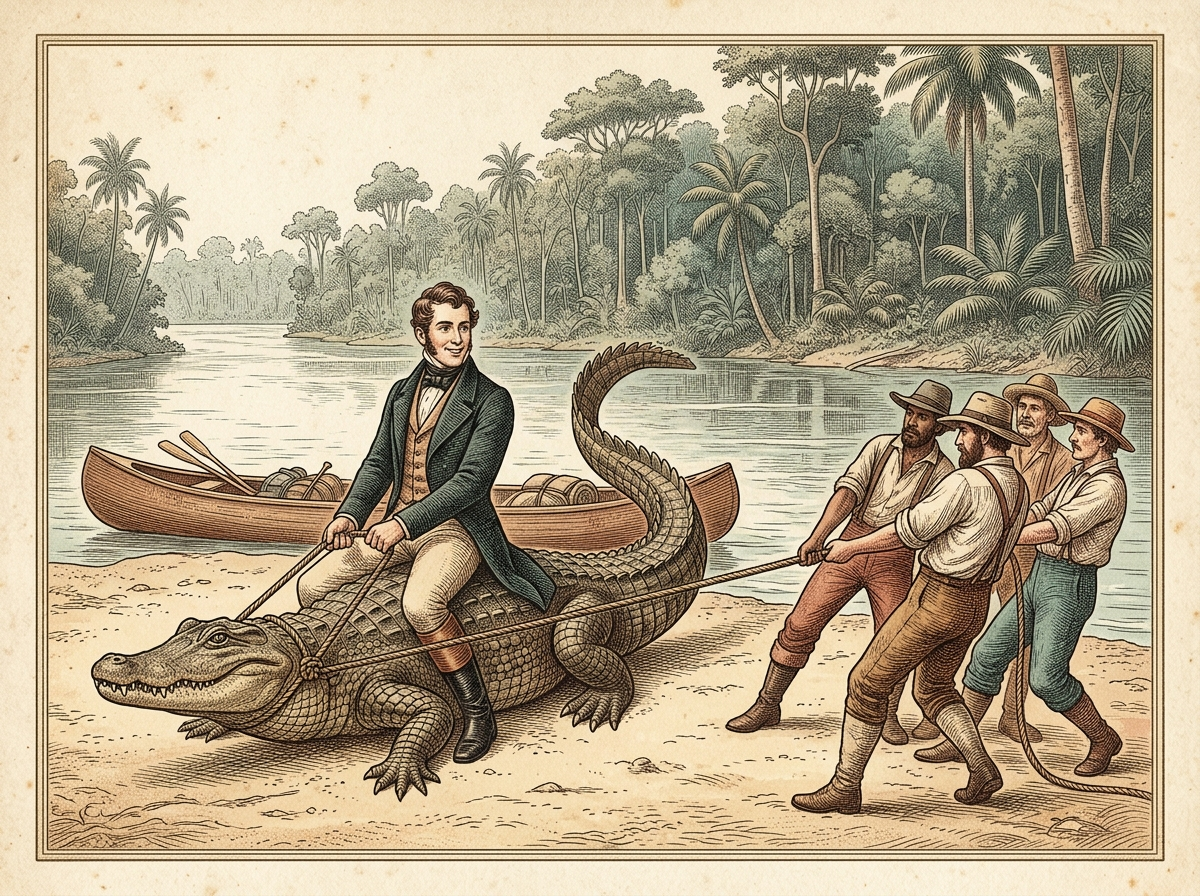
In 1820, on a sandbank in the forests of what is now Guyana, a Yorkshire gentleman crouched in front of a hooked and furious caiman, a South American cousin of the alligator, that his companions were hauling out of the river on a rope. As it reached him, he jumped. "I was on his back in an instant," Charles Waterton later wrote, and he steered by twisting the animal's front legs up behind it: "thus they served me for a bridle." Asked how he kept his seat, he had a ready answer. He had ridden with Lord Darlington's foxhounds for years.
By the Curiosities Desk · · 5 min read · Filed under Biology · Today’s round
What happened?
Charles Waterton was born in 1782 at Walton Hall, his family’s estate near Wakefield in Yorkshire. As a schoolboy he was more interested in birds’ nests and rats than lessons, and in 1804 he sailed to British Guiana to manage his uncle’s sugar plantations near Georgetown. Those plantations were worked by enslaved people, a fact that sits uneasily beside everything else in his story and is worth saying plainly.
From 1812 he began heading into the interior to study wildlife. He made four of these “wanderings,” in 1812, 1816, 1820, and 1824, sometimes walking barefoot through the rainy season, and in 1825 he published them as Wanderings in South America. The book became a bestseller and made him famous.
The caiman ride came on the third journey. Waterton wanted an undamaged specimen to preserve, so his party baited a wooden hook with four barbs and caught one. By his own measurement it was about ten and a half feet long. When the men pulled it onto the sand, he leapt on, tied its jaws shut, and was dragged more than forty yards up the bank before the animal gave in. It went home with him to Walton Hall, stuffed, and visitors asked to see it for decades.
Not every experiment went his way. By his own telling, he spent nights with a foot poking out of his hammock, hoping a vampire bat would bite him so he could describe the experience firsthand. None ever did.
His most important work came after he got home. Starting in 1821, he spent five years building a stone wall roughly nine feet high and more than three miles long around his park. It was meant to keep out foxes and poachers. Inside, he banned shooting, stopped fishing on the lake from late autumn until May, and kept gamekeepers’ dogs out during nesting season. He put up towers for watching birds and made some of the earliest known nest boxes. Then he opened the gates to the public for free. Historic England notes that asylum patients visited as part of their treatment.
He stayed active into old age. Visitors said he could scratch behind his ear with his big toe and was still climbing trees at about 80. He died in May 1865, aged 82, after a fall on the estate, and was buried in the grounds he had protected.
Why was it strange?
In the early 1800s, an English country park was mostly a place for shooting things. Naturalists studied birds by shooting and stuffing them, and landowners measured a good estate by how much game it produced. Waterton spent a fortune on a wall whose whole point was to keep the guns out, which was close to the opposite of what his neighbors were doing.
He was also a hard man to classify. The same person who rode a reptile for a specimen insisted that animals be watched alive in their own habitat. In Wanderings, he defended the sloth, which earlier naturalists had dismissed as deformed and miserable, arguing that it was well suited to life upside down in the trees. He also made fun of the scientific establishment. His taxidermy piece “The Nondescript,” made from the rear end of a howler monkey shaped into a face that looked almost human, was offered to readers as a mysterious unknown creature, and is usually read as a joke at the expense of anyone who believed such claims too easily.
He wasn’t the only naturalist of his day with unusual habits: see The Geologist Who Tried to Eat His Way Through the Entire Animal Kingdom.
What did scientists learn?
Waterton’s travels produced one finding that matters in operating rooms today. He watched the Macushi people of Guyana prepare wourali, the poison they used on blowpipe darts, now known as curare, and brought a supply back to Europe. Curare is a muscle relaxant: it blocks the signal from nerves to muscles, including the muscles you breathe with. So an animal that seems to die from it is actually suffocating.
That explained a famous demonstration. A donkey was dosed with curare until it seemed dead, then kept alive with bellows that pushed air into its lungs through a cut in its windpipe. When the drug wore off, the donkey got up and recovered completely. Waterton renamed her Wouralia, and she lived at Walton Hall for about another 25 years. The lesson was clear: if you keep the lungs working, the paralysis passes.
For an early machine built on the same idea, see The Two Vacuum Cleaners That Learned to Breathe.
How does it affect us today?
Drugs descended from curare relax patients’ muscles during modern surgery, while a ventilator does their breathing, much as the bellows did for Wouralia. Waterton didn’t invent anesthesia, but his supply of wourali and the experiments it led to helped lay the groundwork for it.
His park mattered too. In 2024 Historic England registered Waterton Park and listed its boundary wall, calling it possibly the world’s first nature reserve and the first known landscape designed to protect wildlife. His book also reached a wide audience. The Linda Hall Library credits Wanderings with introducing many English readers, Charles Darwin and Alfred Russel Wallace among them, to tropical wildlife.
There’s also a direct link to Darwin. In Guyana, Waterton taught taxidermy to John Edmonstone, a formerly enslaved man who later moved to Edinburgh. In 1826, Edmonstone gave a 17-year-old Darwin about 40 hours of lessons in preserving birds, and Darwin remembered him as “a very pleasant and intelligent man.”
Another case of a stuffed specimen leading people astray: The Platypus Pelt a Museum Keeper Cut Open With Scissors, Hunting for the Stitches.
Fun fact
In 1856, Waterton told a visitor there were “no stuffed animals in this house,” then pulled the head off a preserved polecat to prove it. His specimens were hollow shells, with no stuffing inside.
Sources
- Waterton, Charles (1825). Wanderings in South America, the North-West of the United States, and the Antilles, in the Years 1812, 1816, 1820, and 1824. Cassell edition with introduction by Norman Moore, Project Gutenberg. https://www.gutenberg.org/ebooks/31811
- Historic England (27 March 2024). “World’s First Nature Reserve Given Protection.” https://historicengland.org.uk/whats-new/in-your-area/yorkshire/worlds-first-nature-reserve-given-protection
- Wakefield Museums and Castles. “Who Was Charles Waterton?” and “Bottle of Three Wourali Poisoned Arrowheads, 1839.” https://museumsandcastles.wakefield.gov.uk/discover/collections/people/charles-waterton/about and https://museumsandcastles.wakefield.gov.uk/discover/collections/people/charles-waterton/wourali
- Linda Hall Library. “Scientist of the Day: Charles Waterton.” https://www.lindahall.org/about/news/scientist-of-the-day/charles-waterton/
- The Linnean Society of London (2018). “The Man Who Taught Charles Darwin Taxidermy.” https://www.linnean.org/news/2018/10/02/the-man-who-taught-charles-darwin-taxidermy