The Scientist Behind It · Chemistry
The Obituary That Supposedly Created the Nobel Prize — and That Nobody Has Ever Found
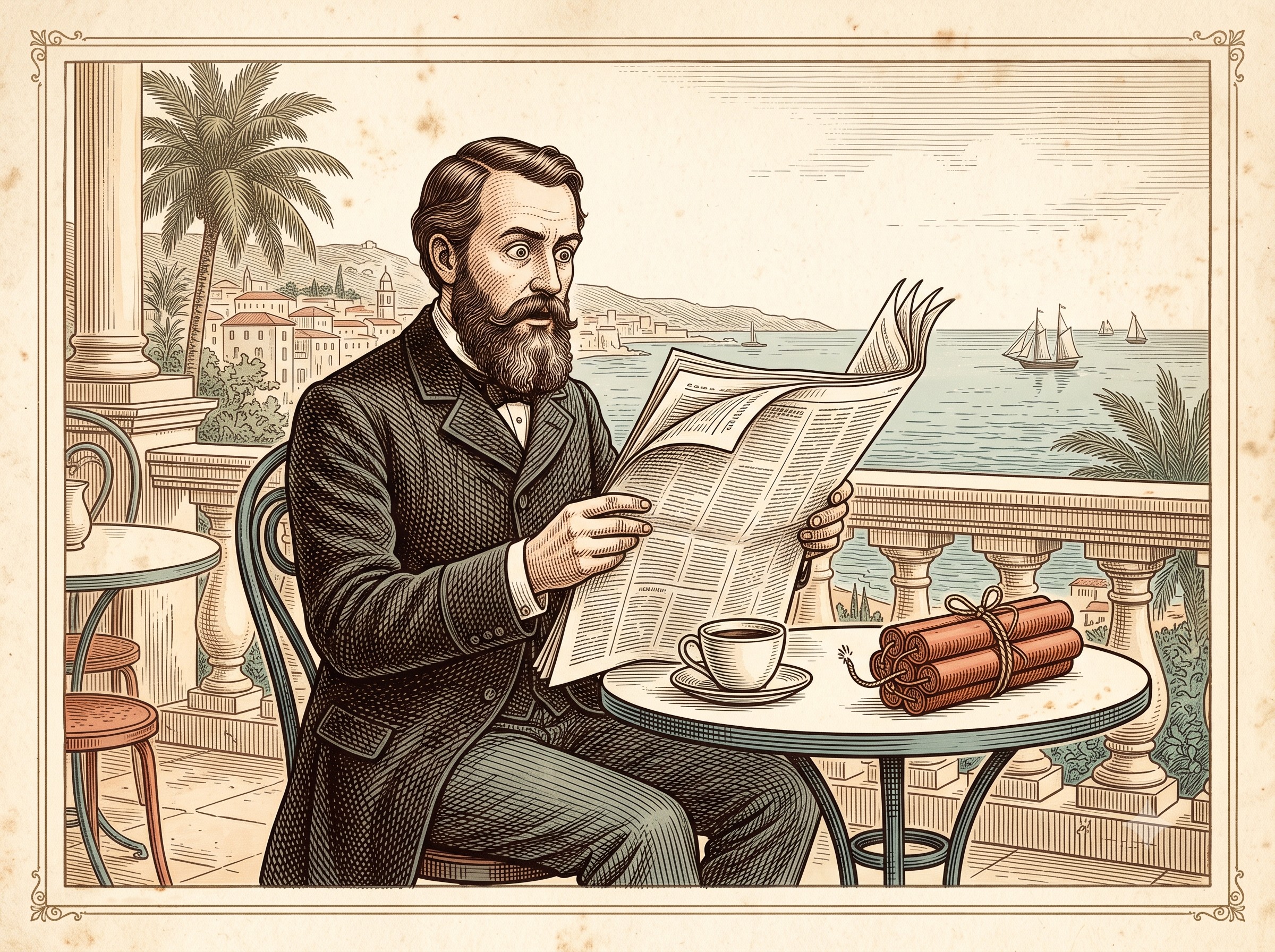
In April 1888, a Paris newspaper announced the death of Alfred Nobel, who was very much alive and, presumably, holding the paper. The notice was two sentences long. It did not call him a monster. It called him "a man who cannot very easily pass for a benefactor of humanity" — which is, in its own way, a far more devastating thing to read about yourself over breakfast.
· 5 min read · Filed under Chemistry
What happened?
Alfred Nobel had four brothers, two of whom lived to adulthood alongside him. Ludvig, the elder, had stayed behind in St. Petersburg when the family’s Russian fortunes collapsed, and had built the Nobel brothers into oil barons of the Caspian. On 12 April 1888, Ludvig died while staying in Cannes, on the French Riviera.
The French press noticed that a Nobel had died in Cannes. At least one paper got the wrong one. Le Figaro ran a short notice reporting that the deceased was “Mr. Nobel, inventor of dynamite,” and added, helpfully, that “Mr. Nobel is Swedish.” The paper printed a correction the following day. A friend of Alfred’s, Juliette Adam-Lambert, wrote to him expressing relief that the rumor was false — a letter that survives in the archives and is the best surviving evidence that Alfred knew about the mix-up at all.
Seven and a half years later, on 27 November 1895, Nobel signed a will at the Swedish-Norwegian Club in Paris directing that the bulk of his estate be converted into a fund, the interest to be distributed annually as prizes to “those who, during the preceding year, have conferred the greatest benefit to humankind.” Physics, chemistry, physiology or medicine, literature — and peace. He died in San Remo, Italy, on 10 December 1896, aged 63, with 355 patents to his name and no public explanation for what he had just done.
Into that silence, the story rushed. The version most of us know goes like this: the 1888 obituary ran under the headline “Le marchand de la mort est mort” — “The merchant of death is dead” — and declared that Nobel “became rich by finding ways to kill more people faster than ever before.” Horrified at his own epitaph, he rewrote his will to buy a better one.
It is a wonderful story. Britannica prints it. So did the Nobel Foundation’s own outreach material. The trouble is that no one has ever produced the newspaper.
Why was it strange?
The oddity here isn’t a man reading his own death notice — that happened, and the actual clipping has been located in the digitized Figaro archive. The oddity is that the sentence everyone quotes appears to postdate the event by more than forty years.
The phrase “merchant of death” doesn’t show up in English as an epithet for arms dealers until the early 1930s, when it was attached to the Greek-born munitions financier Basil Zaharoff in a 1932 magazine piece and then popularized by the 1934 book Merchants of Death. If a French paper in 1888 had coined it first, it left no trace.
The trail instead points to Nicholas Halasz’s 1959 Nobel: A Biography, which opens with Alfred reading his own obituary and grasping that he would be remembered as “quite simply a merchant of death.” Halasz’s book carries no citations at all. The Swedish biographer Kenne Fant repeated a version of the line in 1991, and from there it flowed into encyclopedias, museum placards, and roughly every commencement speech ever given about legacy.
So the strange part is not that a myth exists. It’s that a myth about checking your sources got laundered into the origin story of the world’s most prestigious prize for careful work.
What did scientists learn?
Two things, one about explosives and one about evidence.
Nobel’s actual scientific achievement was making an unusable substance usable. Nitroglycerine — invented by the Italian chemist Ascanio Sobrero in 1847 — released far more energy than gunpowder but detonated unpredictably under heat or shock. It killed Nobel’s youngest brother Emil in an 1864 blast at the family’s Stockholm laboratory. Nobel’s insight was that absorbing the liquid into kieselguhr, a porous silica-rich sediment made of fossilized algae shells, produced a stable paste that could be shaped into rods and would only detonate when you told it to, via his blasting cap. He patented it in 1867 as dynamite. Mining, tunneling, and canal-building got dramatically cheaper; so did war.
The second lesson is the one historians keep relearning. The “merchant of death” story survived for six decades not because anyone verified it but because it was good — a tidy moral arc with a villain, a mirror, and a redemption. Claims that feel explanatory get repeated; repetition gets mistaken for corroboration. The fix is unglamorous: follow the footnote to the actual page. In this case, someone eventually did, and found a very different two sentences.
How does it affect us today?
The prizes are real regardless of what prompted them, and there is decent evidence for a less dramatic explanation. Nobel spent twenty years corresponding with Bertha von Suttner, the Austrian countess who worked briefly as his secretary in 1876 before leaving to marry, then became one of Europe’s leading peace campaigners and wrote the 1889 anti-war novel Lay Down Your Arms. She badgered him for years; in 1892 he attended a peace congress and came away energized. In 1905 she received the Nobel Peace Prize, and Henri Dunant — the Red Cross founder who shared the first one in 1901 — wrote to tell her the prize was, in effect, her doing.
Nobel himself never accepted the premise that he was on the wrong side. “Perhaps my factories will put an end to war sooner than your congresses,” he wrote to Suttner in 1890, arguing that weapons terrible enough would make war unthinkable. It’s a theory the twentieth century tested at length. The Nobel Prizes, first awarded in 1901, are still handed out every 10 December — the anniversary of his death.
Fun fact
The insult Nobel actually read is the more quotable one. Rendered from the French, the whole notice runs: “A man who cannot very easily pass for a benefactor of humanity died yesterday in Cannes. It is Mr. Nobel, inventor of dynamite. Mr. Nobel is Swedish.” Three sentences, and one of them is just his nationality.
Sources
- Le Figaro, April 1888 — digitized issue, Bibliothèque nationale de France (Gallica) — the primary source: the original erroneous death notice, plus the correction printed in the following day’s issue.
- Full text of Alfred Nobel’s will — NobelPrize.org
- Nils Ringertz, “Alfred Nobel – his life and work” — NobelPrize.org — dynamite, the 355 patents, Bertha von Suttner, and the 1896 death in San Remo.
- Evan Andrews, “Did a Premature Obituary Inspire the Nobel Prize?” — HISTORY — on the missing clipping and the competing explanations.
- Kathy Joseph, “Alfred Nobel’s Obituary Calling him a ‘Merchant of Death’ Never Happened” — Kathy Loves Physics — the fully footnoted trace back to Halasz (1959) and the 1932–34 origin of the phrase.
Related stories
- The Chemist Who Fed the World and Gassed the Trenches — The man who fed billions and invented gas warfare
- The Graduate Student, the ‘Little Green Men,’ and the Nobel That Got Away — She found pulsars; the Nobel went to her supervisor
- The Superheavy Element That Only Existed in One Scientist’s Data — An element that existed only in one researcher’s fabricated data