The Scientist Behind It · Chemistry
The Chemist Who Offered to Turn Holland's Sand Dunes Into a Gold Mine — and Passed the Test
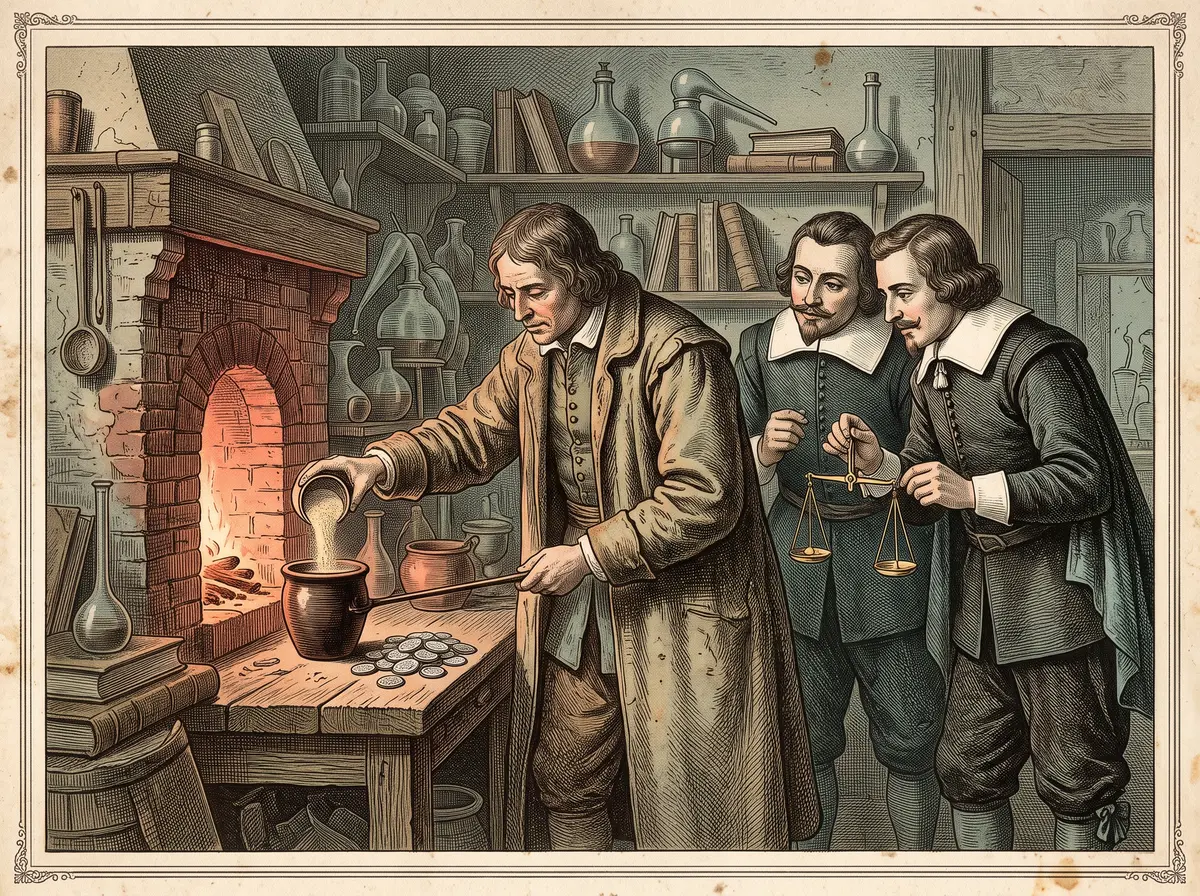
In March 1679, in a workshop in Amsterdam, a German chemist named Johann Joachim Becher melted ordinary dune sand into glass, stirred molten silver into it, and kept the whole glowing mass cooking for hours. Watching him were two officials sent by the government of Holland, one of them a respected mathematician. At the end, there was gold in the silver. Not much — but enough that the States of Holland agreed it had worked.
By the Curiosities Desk · · 5 min read · Filed under Chemistry · Today’s round
Part of The Person Who Would Not Drop It
What happened: The Chemist Who Offered to Turn Holland's Sand Dunes Into a Gold Mine —
Becher, born in Speyer in 1635, was one of the 17th century’s great idea men. By his late twenties he had written on medicine, metals, and even a scheme for a universal written language. He served as a physician and adviser at the courts of Mainz, Bavaria, and Vienna, where he pitched silk factories, trading companies, colonies in South America, and a canal to join the Rhine and the Danube. Many of his ventures stalled or failed, and some of them made him enemies. In 1678, after a brief imprisonment following a failed attempt to enforce an imperial ban on French goods, he went to the Dutch Republic.
He brought with him an old plan. Back in 1673 he had written to an imperial diplomat with a proposal for the States of Holland, the province’s governing assembly: let him set up an “eternal mine” that would pull gold out of the sand along Holland’s coast. He promised it could earn the state around a million rixdollars a year, with no loans and no new taxes on butter or beer. According to the Dutch chemist and historian H.A.M. Snelders, the idea reached Holland’s top official, the Grand Pensionary Caspar Fagel, who raised it with the States that September. Then the war with France got in the way.
By 1678 the talks were back on. Becher haggled over his cut — first 10 percent of a year’s profit, then a lump sum plus 2 percent a year — and the States offered him 50,000 rixdollars and 2 percent of annual profits. Before committing, though, they wanted proof. They set aside 3,000 guilders for a trial and named two commissioners to witness it: Michiel ten Hove, the pensionary of Haarlem, and Johannes Hudde, an Amsterdam official and accomplished mathematician.
Becher ran a first test with the Amsterdam assayer Laurens Keerwolf in February 1679, then repeated it for the commissioners on March 22. Snelders’ account of the method goes like this: Becher melted sand with added ingredients into glass in bellows-fired furnaces, then held the molten mass together with silver for a long time. Any gold, he reasoned, would end up dissolved in the silver, which could later be separated and reused.
The numbers were modest but real. For each mark of silver — about 246 grams — he recovered about 6 aas of gold, roughly a third of a gram. A secret check by a second assayer in The Hague came out the same. The States accepted the result.
Then they did the arithmetic. About five-sixths of the gold went to pay for fuel, materials, and labor, leaving a net gain of roughly one aas per mark of silver. The States approved a larger trial using more than 111 marks of silver, but remained wary, and the negotiations drifted until they were dropped. At the end of 1679 Becher left for England — without his family, according to the Dictionary of Scientific Biography — just as the bigger test was supposed to happen. He spent his last years inspecting mines in Scotland and Cornwall for Prince Rupert and died in London in October 1682.
Why it was strange: The Chemist Who Offered to Turn Holland's Sand Dunes Into a Gold Mine —
The strange part is that nobody seems to have been lying. Becher did produce gold, and two independent assayers confirmed it. Snelders concludes that Becher was no swindler: he sincerely believed metals grow inside the earth and slowly “ripen” toward gold, so pulling gold from sand made sense within his worldview.
The trouble was where the gold came from. Silver from that era was rarely perfectly pure, and it often carried tiny traces of gold. The most likely explanation — the one Snelders gives — is that the gold came from the silver Becher added, and possibly from traces already in the sand. Becher had built a careful, witnessed experiment that measured his own ingredients.
For a far less sincere seaside gold scheme two centuries later, see The Minister Who Sold Gold From Seawater — With a Diver Hiding Under the Wharf.
What scientists learned: The Chemist Who Offered to Turn Holland's Sand Dunes Into a Gold Mine —
Becher’s lasting influence came from a book, not a mine. In Physica subterranea (1669), he argued that minerals contain three kinds of “earth.” One of them, terra pinguis — “fatty earth” — was the part that made things burn. His follower Georg Ernst Stahl reworked that idea into phlogiston, an invisible substance supposedly released by burning.
Phlogiston turned out to be wrong; in the late 1700s Antoine Lavoisier showed that burning involves combining with oxygen, not releasing something. But for most of a century, phlogiston gave chemists a shared framework that organized experiments and connected burning with the rusting of metals.
The gold trial carries its own lesson: a test only proves what it controls for. Without checking how much gold was already in his silver, Becher couldn’t tell creation from recovery. For another alchemist whose gold hunt ended somewhere unexpected, see The Alchemist Who Boiled Urine Looking for Gold and Found Phosphorus.
How it reaches us today: The Chemist Who Offered to Turn Holland's Sand Dunes Into a Gold Mine —
Modern chemistry insists on blanks and controls — running the same procedure without the key ingredient to see what shows up anyway. Assayers today routinely account for trace metals already present in their reagents, exactly the gap that let a sliver of gold look like a discovery in 1679.
Becher’s wider ideas also outlived him. He became a leading figure in cameralism, a German-speaking school of economic thought that stressed state-run industry and trade. And his canal idea did eventually come true: a navigable link between the Rhine and Danube basins opened in 1992, more than three centuries after he proposed one.
Becher, still pitching an eternal mine after the sums failed, sits with the others who would not let go in The Person Who Would Not Drop It.
Fun fact: The Chemist Who Offered to Turn Holland's Sand Dunes Into a Gold Mine —
Becher described his own profession with obvious affection. In a passage usually translated as calling chemists “a strange class of mortals,” he wrote that he would rather die than trade his life of smoke and soot for the throne of the king of Persia.
Sources: The Chemist Who Offered to Turn Holland's Sand Dunes Into a Gold Mine —
- H.A.M. Snelders, “Het tijdperk van de alchemie”, in De geschiedenis van de scheikunde in Nederland, Deel 1 (Delft University Press, 1993), via DBNL.
- “Becher, Johann Joachim”, Complete Dictionary of Scientific Biography, via Encyclopedia.com.
- “Johann Joachim Becher”, Encyclopaedia Britannica.
- John H. Lienhard, “No. 2088: Johann Joachim Becher”, The Engines of Our Ingenuity, University of Houston.
- Pamela H. Smith, The Business of Alchemy: Science and Culture in the Holy Roman Empire (Princeton University Press, 1994; reissued 2016).