The Scientist Behind It · Chemistry
The Chemist Who Got Parliament to Make Gold-Making Legal Again
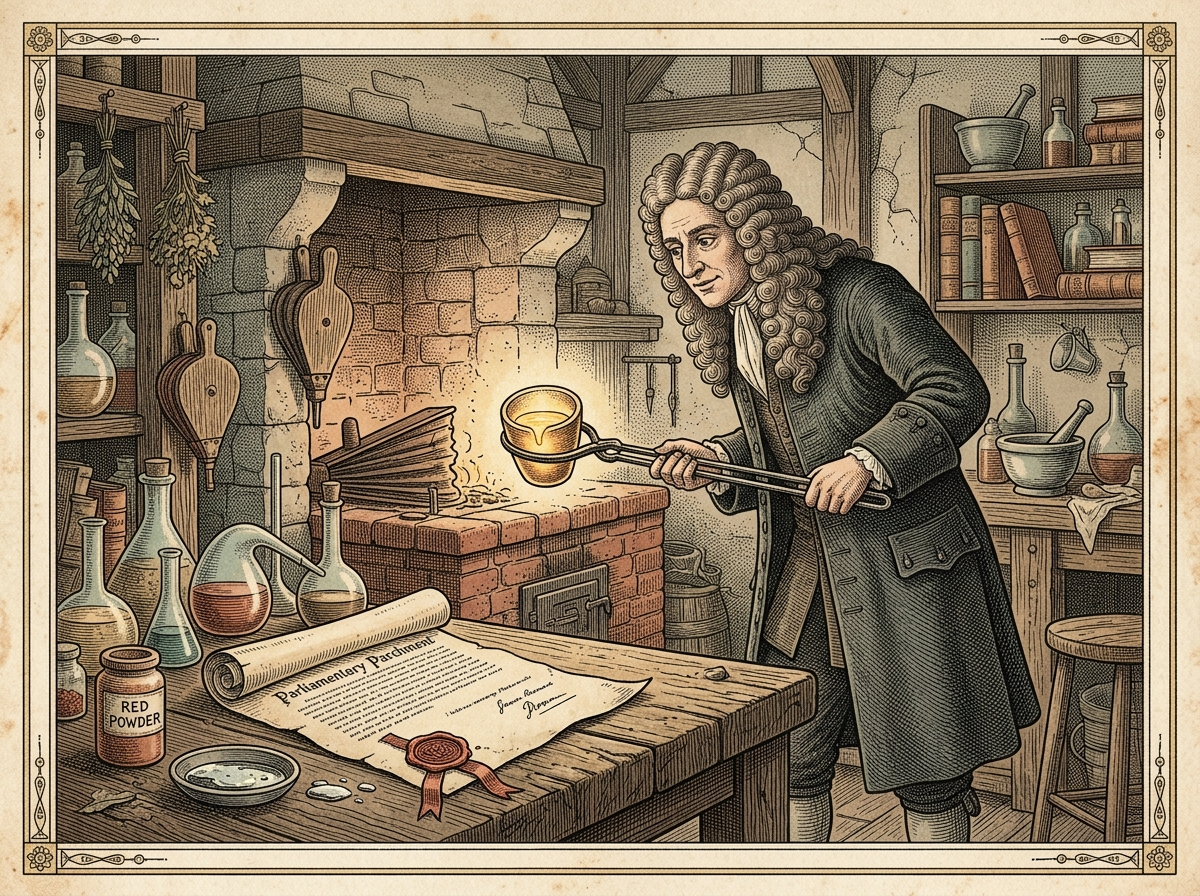
In 1689, the English Parliament passed a law that, among other things, made it legal again to turn ordinary metal into gold. Nobody had actually managed to do it. The man widely credited with getting that law passed was Robert Boyle — the scientist often called the father of modern chemistry, the "Boyle" in Boyle's law, and a lifelong, very quiet alchemist.
By the Curiosities Desk · · 5 min read · Filed under Chemistry · Today’s round
What happened?
The ban was old. In 1404, under King Henry IV, Parliament declared that it would be a felony to “use the craft of multiplication of gold or silver.” Felonies could carry the death penalty. “Multiplying,” in the language of the day, meant using alchemy to make more precious metal than you started with. The worry was practical. If someone could make gold at will, they could flood the country with it, debase the coinage, or bankroll a rival to the Crown. And the trade was crowded with con artists who took people’s savings promising to grow them in a furnace.
The law did not stop royal curiosity. Roughly four decades later, Henry VI began issuing special licences that let selected alchemists work anyway, in the hope that a success might help pay for his wars. But for ordinary experimenters, the 1404 statute stayed on the books for nearly three centuries.
Robert Boyle was born in 1627 in Ireland, the youngest son of the wealthy Earl of Cork. He set up laboratories in Oxford and later London, worked with his assistant Robert Hooke on an air pump, and in 1662 published the pressure-and-volume relationship we now call Boyle’s law. His 1661 book The Sceptical Chymist is often read as the moment chemistry started to break away from alchemy.
That reading leaves out a lot. Boyle never stopped hunting for the philosophers’ stone, the legendary substance said to transmute, or change, base metals into gold. He wrote about it in private codes and shared results only with trusted correspondents. In 1676 he published a paper in the Royal Society’s journal, Philosophical Transactions, about a special mercury that grew hot when mixed with gold — hinting that he had made the “philosophical mercury” alchemists prized. He signed it “B.R.,” a fairly transparent disguise. A young Isaac Newton, himself a dedicated alchemist, wrote to the journal’s editor urging silence, warning that such secrets might cause “immense dammage to the world” if the old writings were true.
Then came 1689. After the Glorious Revolution put William and Mary on the throne, Parliament passed an act titled “An Act to Repeale the Statute made in the fifth yeare of King Henry the Fourth against the Multiplying Gold and Silver.” It received royal assent on 20 August 1689. Boyle’s 18th-century biographer Thomas Birch recorded that Boyle was instrumental in getting it through. Isaac Newton thought so too: in a letter to the philosopher John Locke in August 1692, he said a secret gold-making recipe of Boyle’s was, in Newton’s view, the very reason Boyle had procured the repeal.
Boyle died on 31 December 1691, just over two years after the law changed. He had shared a recipe involving a mysterious “red earth” and mercury with Locke and Newton, and left samples behind. Newton advised Locke not to spend money on a hasty trial. Newton’s own notes suggest he soon went back to his furnaces and tried it himself.
Why was it strange?
We tend to picture the Scientific Revolution as a clean break: alchemy out, chemistry in. Boyle is usually the hero of that story. Yet the same man who insisted on careful, repeatable experiments also spent political capital making sure he, and others, could legally chase transmutation.
He was not being sneaky about chemistry so much as sincere about alchemy. Boyle reportedly claimed to have witnessed lead turned into gold more than once. In 1678 he even published an account of the reverse: a stranger’s dark red powder, dropped into two drams of melted gold, supposedly left a brittle, dirty, silvery metal. He called it an “anti-elixir.” Historians still debate whether an assistant fooled him.
To modern eyes, a founding member of the Royal Society lobbying for gold-making rights sounds like a joke. To Boyle, it was a reasonable step for an open question.
Gold-making scams did not end there; see The Minister Who Sold Gold From Seawater — With a Diver Hiding Under the Wharf.
What did scientists learn?
Boyle’s belief in transmutation was not wild guessing by the standards of his day. He thought all matter was built from tiny particles, and that gold and lead might differ only in how those particles were arranged. Rearrange them, and one metal could become another.
He was half right. Matter is made of particles, but the identity of an element is set by the number of protons in the nucleus of each atom: lead has 82, gold has 79. No chemical reaction — heating, mixing, dissolving — touches the nucleus. That is why centuries of furnaces never produced a single grain of gold from lead. Transmutation only became real in the 20th century, with nuclear physics, and turning lead into gold in a particle accelerator yields a few atoms at a ruinous cost.
Boyle’s careful habits of measuring, recording, and publishing helped build the methods that eventually showed his favorite dream was impossible by chemistry alone.
How does it affect us today?
Historians like Lawrence Principe have spent decades decoding Boyle’s private alchemical papers, and the picture that emerged changed how we teach the history of chemistry. Alchemy was not simply the superstitious ancestor that chemistry discarded. Its practitioners developed lab techniques, purification methods, and a taste for experiment that chemists inherited directly.
The 1689 act also had a more down-to-earth legacy. It declared that a mine of copper, tin, iron, or lead would no longer count as a “royal mine” just because some gold or silver could be extracted from it — breaking crown monopolies and opening up British mining. That section is still partly in force today.
For another chemist who went looking for gold in the lab, see The Alchemist Who Boiled Urine Looking for Gold and Found Phosphorus.
Fun fact
Boyle’s 1676 gold-and-mercury paper is the only article in the history of Philosophical Transactions printed in parallel English and Latin columns — so alchemists across Europe could read it.
Sources
- UK National Archives / legislation.gov.uk, “Royal Mines Act 1688” (1 Will. & Mar. c. 30), “An Act to Repeale the Statute made in the fifth yeare of King Henry the Fourth against the Multiplying Gold and Silver” — https://www.legislation.gov.uk/aep/WillandMar/1/30
- Sir David Brewster, Memoirs of the Life, Writings, and Discoveries of Sir Isaac Newton, ch. XVI, on Newton’s 2 August 1692 letter to Locke about Boyle’s process (The Newton Project, University of Oxford) — https://www.newtonproject.ox.ac.uk/view/texts/normalized/OTHE00077
- Royal Society, “Alchemy in the Transactions” (on Boyle’s 1676 “B.R.” paper and Newton’s reply) — https://royalsociety.org/blog/2015/07/alchemy-in-the-transactions
- Law Library of Congress, “Alchemy and the Act Against Multipliers” (2023) — https://blogs.loc.gov/law/2023/01/alchemy-and-the-act-against-multipliers/
- Lawrence M. Principe, The Aspiring Adept: Robert Boyle and His Alchemical Quest (Princeton University Press, 1998) — https://press.princeton.edu/books/paperback/9780691050829/the-aspiring-adept
Related stories
- The Alchemist Who Boiled Urine Looking for Gold and Found Phosphorus — Hennig Brand’s very different gold hunt
- The Minister Who Sold Gold From Seawater — With a Diver Hiding Under the Wharf — A gold-making scheme that was a scam