The Scientist Behind It · Chemistry
The Chemist Who Caught His Landlady Recycling Dinner With a Pinch of Radioactivity
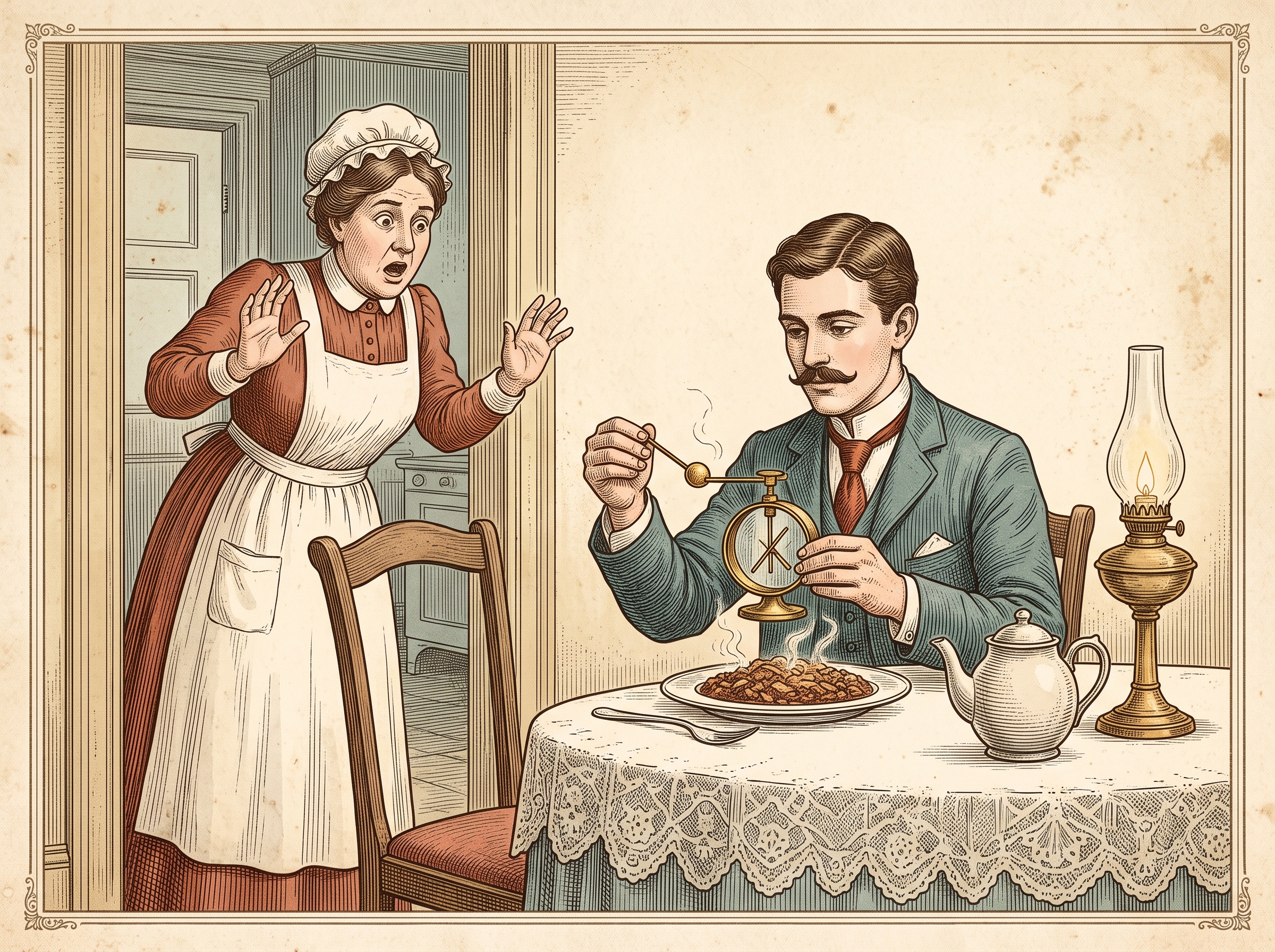
In 1911, a young Hungarian chemist in Manchester grew suspicious that the meat on his boarding-house table kept coming back in new disguises. So, as he later liked to tell it, he slipped a pinch of radioactive material onto the scraps left on his plate. A few days later he carried a radiation detector to dinner, held it over the hash, and watched it react. "This is magic!" his landlady is said to have cried.
By the Curiosities Desk · · 5 min read · Filed under Chemistry · Today’s round
What happened?
George de Hevesy was born in Budapest on August 1, 1885, into a wealthy, titled Hungarian family. He earned his doctorate at the University of Freiburg in Germany in 1908, worked briefly with the chemist Fritz Haber, and then, in 1910, traveled to England to study under Ernest Rutherford at the University of Manchester. Rutherford had won the Nobel Prize in Chemistry two years earlier and was the world’s leading expert on radioactivity.
Hevesy arrived at the lab in January 1911, and Rutherford handed him a problem. The lab owned a large supply of a radioactive substance called radium D, but it was mixed into a far larger amount of ordinary lead, which made its radiation hard to study. According to an account later collected by the Oak Ridge Associated Universities health physics museum, Rutherford told him: “My boy, if you are worth your salt, you separate Radium D from all that nuisance lead.”
Hevesy tried for well over a year. Every chemical trick he used pulled the lead and the radium D along together. He finally summed up the effort in two words: “Entire failure.”
Meanwhile, he had a problem at home. Rutherford had recommended a boarding house, and Hevesy came to believe the landlady was recycling meals: meat served on one day seemed to reappear as hash or goulash later in the week. When he suggested fresh meat more often, she turned him down.
That is when, according to the story, his failure in the lab became his weapon at the table. Hevesy added a small amount of radioactive material to leftover meat on his plate. Later, he brought an electroscope, a simple instrument whose thin metal leaves reveal radiation by losing their electric charge, into the dining room. When the hash arrived, the electroscope showed it was radioactive. The tagged scraps had traveled to the kitchen and come straight back.
A caution is in order. Hevesy never published this “experiment.” It survives because he told it, and later writers, including William G. Myers in a 1979 profile in The Journal of Nuclear Medicine, recorded it secondhand. Retellings differ on details such as which meal it was and how many days passed. The core of the tale has stayed remarkably consistent, but it belongs in the category of well-loved anecdote rather than documented fact.
Why was it strange?
The great joke of the story is that the leftover test worked for exactly the same reason Rutherford’s assignment failed.
Radium D, it turned out, was not a separate element hiding in the lead. It was lead: a radioactive version, or isotope, of lead, now known as lead-210, with a half-life of about 22 years. Isotopes are atoms of the same element with different masses. They behave the same way in chemical reactions, so no amount of chemistry could pull radium D out of ordinary lead.
Hevesy flipped the problem around. If the radioactive atoms could never be separated from the ordinary ones, they would follow those ordinary atoms everywhere, like a bell on a cat. Instead of trying to remove the radioactive “contamination,” he could add a tiny, known amount on purpose and then use its radiation to track where the rest of the material went. In 1913, working in Vienna with chemist Fritz Paneth, he published the first experiments using radioactive “indicators,” or tracers, to study how lead compounds behaved.
The same thread — Nobel Prize — continues in The Physicist Who Levitated a Frog — and Then Won a Real Nobel Prize.
What did scientists learn?
The tracer method gave chemists and biologists a way to watch individual substances move through complicated systems without having to take them apart.
In 1923, Hevesy turned it on living things. Writing in the Biochemical Journal, he described growing broad bean plants in solutions containing tiny traces of radioactive lead and measuring how much showed up in the roots, stems, and leaves. Because the amounts were so small, they didn’t poison the plants. The radiation did the counting.
In 1935, after artificial radioactivity was discovered, Hevesy fed rats tiny amounts of radioactive phosphorus. The results surprised many scientists. Phosphorus atoms passed into and out of the rats’ bones far faster than expected, evidence that bone is a living, constantly rebuilt tissue rather than inert scaffolding. That finding supported a then-new idea: the body is in a “dynamic state,” continually replacing its own building blocks.
Hevesy was awarded the 1943 Nobel Prize in Chemistry “for his work on the use of isotopes as tracers in the study of chemical processes.” The committee held the 1943 prize over, so he actually received it in 1944.
Another scientist, told from the human side: The Alchemist Who Boiled Urine Looking for Gold and Found Phosphorus.
How does it affect us today?
Radioactive tracers are the foundation of nuclear medicine. When a doctor orders a PET scan or a bone scan, a patient receives a small dose of a radioactive tracer that travels through the body the way a natural substance would and gathers where that substance is being used. Detectors outside the body pick up the signal, showing tumors, damaged heart muscle, or hidden fractures. That is why Hevesy is often called the father of nuclear medicine.
Tracers are also used to follow nutrients through crops, to date and track groundwater, and to measure how quickly machine parts wear down. Each of these uses rests on the same idea that rescued Hevesy’s failed assignment: if you can’t separate it, let it show you the way.
Another person who would not drop the question: The Chemist Who Fed the World and Gassed the Trenches.
Fun fact
Hevesy once hid two Nobel Prizes in plain sight. When Germany invaded Denmark on April 9, 1940, the gold medals of German physicists Max von Laue and James Franck were in Niels Bohr’s institute in Copenhagen, and Nazi law barred Germans from keeping Nobel Prizes. Hevesy dissolved both medals in aqua regia, a mix of nitric and hydrochloric acids strong enough to dissolve gold, and left the orange liquid in a flask on a laboratory shelf. It sat there, apparently unnoticed, through the occupation. After the war, the gold was recovered from the solution, and the Nobel Foundation recast the medals and presented them to Franck and von Laue in 1952.
Sources
- Nobel Prize Outreach. “George de Hevesy – Biographical” and “The Nobel Prize in Chemistry 1943 – Summary.” https://www.nobelprize.org/prizes/chemistry/1943/hevesy/biographical/
- Myers, W. G. (1979). “Georg Charles de Hevesy: The Father of Nuclear Medicine.” The Journal of Nuclear Medicine, 20(6): 590–594. https://jnm.snmjournals.org/content/20/6/590.full.pdf
- Hevesy, G. (1923). “The Absorption and Translocation of Lead by Plants.” Biochemical Journal, 17(4–5): 439–445. https://pmc.ncbi.nlm.nih.gov/articles/PMC1263906/
- Oak Ridge Associated Universities, Health Physics Historical Instrumentation Museum. “Four Tales of George de Hevesy.” https://orau.org/health-physics-museum/articles/four-tales-george-de-hevesy.html
- American Institute of Physics, Niels Bohr Library & Archives. “The Invisible Prize.” https://www.aip.org/history-programs/news/invisible-prize