The Scientist Behind It · Physics
The Physicist Who Levitated a Frog — and Then Won a Real Nobel Prize
In a Dutch laboratory in 1997, Andre Geim's levitating frog hung in midair inside the bore of an electromagnet, paddling gently at nothing. No wires, no tricks, no trained frog. It was floating because every atom in its body was very slightly repelled by a magnetic field — and because Geim had a habit of trying things on Friday evenings that no sensible scientist would put in a grant proposal. The stunt won an Ig Nobel. The same habit later won him a real Nobel Prize.
By the Curiosities Desk · · 5 min read · Filed under Physics · Today’s round
Part of The Person Who Would Not Drop It
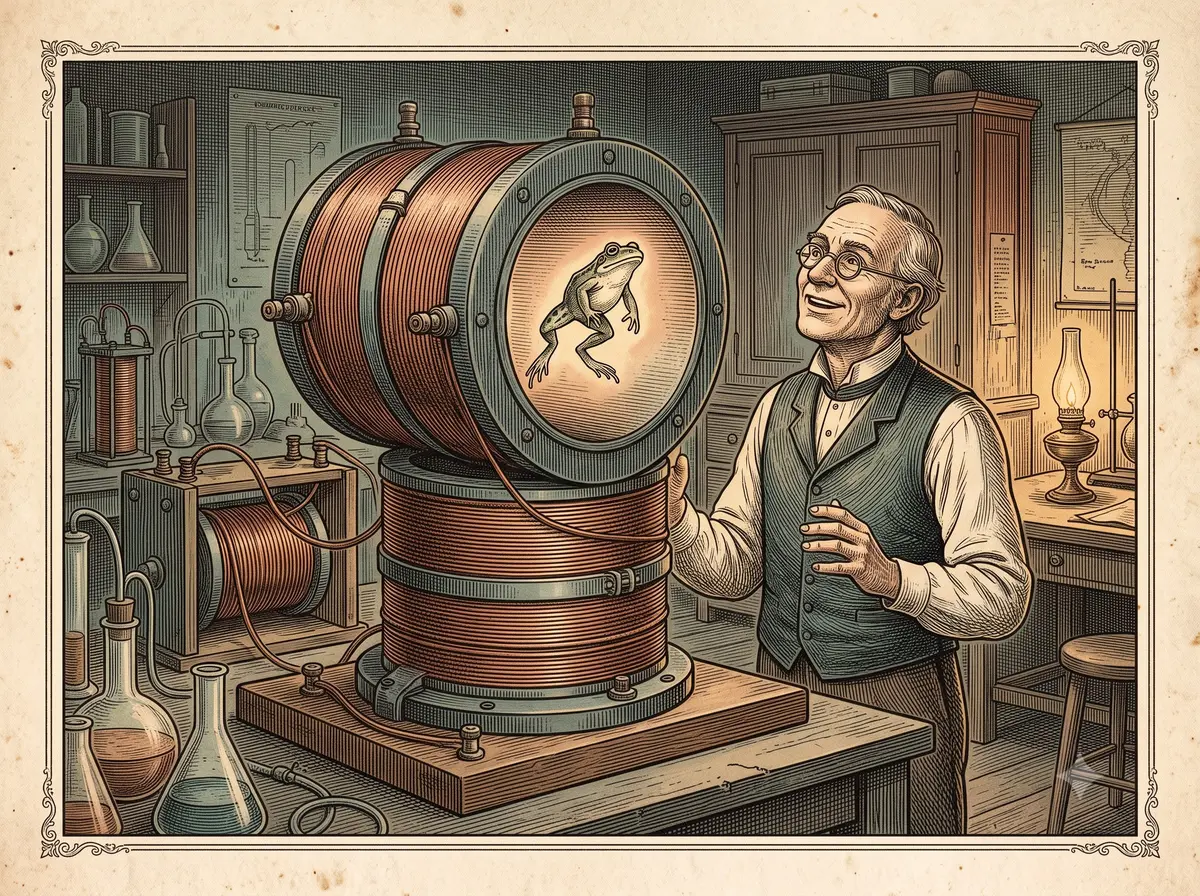
What happened: The Physicist Who Levitated a Frog — and Then Won a Real Nobel Prize
Andre Geim was a Russian-born physicist working at the High Field Magnet Laboratory in Nijmegen, in the Netherlands — a facility built around electromagnets powerful enough to warp the behavior of ordinary matter. By his own telling, the frog story began with an act of pure curiosity bordering on vandalism: one Friday evening he poured water directly into the machine while it was running at full power, just to see what would happen. What happened was that the water didn’t fall. It gathered into balls and hovered inside the magnet.
The effect behind this is called diamagnetism — a property of essentially all matter, in which a magnetic field induces tiny opposing currents in the electron orbits of atoms, so the material is weakly pushed away from the field. Diamagnetism is real but feeble, which is why physicists had largely dismissed it as a curiosity. What Geim’s wet Friday evening demonstrated was that inside a sufficiently monstrous field — the Nijmegen magnet reached about 16 tesla, hundreds of times stronger than a refrigerator magnet is at its surface — that feeble push could balance gravity itself.
And since water is diamagnetic, so is anything mostly made of water. The lab levitated droplets, then hazelnuts, then strawberries, then a grasshopper, and finally, most famously, a live frog, which floated in the magnet’s bore looking mildly puzzled and, by Geim’s account, came through the experience unharmed.
There was a serious puzzle inside the spectacle. A 19th-century result called Earnshaw’s theorem says you can’t hold an object in stable equilibrium using static magnetic forces alone — which is why you can’t float one ordinary magnet motionless above another. A levitating frog looked like it broke that rule. Geim teamed up with the British theoretical physicist Michael Berry of the University of Bristol, and in 1997 the two published “Of flying frogs and levitrons” in the European Journal of Physics, showing exactly why diamagnetic levitation slips through Earnshaw’s loophole: the theorem doesn’t apply to diamagnetic materials, and there are small stable zones inside the magnet where a frog can genuinely rest on a magnetic field.
In 2000, Geim and Berry received the Ig Nobel Prize in Physics — the satirical award for research that “makes people laugh, then think” — for flying the frog. Geim accepted cheerfully. Plenty of scientists would have treated the prize as an insult. He treated it as a mission statement.
The frog turned out to be a rehearsal. Geim moved to the University of Manchester, where he institutionalized his Nijmegen habit as “Friday night experiments” — sessions reserved for playful ideas with a high chance of failure. Most failed. One did not. In 2004, Geim and his colleague Konstantin Novoselov used ordinary sticky tape to peel flakes of graphite — pencil lead — thinner and thinner, until they isolated graphene: a sheet of carbon exactly one atom thick, a material many physicists had assumed couldn’t exist in a stable, free form. In 2010, Geim and Novoselov won the Nobel Prize in Physics for it.
Why it was strange: The Physicist Who Levitated a Frog — and Then Won a Real Nobel Prize
Frogs are not supposed to fly, and Nobel laureates are not supposed to have a frog-flying award already on the shelf. Geim remains the only person ever to win both an Ig Nobel Prize and a real Nobel Prize — a double act so unlikely that Guinness World Records certified it. The deeper strangeness is that both prizes came from the same method. The levitating frog and the Scotch-tape discovery of graphene weren’t a silly phase followed by serious work; they were the identical experiment philosophically — grab something ordinary (water, tape, a pencil), do something slightly ridiculous with it, and pay close attention to the result.
The same thread — Nobel Prize — continues in The Chemist Who Caught His Landlady Recycling Dinner With a Pinch of Radioactivity.
What scientists learned: The Physicist Who Levitated a Frog — and Then Won a Real Nobel Prize
The frog made a textbook point vivid: diamagnetism belongs to everything, including you, and given a strong enough field gradient, anything can levitate. Berry and Geim’s paper mapped out precisely where the stable floating zones sit inside a magnet, turning a stunt into a reusable piece of physics. Diamagnetic levitation has since been used as a cheap way to mimic weightlessness for small samples — a “poor man’s microgravity” for studying how fluids, crystals, and living cells behave when gravity’s effects are canceled out, without leaving the ground. Graphene delivered a bigger lesson: a one-atom-thick material could be stronger than steel by weight, nearly transparent, and a superb conductor — and it was hiding in pencil lead all along.
Another person who would not drop the question: The Three Safes of Atomic Secrets That All Opened With the Same Number.
How it reaches us today: The Physicist Who Levitated a Frog — and Then Won a Real Nobel Prize
Graphene research is now a global industry, feeding into flexible electronics, composite materials, sensors, and battery development. Magnetic levitation of diamagnetic materials continues to be explored for containerless experiments, where samples float free of any contaminating surface. But the frog’s most durable legacy may be cultural: it’s the standard example, cited in classrooms and Nobel coverage alike, that playfulness and first-rate science are not opposites. Geim’s Friday-night rule — spend a small fraction of your time on ideas that are probably doomed but definitely interesting — has been adopted, in spirit, by labs and companies far outside physics.
Another scientist, told from the human side: The Trumpeters Who Rode a Steam Train Back and Forth to Test a Theory About Stars.
Fun fact: The Physicist Who Levitated a Frog — and Then Won a Real Nobel Prize
The frog wasn’t Geim’s only unconventional collaborator. In 2001 he published a genuine physics paper on levitating gyroscopes with a co-author listed as “H.A.M.S. ter Tisha” — his pet hamster, Tisha, who had personally been levitated in the magnet and therefore, Geim reasoned, had contributed directly to the research.
Sources: The Physicist Who Levitated a Frog — and Then Won a Real Nobel Prize
- M. V. Berry & A. K. Geim, “Of flying frogs and levitrons,” European Journal of Physics 18 (1997)
- Andre Geim — Facts, The Nobel Prize in Physics 2010, NobelPrize.org
- A. K. Geim & H.A.M.S. ter Tisha, “Detection of earth rotation with a diamagnetically levitating gyroscope,” Physica B 294–295 (2001)
- “Geim becomes first Nobel & Ig Nobel winner,” Improbable Research (2010)
- “Ig Nobel To Nobel: Creative (And Fun) Science Wins,” NPR (2010)
Related stories: The Physicist Who Levitated a Frog — and Then Won a Real Nobel Prize
- The Horses That Battled an Army of Electric Eels — Humboldt drove horses into a pond full of electric eels
- From Frog Legs to Lithium: A Short History of the Battery — Twitching frog legs to the lithium cell in your pocket
- The Cat Who Co-Authored a Physics Paper Because His Owner Used the Word ‘We’ — A physicist listed his cat as co-author to fix a pronoun