The Scientist Behind It · Chemistry
The Alchemist Who Boiled Urine Looking for Gold and Found Phosphorus
In a Hamburg workshop around 1669, a merchant named Hennig Brand bent over a pot of putrefied urine he had been boiling for days. What he scraped out of the residue was not gold. It was a soft, waxy substance the color of pale honey — and in the dark of the room, it glowed. Cold light, with no flame, pouring out of nothing. He had been trying to get rich. Instead, without knowing it, he had become the first person in recorded history to discover a chemical element.
By the Curiosities Desk · · 5 min read · Filed under Chemistry · Today’s round
Part of The Person Who Would Not Drop It
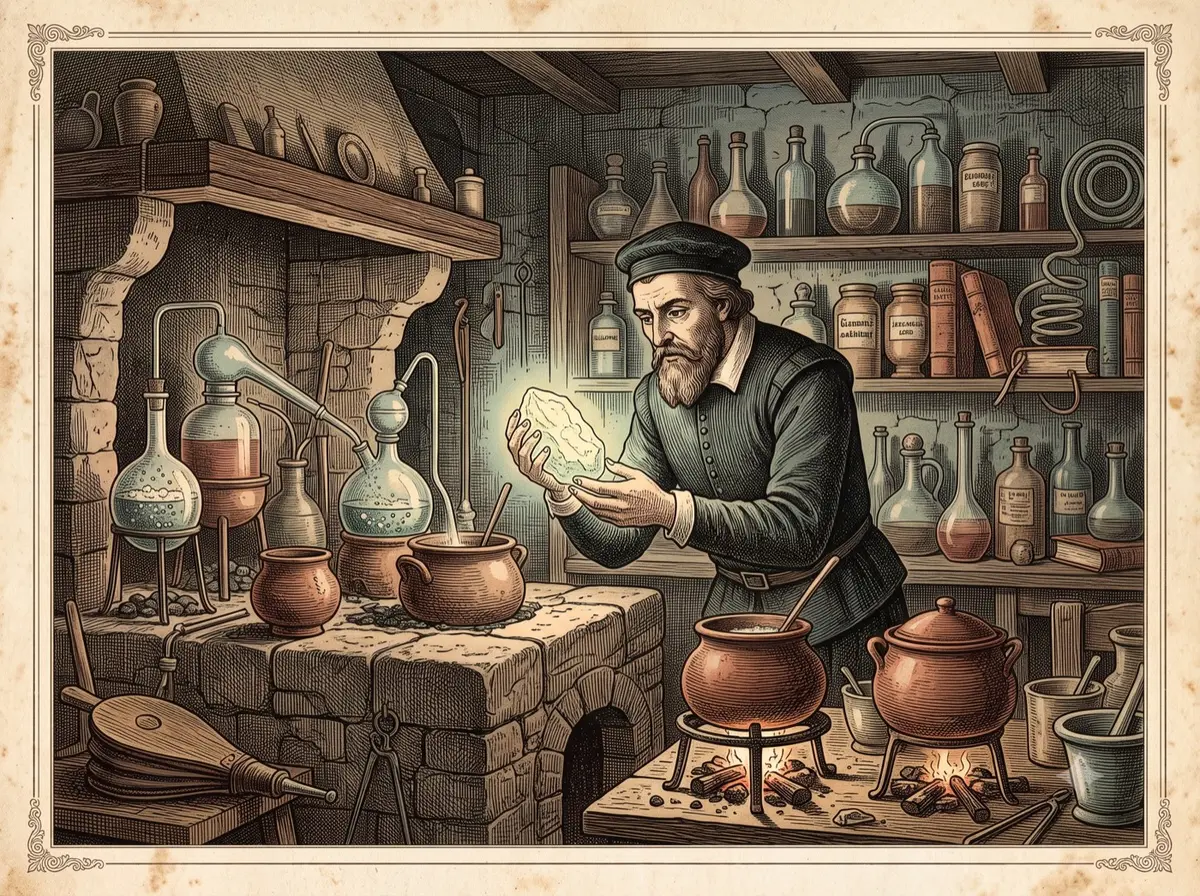
What happened: Phosphorus in Boiled Urine
Hennig Brand was an alchemist in the most literal sense: he believed that ordinary matter could be transmuted into gold, and he spent a fortune chasing the legendary “philosopher’s stone” that was supposed to make it happen. Like many alchemists of the 1600s, he worked partly on mystical reasoning. And one piece of that reasoning pointed him toward an unlikely raw material — human urine.
The logic, as strange as it sounds, was a kind of color-matching. Gold is golden. Urine is golden. Perhaps, Brand reasoned, the essence of gold was hiding inside the body’s golden waste, waiting to be concentrated and coaxed out.
So he collected urine in enormous quantities — by some accounts as much as several thousand liters, gathered and stored until it rotted. He let it stand, then boiled it down to a thick paste, heated that paste to extreme temperatures, and distilled the vapors. After a long, foul process, what condensed was not a precious metal but a glowing white solid he could barely explain. Because it seemed to carry light itself, the substance was eventually given a name from Greek: phosphoros, “light-bringer.”
Brand had isolated phosphorus, element number 15. He kept his method a secret for years, hoping to profit from it, and sold or revealed the recipe to other alchemists over time. Word spread through Europe’s small community of chemical experimenters. In 1680, working independently in England, the renowned scientist Robert Boyle managed to produce phosphorus himself, and his assistant later turned its manufacture into an actual business. The glowing element went from a Hamburg curiosity to one of the most talked-about substances in early modern science.
Why it was strange: Phosphorus in Boiled Urine
For most of human history, elements weren’t “discovered” — they were simply always around. Gold, copper, silver, iron, tin, lead, carbon, sulfur: people had used these since antiquity, with no single moment of discovery and no name attached to a finder. Phosphorus broke that pattern. It is generally regarded as the first element isolated by a known individual at a known time, the start of the long, deliberate hunt for the building blocks of matter that would eventually fill the periodic table.
And then there was the glow. A lump of matter that shines steadily in the dark, without burning, without heat you can feel, was genuinely bewildering in the 1600s. Fire consumed things; this “cold fire” seemed to give light for free. To people who had never seen anything like it, it looked less like chemistry than magic — which is exactly how Brand and his successors marketed it, dazzling wealthy patrons with the glowing wonder.
Another scientist, told from the human side: The Chemist Who Caught His Landlady Recycling Dinner With a Pinch of Radioactivity.
What scientists learned: Phosphorus in Boiled Urine
The glow that astonished everyone turned out to be one of nature’s cleaner demonstrations of a real phenomenon: chemiluminescence, light produced by a chemical reaction rather than by heat. White phosphorus reacts slowly with oxygen in the air, and that gentle oxidation releases energy as a faint greenish light. It is, quite literally, the element slowly combining with the air and glowing as it does so.
That same reactivity makes white phosphorus dangerous. It ignites on its own at only mildly warm temperatures and must be stored under water to keep it from bursting into flame. It is also highly toxic. Over the following centuries, chemists learned to handle it, to convert it into safer forms, and to understand that phosphorus is not some exotic rarity but one of the most essential elements in all of biology. It forms the backbone of DNA and RNA, it carries energy through every living cell in the molecule ATP, and it hardens our bones and teeth as calcium phosphate. The element an alchemist pulled out of waste turned out to be woven through the chemistry of life itself.
Another person who would not drop the question: The Chemist Who Fed the World and Gassed the Trenches.
How it reaches us today: Phosphorus in Boiled Urine
Phosphorus quickly found a use that touched ordinary households: matches. Early “strike-anywhere” matches were tipped with white phosphorus, which made them wonderfully convenient and quietly deadly. Workers in match factories — many of them young women — developed a horrific bone disease of the jaw, nicknamed “phossy jaw,” from breathing phosphorus fumes. Public outrage over their conditions helped push the industry toward safer red phosphorus, the much more stable form still used on the striking strip of matchboxes today.
The bigger legacy is in our food supply. Phosphorus is one of the three major nutrients plants need to grow, which is why it is a core ingredient in fertilizer. Modern agriculture depends on phosphate mined from rock, and because those deposits are finite and unevenly distributed, scientists now warn about “peak phosphorus” — the long-term challenge of sustaining the world’s harvests as a non-renewable nutrient runs short. A substance first prized for a glow in the dark has become quietly essential to feeding eight billion people.
A close cousin: The Obituary That Supposedly Created the Nobel Prize — and That Nobody Has Ever Found.
Fun fact: Phosphorus in Boiled Urine
The discovery was striking enough to become great art. Around 1771, the English painter Joseph Wright of Derby created a dramatic canvas of a robed alchemist kneeling before a glowing flask, often titled The Alchymist, in Search of the Philosopher’s Stone, Discovers Phosphorus. It captures the moment perfectly — a seeker of gold, on his knees, bathed in the eerie light of an element he never set out to find. The painting hangs in the Derby Museum and Art Gallery in England.
Sources: Phosphorus in Boiled Urine
- Royal Society of Chemistry, Periodic Table: Phosphorus (Element 15) — https://www.rsc.org/periodic-table/element/15/phosphorus
- Science History Institute, Historical Profile: Hennig Brand and the discovery of phosphorus — https://www.sciencehistory.org/education/scientific-biographies/
- Encyclopaedia Britannica, Phosphorus (chemical element) — https://www.britannica.com/science/phosphorus-chemical-element
- Derby Museums, Joseph Wright of Derby: “The Alchymist… Discovers Phosphorus” (1771) — https://www.derbymuseums.org/
A note: this story touches on workplace illness and historical suffering. The “phossy jaw” of match workers was real and severe; the move to red phosphorus and modern safety matches came directly from the reforms their advocates fought for.
Related stories: Phosphorus in Boiled Urine
- The Blank Squares That Predicted Three Undiscovered Elements — Mendeleev left gaps in his table, and the missing elements showed up
- The Seaweed Ash That Ate Its Own Vats — and Gave Up a New Element — Seaweed ash corroded its own vats and gave up a new element
- The Teenager Who Tried to Make Malaria Medicine and Accidentally Invented Purple — A teenager chasing malaria medicine invented the color purple