Accidental Discoveries · Chemistry
The Teenager Who Tried to Make Malaria Medicine and Accidentally Invented Purple
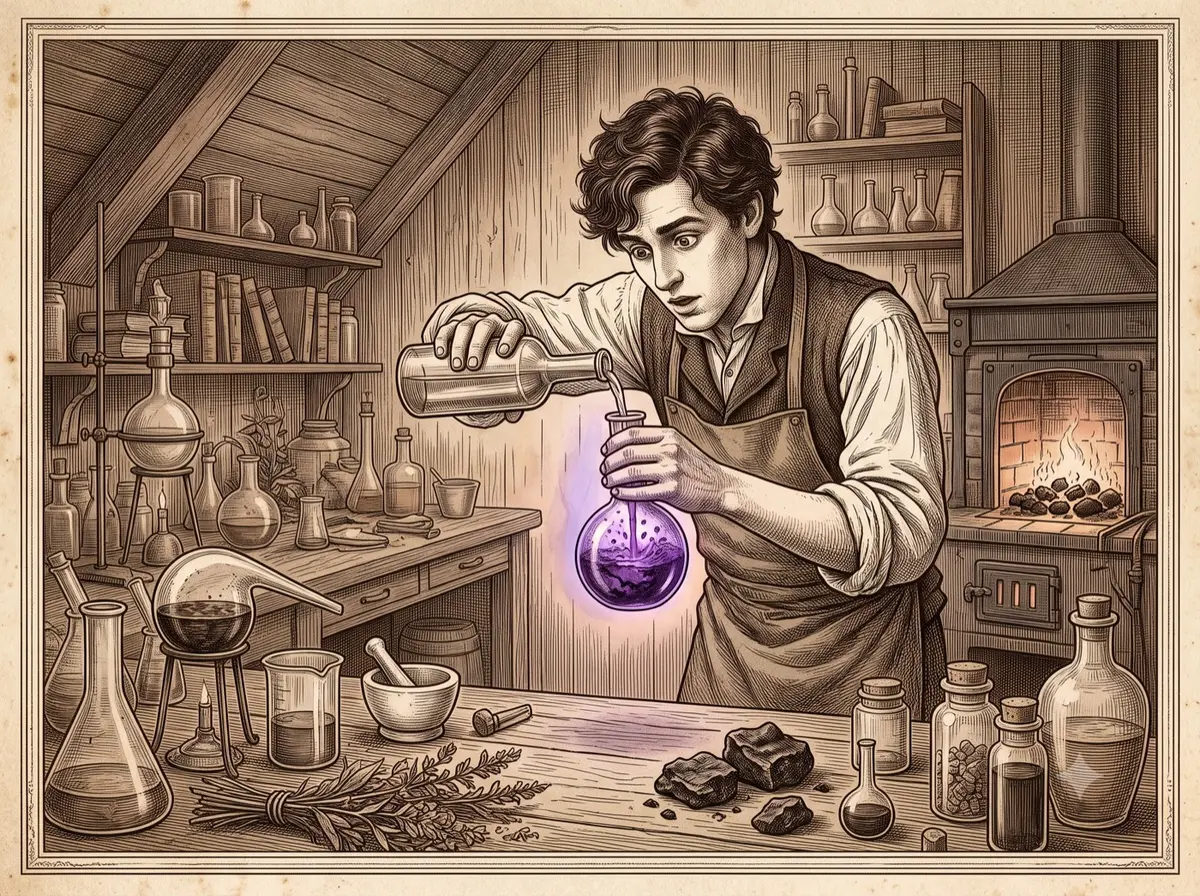
It was Easter break, 1856. In a makeshift laboratory on the top floor of his family's house in east London, an 18-year-old student was trying to clean out a flask of black, tarry sludge — the residue of yet another failed experiment. He rinsed it with alcohol. The sludge dissolved into something astonishing: a deep, glowing purple. He had set out to cure malaria. Instead, the teenager had just stumbled onto the first mass-produced synthetic dye — and lit the fuse on the modern chemical industry.
By the Curiosities Desk · · 6 min read · Filed under Chemistry · Today’s round
What happened: Purple by Accident
The student was William Henry Perkin, born in London on 12 March 1838. At 15 he had talked his way into the Royal College of Chemistry (now part of Imperial College London), where he studied under the formidable German chemist August Wilhelm von Hofmann. By the time he was 18, Perkin was one of Hofmann’s lab assistants.
Hofmann had floated a tantalizing idea: that quinine, the expensive natural drug used to treat malaria, might be synthesized in the lab. At the time, quinine came only from the bark of the South American cinchona tree, and demand from a colonizing, malaria-plagued Europe far outran supply. A factory-made version would have been worth a fortune.
So during the Easter vacation of 1856, Perkin tinkered at home, trying to coax quinine out of aniline, a cheap compound derived from coal tar — the gloopy black waste left over from making coal gas and coke. Nineteenth-century chemists had no reliable way to picture how atoms were arranged inside a molecule, so much of the work was educated trial and error. Perkin oxidized his aniline with potassium dichromate and got exactly what failure looks like: a dark, useless sludge. No quinine in sight.
But when he cleaned the flask with alcohol, the residue bled out a vivid purple. Perkin, who painted and dabbled in photography, was captivated. He ran more trials with his brother Thomas and his friend Arthur Church — in a hut in the garden, partly to keep the side project secret from Hofmann. They found that the purple substance dyed silk and held its color when washed and exposed to light. Perkin called it mauveine.
He sent samples to a dye works in Perth, Scotland, and got an enthusiastic reply from its manager, Robert Pullar. In August 1856, still only 18, Perkin filed for a patent. He persuaded his father to put up the money and his brothers to go into business with him, and within a year the family had built a dye factory at Greenford, on the Grand Union Canal in Middlesex. Local lore says the canal water changed color week to week depending on what was being made.
Why it was strange: Purple by Accident
Consider what Perkin was actually working with. Coal tar was sticky industrial garbage, a nuisance byproduct that gasworks were happy to be rid of. Purple, meanwhile, had been the most exclusive color on Earth for thousands of years — “Tyrian purple,” painstakingly extracted from sea snails, so costly that Roman emperors reserved it for themselves. The two could hardly have been further apart in status.
Perkin collapsed that distance in a single accidental reaction. He turned waste into the color of kings. And he did it not as a celebrated professor but as a teenager working over the holidays, chasing a goal he never reached. The malaria drug stayed out of reach for nearly another century. The byproduct of his failure changed the world instead.
Another accident worth keeping: The Glue Rejected for Being Too Sticky — That Later Hoisted a TV Host Into the Air.
What scientists learned: Purple by Accident
The deepest lesson wasn’t about purple at all — it was that you could build valuable, complex substances from cheap raw materials by deliberate chemical synthesis. Before mauveine, essentially every dye came from a plant, an insect, or a mollusk. After it, color became something you could manufacture.
The chemistry itself turned out to be wonderfully messy. Mauveine isn’t one compound but a mixture of related molecules, and pinning down its exact structure defeated chemists for well over a century — the main components weren’t firmly identified until 1994, with still more isolated in 2007 and 2008. Perkin succeeded commercially long before anyone fully understood what he had made. Part of why his accident worked at all was luck: his aniline was contaminated with related compounds called toluidines, and those impurities were essential to forming the dye. Pure aniline alone wouldn’t have given him his purple.
Another time the mistake was the invention: The Hot Stove Accident That Invented Modern Rubber.
How it reaches us today: Purple by Accident
Mauve became a craze. After Queen Victoria and the French Empress Eugénie were seen in similar shades, the color exploded across European fashion between roughly 1859 and 1861 — Punch magazine joked about an outbreak of “the mauve measles.” Perkin grew rich, and a wave of other coal-tar dyes followed.
But the real legacy is bigger than a fad. Perkin had shown that coal tar was a treasure chest of useful molecules, and chemists raced to mine it. That gold rush built the modern organic chemical industry — and the German firms that came to dominate it, including BASF, Bayer, and Hoechst, began as dye companies. Those same companies later became pharmaceutical giants. The conceptual leap mattered too: the observation that certain dyes stain some cells and not others helped inspire Paul Ehrlich’s idea of a “magic bullet,” a chemical that targets disease while sparing healthy tissue — the foundation of modern chemotherapy. The first widely used antibacterial drug, Prontosil, came straight out of dye research at Bayer in the 1930s. The next time you take a synthesized medicine, you are downstream of a teenager’s ruined Easter experiment.
A close cousin: The Oil-Well Gunk Drillers Hated That Became Vaseline.
Fun fact: Purple by Accident
Perkin was knighted in 1906, and that same year received the first-ever Perkin Medal — created to mark the 50th anniversary of his discovery. It is still awarded today and is considered the highest honor in American industrial chemistry. Fittingly, when the William Perkin Church of England High School opened in Greenford in 2013, it adopted a mauve uniform.
A note on health
The early aniline dye industry came at a human cost: workers exposed to these chemicals were later found to face an increased risk of bladder cancer, and that grim discovery helped launch the field of occupational and industrial health. Modern dye and chemical manufacturing is far more tightly regulated as a result.
Sources: Purple by Accident
- William Henry Perkin — Wikipedia (cross-referenced with its Encyclopædia Britannica and Oxford DNB citations)
- Mauveine — Wikipedia (and its cited chemistry papers, including Meth-Cohn & Smith, 1994)
- Anthony S. Travis, “Perkin’s Mauve: Ancestor of the Organic Chemical Industry,” Technology and Culture 31, no. 1 (1990): 51–82
- Science and Industry Museum: “William Henry Perkin and the world’s first synthetic dye”
- Simon Garfield, Mauve: How One Man Invented a Color That Changed the World (W. W. Norton, 2000)
Related stories: Purple by Accident
- The Chemist Who Forgot to Wash His Hands and Discovered Saccharin — A chemist skipped washing his hands and tasted sweetness
- The Alchemist Who Boiled Urine Looking for Gold and Found Phosphorus — An alchemist boiled urine looking for gold and found glowing phosphorus
- The Billiard Ball Prize That Invented Plastic — A prize for a billiard ball substitute launched the plastic age