Accidental Discoveries · Chemistry
The Hot Stove Accident That Invented Modern Rubber
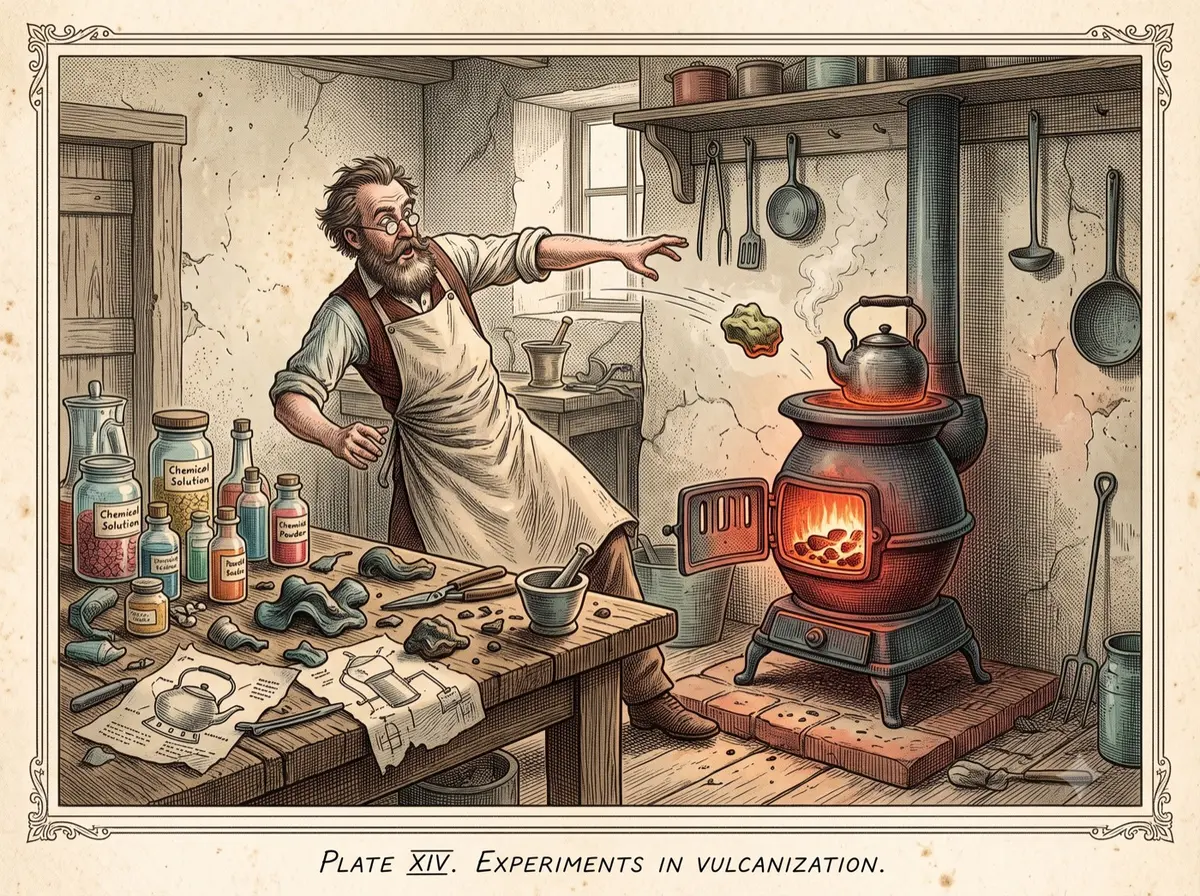
A lump of gummy, sulfur-streaked rubber flew out of Charles Goodyear's hand and landed on a red-hot stove. By every rule he knew, it should have melted into a smoking puddle, just like every other batch of rubber he'd ruined that summer. Instead, when he scraped it off, the edges were charred — but the rest had turned into something new: tough, dry, and springy, like leather that could stretch. The material that was supposed to fall apart in heat had just been saved by it.
By the Curiosities Desk · · 6 min read · Filed under Chemistry · Today’s round
What happened: The Hot Stove Accident That Invented Modern Rubber
By 1839, Charles Goodyear was a man who had failed at almost everything he’d tried. He’d gone bankrupt running his father’s hardware business in 1830, and a few years later he became obsessed with an idea that struck most people as a dead end: fixing rubber. Natural rubber, harvested as latex from trees in Brazil, seemed like a miracle material in the 1830s — waterproof, stretchy, moldable. But it had a fatal flaw. It turned into a sticky, foul-smelling glob in summer heat and cracked like glass in winter cold. Investors who’d poured money into rubber goods were watching their factories fail as their products melted in warehouses.
Goodyear decided he could solve this, despite having no formal training in chemistry. For the next several years he mixed rubber with whatever he could find — magnesia, lime, nitric acid, turpentine — in makeshift labs set up in his wife’s kitchen, and later in debtors’ prison, where he was jailed repeatedly for unpaid debts. He pawned his family’s furniture and his children’s schoolbooks to fund the experiments. In 1837, he thought he’d cracked it with a nitric-acid treatment and won a contract to supply the U.S. Post Office with rubber mailbags. The bags melted in the heat before the deal could be delivered.
Around 1838, Goodyear bought the rights to a process from Nathaniel Hayward, a former rubber-factory worker who had found that mixing raw rubber with sulfur and drying it in the sun — he called it “solarization” — made it less sticky. Goodyear kept experimenting with sulfur, trying to push the process further.
Then came the accident, in 1839, at a rubber works in Woburn, Massachusetts. Accounts differ on the exact staging — one telling has Goodyear demonstrating his sulfur-treated rubber to skeptical locals in a general store and flinging it in an animated gesture; a more sourced version, favored by Connecticut biographers, places it inside the Eagle India Rubber Company factory where Goodyear was working. Either way, the core fact is well documented: a rubber-and-sulfur compound hit a hot stove, and instead of melting, it hardened into a stable, elastic material unaffected by temperature. It took him several more years of trial and error to reliably reproduce the result — he eventually found that steam-heating the compound under pressure at around 248°F (120°C) for four to six hours gave the most consistent product. He patented the process in 1844 and named it vulcanization, after Vulcan, the Roman god of fire.
Why it was strange: The Hot Stove Accident That Invented Modern Rubber
Everything about rubber’s problem pointed toward heat as the enemy. Rubber melted when it got hot — that was the whole crisis Goodyear was trying to fix. So the idea that deliberately cooking rubber with sulfur at high temperature would make it stronger, not weaker, ran against everything rubber workers had observed. Goodyear wasn’t chasing that hypothesis when the accident happened; he stumbled into the exact opposite of what experience predicted. It’s also strange that the breakthrough came from a man with no chemistry credentials, working in prison cells and borrowed kitchens, years after everyone around him — including his own family — had reason to think he was chasing a fantasy.
Another accident worth keeping: The Glue Rejected for Being Too Sticky — That Later Hoisted a TV Host Into the Air.
What scientists learned: The Hot Stove Accident That Invented Modern Rubber
Vulcanization works because sulfur atoms form chemical bridges — called cross-links — between the long, coiled molecular chains that make up natural rubber (a polymer, meaning a molecule built from many repeating units strung together). Untreated, those chains can slide past one another, which is why raw rubber turns gummy when warm and brittle when cold. Heating the rubber-sulfur mixture triggers a reaction at the chains’ carbon-carbon double bonds, locking sections of neighboring chains together with sulfur bridges. The result still stretches — the chains can uncoil under stress — but the cross-links pull it back to its original shape once the stress is released, and they stop the material from melting or going permanently gooey. Goodyear didn’t have the molecular theory to explain any of this; that understanding came from chemists decades later. What he’d found empirically was the first reliable method for stabilizing an unpredictable natural polymer, a problem that would become central to materials chemistry.
Another time the mistake was the invention: The Teenager Who Tried to Make Malaria Medicine and Accidentally Invented Purple.
How it reaches us today: The Hot Stove Accident That Invented Modern Rubber
Vulcanized rubber made the entire rubber industry viable, and from there, the modern one. Automobile and bicycle tires, hoses, gaskets, seals, conveyor belts, shoe soles, and rubber gloves all depend on some version of Goodyear’s process. The cross-linking principle he discovered by accident also became a template for later synthetic polymer and materials science work. There’s a sharp irony attached to his name: the Goodyear Tire & Rubber Company, founded in Akron, Ohio, in 1898, was started by Frank Seiberling — no relation to Charles Goodyear — and named for him purely as a tribute, decades after his death.
A close cousin: The Ulcer Experiment That Splashed Out of Its Flask and Became Diet Soda.
Fun fact: The Hot Stove Accident That Invented Modern Rubber
Goodyear never got rich off his discovery. He spent years fighting patent infringement lawsuits in the U.S. and Europe, was jailed for debt again in Paris in 1855, and died in 1860 at 59, roughly $200,000 in debt — an amount worth several million dollars today. The company that made his name famous worldwide didn’t exist yet, and he never earned a cent from it.
Sources: The Hot Stove Accident That Invented Modern Rubber
Related stories: The Hot Stove Accident That Invented Modern Rubber
- The Billiard Ball Prize That Invented Plastic — A prize for a billiard ball substitute launched the plastic age
- The Cylinder That Weighed Too Much and Became Teflon — A gas cylinder that weighed too much held the first Teflon
- The Secret Rubber Substitute That Became Silly Putty — A failed rubber substitute that became a toy in an egg