The Secret Rubber Substitute That Became Silly Putty
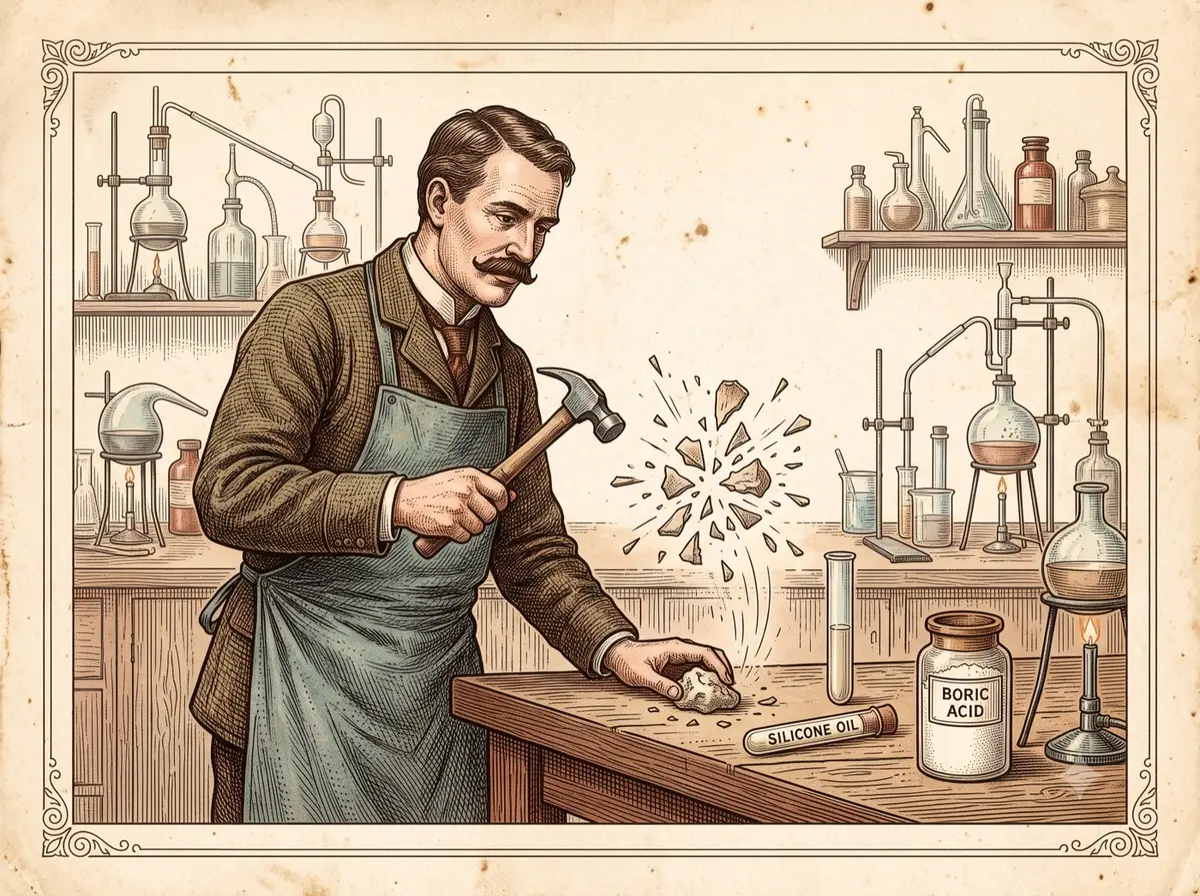
A chemist mixes boric acid into a test tube of silicone oil, hoping to help win a world war. What comes out isn't rubber. It bounces off the wall. It shatters when you hit it with a hammer. Left alone, it slowly puddles like syrup. It is, by any wartime measure, useless. Seven years later, a debt-ridden ad man will sell it in plastic eggs and make a fortune.
By the Curiosities Desk · · 5 min read · Filed under Chemistry · Today’s round
What happened: The Secret Rubber Substitute That Became Silly Putty
In 1942, Japan’s invasion of Southeast Asia cut the United States off from roughly ninety percent of its natural rubber supply. Rubber was not a luxury — it was in tires, gas masks, life rafts, and aircraft parts, and the U.S. military needed enormous quantities of it to keep fighting. Scrap drives asking Americans to donate old raincoats and hoses barely made a dent, since recycled rubber performed far worse than the real thing. So the government turned to its chemists, funding a scramble to invent a synthetic substitute.
Two of those chemists, working independently and unaware of each other, both landed on the same odd idea: silicone oil. Earl Warrick, at the newly formed Dow Corning, and James Wright, an engineer at General Electric’s lab in New Haven, Connecticut, each mixed silicone oil with boric acid and got a springy, puttylike substance. Warrick filed for a patent in 1943; Wright filed the following year. (Company histories from Crayola, which eventually owned the toy, credit Wright as the one who “invented” it, but the patent office’s paper trail favors Warrick — the two men reportedly disputed the credit for the rest of their lives.)
Whoever technically got there first, neither man could turn the stuff into what the war actually needed. It had almost none of rubber’s practical virtues — it didn’t hold a fixed shape, and it definitely wasn’t going into a truck tire. The real synthetic-rubber breakthrough came later, from separate government-funded labs working with petroleum. So Warrick and Wright set their bouncy, oozing curiosity aside and moved on. Wright reportedly kept a sample around to entertain friends, who passed it along to more friends, the way you’d pass around a strange souvenir.
Eventually, in 1949, a sample reached Ruth Fallgatter, who ran a toy store in New Haven and sold it briefly as “bouncing putty.” When Fallgatter dropped the item, an advertising consultant she’d worked with, Peter Hodgson, saw something she didn’t. Already about $12,000 in debt, Hodgson borrowed $147, bought a batch of the putty from the GE lab where Wright had made it, and packaged one-ounce lumps inside small plastic eggs. He renamed it Silly Putty and had it on shelves in time for Easter 1950.
Sales started slow. Then, in August 1950, a New Yorker reporter wandered into a Doubleday bookstore looking for a book and wrote a short, admiring item about the strange egg-shaped toy instead. The mention set off a buying spree — one contemporary account put it at 250,000 eggs sold in three days — and by the early 1970s, annual sales topped five million dollars. A product born from a failed military contract had become, almost by accident, one of the best-selling toys in America.
Why it was strange: The Secret Rubber Substitute That Became Silly Putty
The premise runs backward from how invention stories are supposed to go. This wasn’t a lone hobbyist tinkering in a garage — it was two credentialed industrial chemists, funded by wartime urgency, deliberately trying to solve a specific, serious problem. They succeeded at creating something remarkable and failed completely at the actual assignment. The material they made was almost defiantly impractical: it couldn’t hold a shape, couldn’t bear a load, and behaved differently depending on how fast you handled it. The U.S. military had no use for a compound that shatters if you swing a hammer at it but oozes into a puddle if you leave it on a shelf. A toy store owner and a hard-up ad man found the one context — pure, purposeless play — where that same uselessness became the entire appeal.
Another ordinary thing with a strange past: The Dentist Who Invented Cotton Candy — and Sold 68,655 Boxes of It.
What scientists learned: The Secret Rubber Substitute That Became Silly Putty
Silly Putty is what’s known as a viscoelastic material, and more specifically a non-Newtonian fluid — a substance that doesn’t behave like water or oil, whose thickness stays constant no matter how you push on it. Instead, apply force quickly (a hard yank, a hammer blow) and it acts like a brittle solid, snapping or shattering. Apply force slowly, and it flows like a thick liquid, stretching and eventually puddling under its own weight — the same reason a lump left on a shelf for a few days will have crept into a flat pancake. Other everyday examples of non-Newtonian behavior, in far less dramatic form, include ketchup, toothpaste, and blood. What Warrick and Wright had actually discovered wasn’t a rubber substitute at all — it was an unusually clean, visible demonstration of how a material’s response to force can depend on speed as much as on substance, a property polymer chemists still study today under the more formal banner of viscoelasticity.
Another object that did not start out as itself: The Minister Who Lived Next to a Brewery and Invented Soda Water to Cure Scurvy.
How it reaches us today: The Secret Rubber Substitute That Became Silly Putty
Silly Putty outgrew the toy box. Because it has roughly the same density as human tissue, doctors have used it to help calibrate CT scanners. Geology teachers use it to model how the plastic layers of Earth’s crust flow and deform over long timescales, and hobbyist model-builders use it as a temporary paint mask. Researchers at Trinity College Dublin even mixed it with graphene to build an ultra-sensitive pressure sensor, one delicate enough, they reported, to register the footsteps of a spider walking across it. And in 1968, it followed the Cold War all the way into orbit: Apollo 8’s astronauts carried Silly Putty packed in sterling-silver eggs, using it to keep loose tools from drifting away in zero gravity during humanity’s first crewed trip around the Moon.
A close cousin: The Rust Spray Named After the 39 Times It Didn’t Work.
Fun fact: The Secret Rubber Substitute That Became Silly Putty
When newsprint used oil-based ink, pressing Silly Putty onto a newspaper would lift the image clean off the page — comic strips included, which kids could then stretch and twist into deliberately warped, funhouse-mirror versions of the original. Modern soy-based inks mostly killed the trick.
Sources: The Secret Rubber Substitute That Became Silly Putty
Related stories: The Secret Rubber Substitute That Became Silly Putty
- The Wallpaper Cleaner Nobody Needed Anymore That Became Play-Doh — A wallpaper cleaner nobody needed anymore became Play-Doh
- The Cylinder That Weighed Too Much and Became Teflon — A gas cylinder that weighed too much held the first Teflon
- The Slinky: The Walking Spring That Fell Off a Navy Workbench — A spring fell off a workbench and walked into toy history